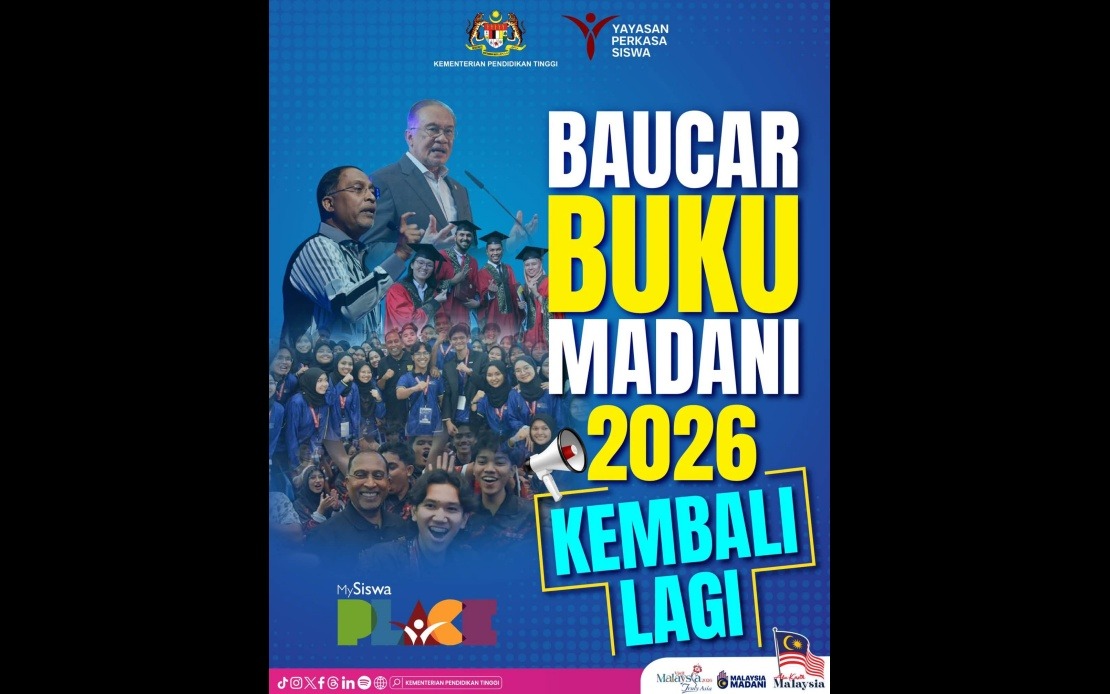
From 11 am on July 15, roughly 1.18 million students across Malaysia's public and private universities will be able to access RM100 MADANI Book Vouchers, a government initiative designed to lighten the financial burden of acquiring essential academic reading materials. The Ministry of Higher Education announced that the redemption process will operate through MySiswaPlace, a dedicated online portal offering secure transactions and broad purchasing options.
The MADANI Book Voucher scheme represents a continuation of government support for tertiary education affordability, building on previous iterations of subsidised reading material access. For Malaysian students already grappling with tuition fees, accommodation, and living expenses, the additional RM100 purchasing power addresses a genuine gap in educational budgets. Many postgraduate and undergraduate programmes demand substantial investments in textbooks, reference materials, and specialised publications that can collectively exceed several hundred ringgit annually, particularly in fields such as engineering, medicine, and law.
Through MySiswaPlace, participating students gain eligibility verification, voucher generation, and redemption capabilities all within a single integrated system. The platform's design emphasises both convenience and security, allowing students to browse and purchase reading materials from their dormitories or home environments without requiring physical trips to bookstores. This digital-first approach reflects broader government digitisation efforts and recognises the realities of contemporary student life, where campus populations increasingly span multiple locations and study schedules vary significantly.
The ecosystem supporting this voucher scheme encompasses more than 300 registered business partners, predominantly comprising locally-based publishers and booksellers. This partnership structure deliberately channels student purchasing power toward Malaysia's domestic publishing industry, supporting small and medium-sized enterprises that might otherwise struggle to compete against international competitors. By aggregating substantial student demand through a single platform, MySiswaPlace creates economies of scale that benefit participating vendors while maintaining competitive pricing structures for consumers.
Catalogues available through MySiswaPlace span diverse categories essential to contemporary higher education. Beyond traditional printed textbooks and academic monographs, the platform includes reference materials, scholarly journals and publications, electronic books, and general interest titles that broaden intellectual exposure beyond narrow disciplinary boundaries. This breadth acknowledges that meaningful education encompasses both specialised knowledge acquisition and the cultivation of broader intellectual curiosity—dimensions that reading vouchers should encourage rather than constrain through overly restrictive purchasing categories.
The Ministry of Higher Education positioned this initiative as fundamentally aligned with the MADANI government's stated commitments to strengthening reading culture and promoting lifelong learning among Malaysian populations. Such framing extends beyond simple cost assistance; it articulates a vision wherein government support for educational consumption directly influences cultural orientations toward knowledge engagement and intellectual development. By subsidising book purchases at the point of demand, policymakers signal that reading represents a social good worthy of public investment, not merely a private consumer choice.
For Malaysia's publishing and bookselling sectors, the voucher scheme generates predictable demand while providing valuable data regarding student reading preferences and purchasing patterns. Publishers can tailor production decisions based on aggregated demand signals emerging from student populations, potentially supporting more responsive publishing strategies and reducing oversupply of titles with limited genuine readership. Similarly, booksellers gain advance visibility into seasonal purchasing trends and can optimise inventory management accordingly.
The RM100 voucher value merits contextual analysis within Malaysian higher education cost structures. While meaningful, the amount typically covers between two and four academic texts, depending on discipline and whether students prioritise new versus secondhand volumes. Students pursuing science, technology, engineering, and mathematics programmes often require more specialised materials commanding higher prices, potentially rendering vouchers less comprehensive than for humanities students accessing more competitively priced publications. Nevertheless, every reduction in student borrowing requirements or delayed textbook purchases contributes to financial stability and improved academic performance, particularly among students from lower-income backgrounds.
Students intending to utilise vouchers should verify their eligibility through MySiswaPlace before July 15, ensuring smooth access when redemption commences. The process requires basic authentication, likely using existing institutional credentials from respective universities. Those encountering technical difficulties should contact their institution's student services offices, which typically maintain records enabling account recovery and support access for eligible students.
The timing of the initiative merits consideration within Malaysia's academic calendar. July redemption aligns with mid-year intake periods at many institutions and precedes second-semester commencements at universities operating semester-based systems. This scheduling enhances practical utility, allowing students to acquire necessary materials for upcoming coursework rather than retroactively addressing reading lists. For institutions on quarter-based or trimester-based systems, the timing may require students to plan strategically, potentially banking vouchers for subsequent academic periods if immediate course requirements prove lighter.
Government commitment to sustaining this initiative indicates confidence in its effectiveness and alignment with broader higher education policy objectives. Continuation signals that policymakers view student text accessibility as sufficiently important to warrant recurring budget allocation, distinguishing it from one-off promotional programmes. This consistency supports long-term planning among publishers and booksellers, who can confidently invest in inventory and marketing knowing that substantial annual demand will materialise.
The broader implications extend beyond individual student financial relief. By systematically reducing barriers to reading material acquisition, the voucher scheme potentially influences academic outcomes measurable through retention rates, graduation timelines, and quality of student work. Research consistently demonstrates that textbook unavailability correlates with reduced course performance, suggesting that subsidised access generates benefits extending far beyond simple household accounting into institutional and societal human capital development. For Malaysia's competitive positioning within global knowledge economies, investments in equitable education access represent strategic infrastructure development rather than expenditure.

