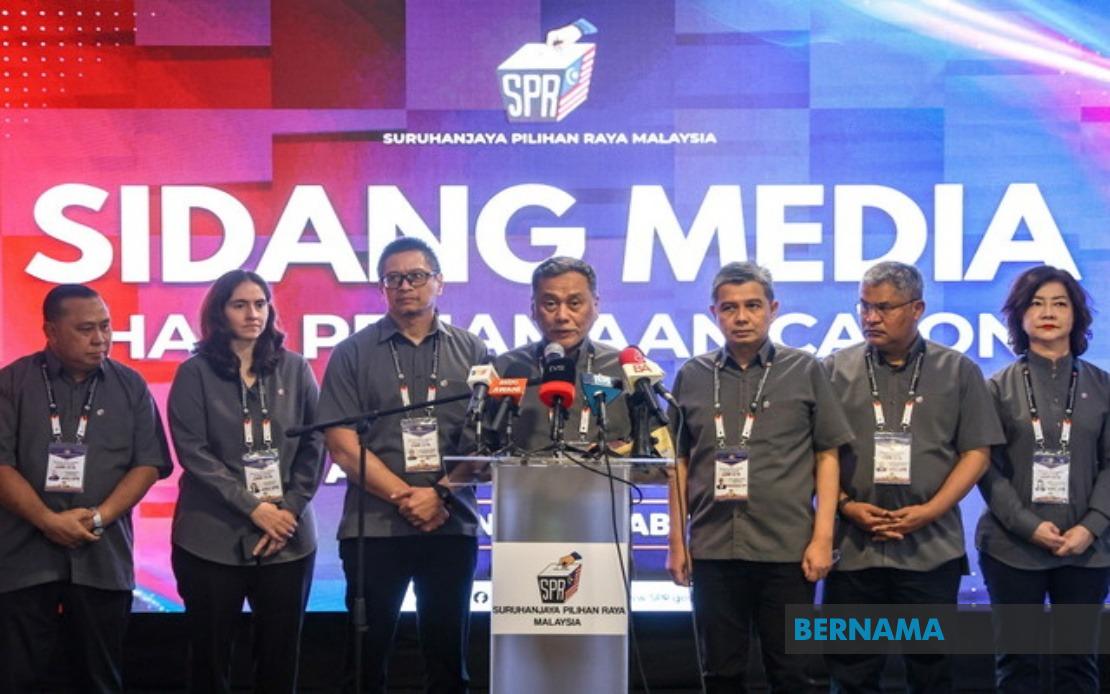
The 16th Johor state election will field a broad spectrum of political contenders after the Election Commission accepted all 172 nomination papers submitted across the state's 56 constituencies. Ending the nomination phase at 10 am on June 27, the poll body confirmed that no candidates faced disqualification, setting the stage for what promises to be a competitive electoral battle in the southern state. Election Commission chairman Datuk Seri Ramlan Harun announced the final figures at a press conference in Johor Bahru, noting that the nomination process had proceeded smoothly without administrative obstacles.
The gender composition of candidates reflects ongoing patterns in Malaysian electoral politics, with male representation substantially outnumbering female contenders. Of the 172 nominees approved, 138 are men while 34 are women, underscoring persistent challenges in achieving gender balance within political party candidacies across Malaysia. This ratio, while perhaps unsurprising given historical trends, continues to draw attention from civil society advocates who have repeatedly called for greater female representation in electoral contests at both state and federal levels.
The two major political coalitions dominate the field, with Barisan Nasional and Pakatan Harapan each fielding 56 candidates—enough to contest every seat in the state legislature. This symmetry reflects the competitive positioning of the country's two leading political blocs, both seeking to secure control of the 56-seat assembly. Behind them, Perikatan Nasional enters the race as a significant third force with 33 candidates, demonstrating the continued fragmentation of Malaysia's political landscape following the internal upheavals and realignments of recent years.
Several smaller parties and movements have also secured candidates in the election. Parti Bersama Malaysia will put forward 15 contenders, while the youth-oriented MUDA has registered four nominees. Both Parti Orang Asli Malaysia and Parti Sosialis Malaysia will each have a single representative on the ballot, reflecting their smaller organizational capacity or more narrowly focused mandates. Additionally, six independent candidates have chosen to run outside formal party structures, a phenomenon that persists despite the dominance of established political organizations.
The distribution of electoral contests across the state reveals a complex tapestry of competition. Fourteen of the 56 seats will be decided in straight fights between two candidates, providing the most straightforward electoral mathematics. However, the majority of contests will be significantly more complicated, with 27 seats featuring three-way battles involving three distinct candidates. A further 12 constituencies will see four-cornered contests, while three particularly crowded seats will feature five candidates each, creating scenarios where vote fragmentation and strategic voting become critical factors in determining outcomes.
This fragmented competitive landscape has important implications for Johor's electoral outcome. The multiplication of candidates across constituencies means that winning candidates in many areas may do so with substantially less than a majority of votes cast, particularly in the three, four, and five-candidate contests. Such outcomes can amplify the importance of vote splits between ideologically similar parties or candidates, potentially producing results that may not reflect the aggregate preferences of the electorate in a straightforward manner. Voters face complex choices about how their votes might be distributed across a wider range of options than in previous elections.
The Johor election occurs amid Malaysia's continuing political transition, where the traditional two-coalition framework has gradually given way to a more multipolar system. The presence of Perikatan Nasional as a substantial third force, alongside smaller parties and independent candidates, reflects this evolution. For Johor specifically, the state has historically been a Barisan Nasional stronghold, but recent national political currents have created uncertainty about whether that dominance will persist or be challenged more effectively by coordinated opposition efforts.
The nomination process itself proceeded without controversy, with all submission deadlines met and no candidates rejected for failing to meet eligibility requirements or presenting defective documentation. This procedural smoothness contrasts with occasional past elections where nomination issues have generated disputes or last-minute withdrawals. The Election Commission's confirmation that every nomination paper met the required standards suggests that participating parties had adequately prepared their candidates and submissions in advance of the final deadline.
For Malaysian observers watching Johor's electoral dynamics, the state election carries broader significance beyond its local impact. Johor remains one of the country's largest and most economically important states, serving as a bellwether for national political sentiment. The election results will provide early indicators of how electoral competition has evolved since previous contests and may offer clues about shifting voter allegiances across different demographic and geographic segments. The sheer number of candidates and variety of contests will make vote analysis particularly interesting when results are finally tallied.
The practical implications for election administration and voters themselves should not be overlooked. Poll workers will need to manage voting processes across substantially more candidate options than routine single-round elections might involve. Voters will face longer ballots and more complex decision-making, potentially affecting turnout or participation patterns. The multiplication of choices, while expanding democratic representation, also introduces logistical and cognitive complexity into the electoral process that election officials must navigate carefully to ensure voting proceeds smoothly and transparently.

