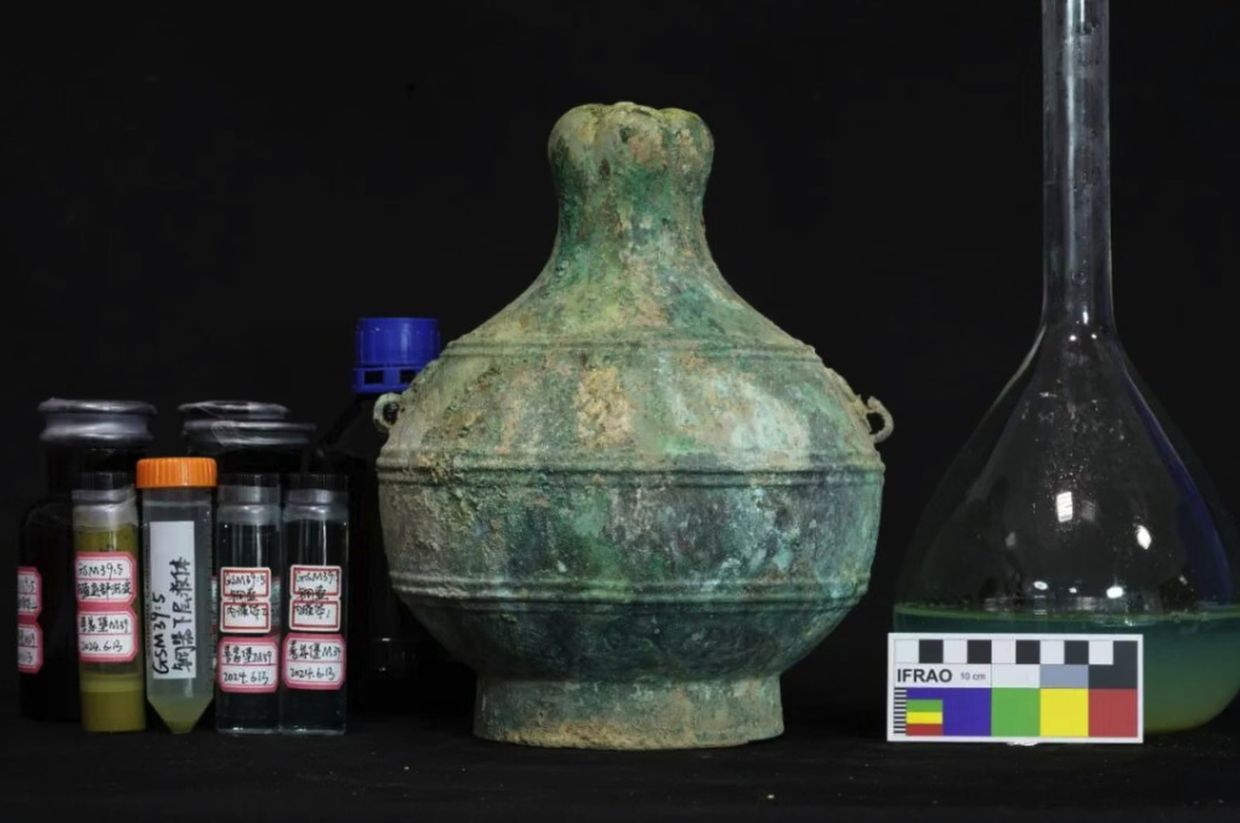
A bronze wine vessel sealed for more than 2,300 years has emerged from an archaeological site in northwestern China, offering researchers an extraordinary window into the drinking habits and brewing knowledge of soldiers stationed along the ancient Great Wall during the Warring States period. The discovery at the Shanjiabao cemetery, located just 2 kilometres from the fortified Qin Great Wall in Guyuan, Gansu, promises to reshape scholarly understanding of grain-based fermentation techniques in early Chinese civilization, particularly in regions north of the Yellow River where such findings remain relatively uncommon.
The intact vessel was unearthed from Tomb No 39 during systematic excavations of a cemetery that once served the garrison communities and their families living within the extensive network of military installations spanning 170 kilometres of the Great Wall. Archaeologists extracted approximately 3,740 millilitres of liquid residue from the distinctively shaped bronze pot, which archaeologists recognize as a garlic-head design characteristic of Qin culture. The remarkable preservation owes much to the sophisticated sealing methodology employed by ancient craftspeople, who employed a double-layer technique combining a textile inner lining with an outer coating of organic clay. This engineering innovation succeeded in isolating the wine from exposure to air and contamination for more than two millennia.
According to Wang Xiaoyang, who leads the Shanjiabao cemetery research project at the Ningxia Institute of Cultural Relics and Archaeology, the discovery represents an exceptional achievement in Chinese archaeological science. In an interview with Chinese Social Sciences Today, Wang described the finding as "the most well-preserved and information-rich wine relic from the period of the Qin state that has been publicly reported in China." The significance extends beyond mere preservation; the vessel's contents offered sufficient material for comprehensive chemical analysis, a luxury rarely available when examining ancient fermented beverages.
The excavation itself illuminated the broader social context of life along China's militarized frontier during antiquity. A total of 183 tombs from the Warring States period were systematically excavated at Shanjiabao, with 179 identified as belonging to Qin culture, suggesting the cemetery functioned as a common burial ground for soldiers, border officials, and their dependents stationed at various fortifications. This archaeological evidence corroborates historical understanding of how frontier garrisons operated as semi-permanent military communities rather than purely transient military camps, with personnel establishing families and developing settled communities even in remote defensive locations.
The chemical composition of the ancient wine proved illuminating when researchers partnered with Northwest University to conduct advanced laboratory analysis. Scientists detected 24 distinct types of organic compounds within the liquid, including organic acids and their derivatives, amino acids and their derivatives, and carbohydrates. This molecular profile proved crucial in determining the beverage's origins and production methods. The distribution pattern of organic acids matched closely with artificially aged yellow wine, a category of grain-based alcoholic beverages distinct from fruit wines such as those produced from grapes or berries. This distinction matters considerably for understanding regional brewing traditions, as northern Chinese brewers traditionally relied upon grain fermentation rather than the fruit-based production common in southern regions.
Particularly revealing was the starch residue analysis conducted on the liquid's contents. Researchers determined that over 92 percent of the detectable starch originated from broomcorn millet, a resilient grain variety well-suited to the semi-arid climate of the Ningxia and Gansu regions. This finding demonstrates that Qin-era northern brewers had developed specialized fermentation knowledge adapted to locally available resources, employing grain varieties that flourished in the harsh conditions along the Great Wall's frontier. The preponderance of millet points to deliberate agricultural and culinary choices rather than happenstance, suggesting systematic knowledge transmission regarding which grain varieties yielded superior fermented beverages.
The discovery carries particular resonance for understanding China's ancient relationship with alcoholic beverages and fermentation technology. Archaeological evidence increasingly demonstrates that alcoholic drink production emerged extraordinarily early in Chinese civilization, with fermentation techniques evolving continuously across several millennia. Yet the historical record has preserved far more information about southern Chinese brewing practices, particularly those utilizing rice as the primary ingredient, leaving significant gaps in scholarly comprehension of northern traditions. This Qin-period wine vessel directly addresses that imbalance, offering concrete evidence regarding what northern garrison communities actually consumed and how they produced their preferred beverages.
The implications extend beyond purely archaeological or historical interest. For contemporary food historians and ethnobotanists studying the evolution of Chinese culinary practices, the Shanjiabao discovery provides calibrated data regarding grain utilization patterns in antiquity. Modern northeastern and northwestern Chinese cuisines retain strong connections to millet-based traditions, suggesting unbroken cultural continuity spanning more than two thousand years. The ancient Qin brewer's choice of broomcorn millet links directly to agricultural and dietary patterns that persisted through subsequent dynasties, demonstrating remarkable stability in regional food production and consumption preferences.
The sealing methodology employed by the ancient wine's creator warrants particular scholarly attention. The double-layer textile and clay system suggests sophisticated understanding of preservation principles, potentially indicating that Qin craftspeople possessed empirical knowledge about oxygen exclusion and contamination prevention, even without modern scientific terminology. This engineering solution rivals in effectiveness some modern preservation techniques, raising intriguing questions about how such specialized knowledge developed and spread among artisans working in isolated frontier communities. The deliberate investment of resources and labour in creating such elaborate sealing systems further indicates that wine held considerable social and economic value within garrison communities.
The human narrative underlying the archaeological discovery adds poignant dimension to the scientific findings. Wang and his colleagues have suggested that the wine-filled vessel accompanied an individual—possibly a soldier or administrative official—to the afterlife as a cherished possession. The decision by the deceased's family to fill the bronze pot with fine wine rather than leaving it empty speaks to the emotional and cultural significance of the beverage. It suggests that even along remote, harsh frontier postings, soldiers and their families maintained habits and practices that connected them to broader Qin cultural values and social practices. The act of providing fermented grain wine for the deceased person's eternal journey reflects beliefs about the continuity of sustenance and pleasure beyond physical death.
This discovery simultaneously raises new questions worthy of future investigation. Researchers might profitably examine whether other tombs from the cemetery contained beverages or beverage vessels, potentially revealing variations in brewing techniques or preferred grain sources among different social groups. Comparative analysis with wine vessels recovered from other Qin military installations could illuminate whether northern frontier brewers maintained consistent practices or adapted their methods to local environmental and resource conditions. Such investigations would further enrich understanding of how ancient military communities maintained cultural coherence while adapting to disparate geographical circumstances across the empire.
The Shanjiabao finding ultimately demonstrates the extraordinary potential of archaeological science to recover specific details about ancient daily life and technology. Through meticulous excavation, rigorous chemical analysis, and contextual interpretation, researchers have reconstructed not only what an individual consumed twenty-three centuries ago, but also how ancient craftspeople engineered preservation systems, how garrison communities obtained and processed agricultural products, and what values families held regarding commemoration of their deceased. Such discoveries remind contemporary observers that archaeological work at remote frontier sites can yield information as rich and meaningful as excavations conducted in imperial capitals or major urban centres.

