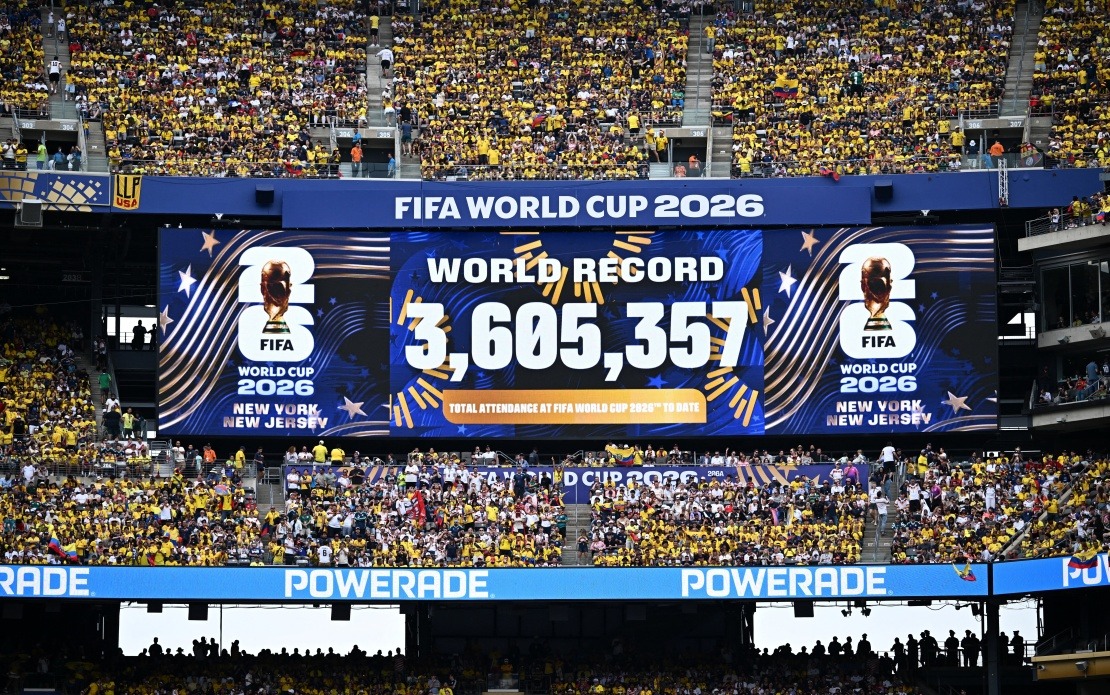
The 2026 FIFA World Cup has etched its name into the sport's record books as the most-watched tournament ever, having exceeded the long-standing attendance mark established 32 years earlier. The announcement came during the second half of Germany's clash against Ecuador at East Rutherford in New Jersey on Thursday, with the milestone of 3,605,357 spectators displayed on giant screens to thunderous applause from the crowd. This historic achievement arrives at a pivotal moment in the tournament's progress, underlining the unprecedented global appetite for football that has defined this edition across North America.
The previous benchmark, set during the 1994 World Cup held in the United States, had stood at nearly 3.6 million spectators across the entire tournament. That competition, structured around 52 matches, had long been considered the zenith of World Cup attendance. The 2026 tournament's expanded format, featuring 16 host nations and a larger pool of matches, has fundamentally altered the landscape of football viewership. Yet the striking aspect of this achievement lies not merely in scale but in its timing: the record has been shattered while nearly half the competition remains uncompleted, a testament to the organisational scope and the genuine magnetism of the event across multiple nations and cultures.
With 48 fixtures still remaining on the schedule, projections suggest that final attendance figures could approach double the 1994 total, a prospect that seemed almost implausible when planning commenced for this continental hosting arrangement. The tournament's distribution across 16 cities has diluted competition for venue capacity, yet paradoxically deepened the reach and engagement of fans unable to attend matches in their own regions. This geographic dispersal across the United States, Canada, and Mexico has transformed what might have been a concentrated spectacle into a genuinely continental phenomenon, allowing millions to experience the tournament within reasonable travel distances.
The consistently high stadium occupancy rates offer quantifiable evidence of this phenomenon. Venues hosting matches across the tournament have operated at more than 99 percent capacity on average, a figure that underscores not merely ticket sales but genuine public enthusiasm. This density of attendance, maintained across such an extended schedule and numerous stadiums of varying sizes, suggests deep penetration of the tournament's appeal throughout the host nations. For regional observers in Southeast Asia, this development carries implications regarding the global commercial ecosystem surrounding football and the increasing sophistication of tournament organisation that emerging football nations might aspire toward.
FIFA President Gianni Infantino characterised the record as a reflection of football's universal resonance and its capacity to transcend national, cultural, and linguistic boundaries. He emphasised that the scenes witnessed across the 16 host cities and their respective stadiums have proven exceptional, pointing to an atmosphere of celebration and communal joy that extends beyond the competitive dimensions of the sport. This framing aligns with FIFA's strategic positioning of the World Cup as more than athletic competition—as a vehicle for social cohesion and shared human experience, a narrative particularly significant as the organisation seeks to expand the tournament's scope and influence.
The expansion of the World Cup from 32 to 48 teams, implemented for the first time at the 2026 tournament, has fundamentally altered the match schedule and extended the tournament duration. This restructuring, whilst sometimes debated among traditionalists regarding its impact on competition quality, has demonstrably succeeded in broadening the calendar of matches and distributing them across an extended timeframe. The consequence has been the creation of multiple opportunities for attendance across diverse geographic locations, a strategic advantage for organisers seeking to maximise spectator engagement and minimise the concentrated demand that characterised previous tournaments.
For Malaysian football enthusiasts and the broader Southeast Asian sporting public, the 2026 World Cup attendance records carry significance beyond mere statistics. They illustrate the evolving capacity of football to command resources and attention across geographically dispersed populations, a lesson pertinent as discussions continue regarding regional tournament hosting and development of football infrastructure. The commitment demonstrated by North American audiences to attending matches throughout the tournament offers comparative data relevant to understanding how emerging markets might approach similar undertakings.
The distribution of matches across multiple nations represents a departure from historical precedent, where World Cups have typically concentrated hosting within single countries. This 2026 approach, whilst creating logistical complexities, has enabled organisers to leverage existing stadium infrastructure across three nations rather than constructing extensive new facilities. The consequence extends beyond economics into cultural geography: football becomes accessible to substantially larger populations across diverse metropolitan and regional contexts, a model with potential implications for how future tournaments might be structured to balance competitive integrity with inclusive access.
The milestone achieved during a fixture between Germany and Ecuador carries symbolic weight as well. These nations represent the heterogeneous competition that the expanded format now encompasses, with the presence of Ecuador—a team from outside traditional football powerhouse regions—normalised within the tournament structure. The geographic and competitive diversity within the tournament mirrors the broader inclusivity that expanded participation has introduced, challenging historical hierarchies whilst maintaining competitive balance across a larger participant pool.
As the tournament progresses toward completion, the attendance trajectory will likely continue its ascendant course. The remaining 48 matches will provide additional opportunities for records to accumulate, and the final accounting will establish a benchmark that may influence tournament planning discussions for decades. For Malaysia and other nations in Southeast Asia considering their own involvement in international football development and potential hosting responsibilities, the 2026 experience provides demonstrable evidence regarding the commercial viability and public enthusiasm that sophisticated tournament organisation can generate. The record attendance figures validate the expansionary approach, regardless of ongoing debates surrounding competitive structure and format evolution.

