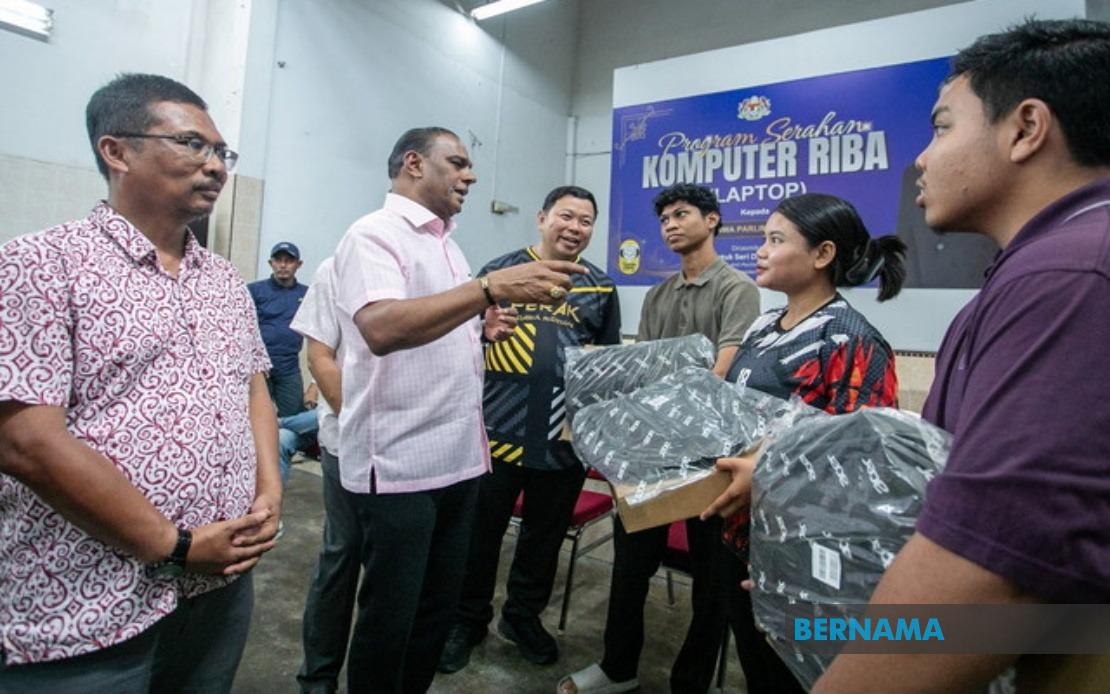
Forty-five university students from lower-income families in the Tapah parliamentary constituency have been handed laptops as part of a longstanding assistance programme aimed at bridging the digital divide in higher education. The laptops were distributed during a ceremony held at Mahatma Gandhi Hall, marking another year of the Tapah Parliamentary Constituency Student Laptop Handover Programme, which has been operating since 2008 and has supported more than 1,000 students over its existence.
Tapah Member of Parliament Datuk Seri M. Saravanan emphasised that digital devices are no longer luxury items but essential tools for modern learning. With educational institutions increasingly adopting technology-driven teaching methods, students without access to computers face significant disadvantages in completing coursework, accessing online resources, and participating in virtual learning environments. The programme specifically targets the B40 segment—households earning less than RM4,360 monthly—where families often struggle to afford such equipment alongside other educational expenses.
The cohort of 45 recipients this year represents diverse levels of higher education. The group comprised 30 diploma students, five pursuing certificate-level qualifications, four at the matriculation stage, and three degree-level undergraduates. Additionally, individual students from the SPM, STPM, and foundation programme levels received support. This varied distribution reflects the programme's commitment to ensuring that low-income families at all educational junctures have access to technological tools, recognising that the digital divide can emerge at any stage of a student's academic journey.
The selection process for laptop recipients involves rigorous vetting to ensure resources reach genuinely eligible families. A dedicated committee evaluates applications using multiple sources of information, including collaboration with the District Education Office and consultations with local community leaders. This multi-layered approach prevents the misallocation of resources and ensures that assistance goes to students who would otherwise face genuine hardship in obtaining computers. Such transparency is particularly important in building public confidence in parliamentary assistance programmes.
Saravanan highlighted broader implications of educational support in his constituency, noting that improved access to higher education over the past two decades has led to significant social mobility among indigenous communities. Orang Asli youths from Tapah have increasingly entered professional fields, becoming doctors, lawyers, and other specialists—achievements that were previously rare in these communities. These success stories serve as powerful examples and motivation for younger generations contemplating higher education, demonstrating that pathways to professional careers exist even for those from historically marginalised backgrounds.
The digital access initiative addresses a critical barrier to social mobility in Malaysia. For families living paycheck-to-paycheck, the cost of a laptop—typically ranging from RM1,500 to RM3,000—represents a significant investment that might necessitate choosing between educational tools and basic necessities like food or utilities. By removing this financial obstacle, the programme enables talented students from disadvantaged backgrounds to compete fairly with their wealthier peers in academic settings. This has measurable implications for reducing educational inequality across Malaysia's regions.
Aidil Iskandar Ramlan, 18, was among the recipients, having been selected as he prepares to pursue a Diploma in Public Administration at Universiti Teknologi MARA Raub in Pahang. A former student of SMK Syeikh Abdul Ghani in Bidor, Aidil comes from a working-class family—his father is employed as a security guard at a secondary school while his mother manages the household. For Aidil, the laptop represents more than a device; it signifies that institutional support exists for students like him, easing the financial strain on his family during a critical transition into higher education.
Another recipient, Ea Endry Iana Aslan, 19, is pursuing a Diploma in Early Childhood Education at FELCRA College. Like many B40 households, Ea's family operates with limited disposable income, making large purchases like computers impossible without external assistance. She articulated how the laptop lightens her family's burden while providing her with tools necessary to compete academically. Her gratitude toward the support reflects a broader truth about assistance programmes: they often serve not merely to provide material goods but to signal to disadvantaged communities that their participation in higher education is valued and supported by elected representatives.
The persistence of the Tapah laptop programme since 2008 demonstrates sustained commitment to educational equity at the parliamentary level. Over 15 years, the initiative has supported over 1,000 students, each equipped to engage more fully with their studies. However, the programme also highlights existing gaps in national education financing. That a parliamentary assistance scheme remains necessary to provide what should arguably be standard educational equipment suggests that broader government funding mechanisms may not adequately account for the technological requirements of contemporary higher education.
For Malaysian policymakers and educators, the Tapah initiative offers lessons relevant to other constituencies and regions. Digital access remains unevenly distributed across the country, with students in urban areas and higher-income families enjoying clear advantages. Replicating such targeted programmes nationally could significantly narrow achievement gaps. Additionally, as Malaysia positions itself as a technology-enabled knowledge economy, ensuring that disadvantaged students have access to digital tools becomes not merely a social equity issue but an economic imperative—the nation cannot afford to exclude talented individuals from lower-income backgrounds who lack access to computers.
The broader context of such programmes reveals the intersection of parliamentary responsibility and national educational outcomes. While the Tapah scheme demonstrates local leadership, systemic solutions require coordination across multiple government levels. This includes ensuring that higher education institutions remain affordable, that digital infrastructure reaches all students, and that admission criteria recognise talent regardless of socioeconomic background. Parliamentary assistance programmes, valuable as they are, function best as complements to comprehensive national policies rather than substitutes for them.

