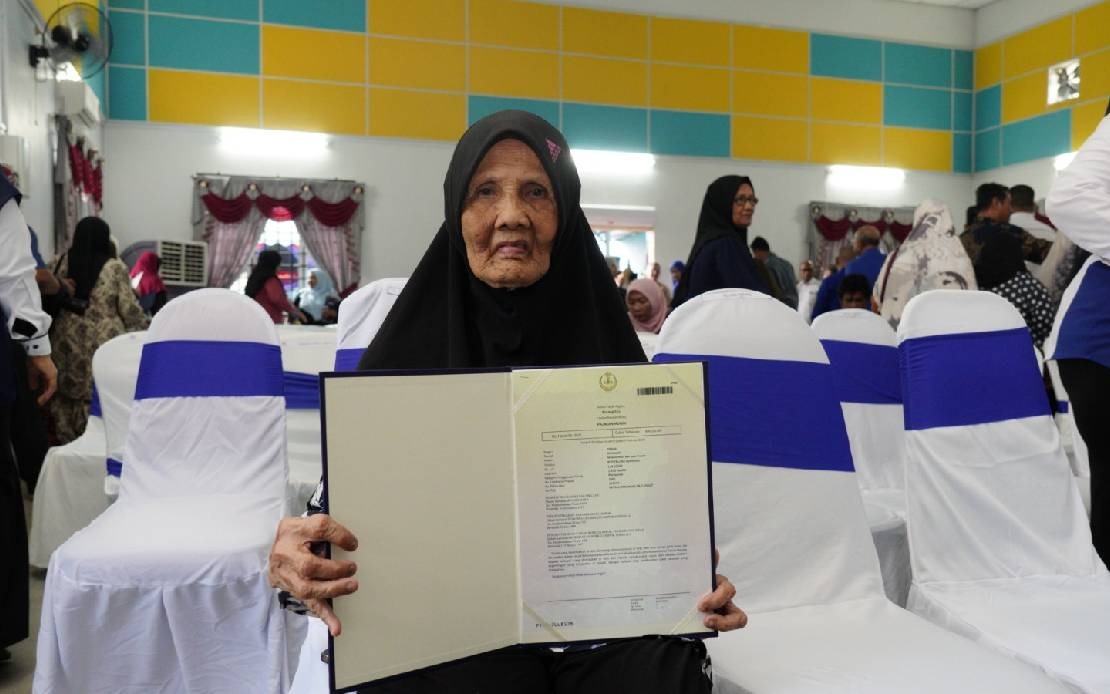
The Federal Land Consolidation and Rehabilitation Authority (FELCRA) distributed land ownership grants to 47 participants at the Seri Gala site in Perak on July 14, underscoring the federal government's commitment to converting marginal agricultural land into productive assets that strengthen rural livelihoods. The handover ceremony, held at the newly inaugurated FELCRA Berhad Seri Gala PPSK Grand Hall, represents a milestone in one of Malaysia's longest-running rural development programmes, which has operated for decades across multiple states.
Peeling back the importance of this distribution, Perak Menteri Besar Datuk Seri Saarani Mohamad characterised the FELCRA Consolidation and Rehabilitation (P&P) Programme as a proven model for revitalising rural economies. Rather than viewing the land grant handover as mere bureaucratic procedure, Saarani framed it as a dignifying intervention that anchors rural families to tangible assets and genuine economic opportunity. The Menteri Besar emphasised that the programme has successfully galvanised community confidence in agricultural potential, created employment avenues, stimulated local commerce, and narrowed the traditional gap between urban and rural prosperity.
The P&P Programme operates by identifying underutilised or degraded agricultural land, consolidating scattered plots, and rehabilitating them through systematic planning and managed investment. This approach transforms what might otherwise remain economically dormant into parcels generating consistent returns for participating families. For rural communities, particularly those with limited capital for independent agricultural modernisation, the scheme provides essential infrastructure—access roads, water systems, and extension services—that would be financially prohibitive for individual smallholders to develop alone.
Pearak's significance within FELCRA's nationwide footprint has grown substantially. According to Zainal Abidin Alias, director of participant affairs at FELCRA Berhad, the authority now manages approximately 32,000 hectares across nearly 20,000 participants in Perak, positioning the state as the second-largest operational region after Pahang. This concentration of FELCRA activity reflects both the availability of suitable land in Perak and sustained government investment in the state's agricultural sector. The scale of operations indicates that FELCRA grants affect tens of thousands of rural households across the peninsula, making the scheme a significant social welfare lever.
The contemporary framing of rural development by Deputy Prime Minister Datuk Seri Dr Ahmad Zahir Hamidi extends beyond simple infrastructure provision. During the World Rural Development Day 2026 celebrations in Jengka, Pahang, Ahmad Zahir articulated a vision of rural advancement encompassing human capital development, entrepreneurial capacity-building, and community agency. FELCRA's role evolves accordingly—securing land ownership alone proves insufficient without complementary investments in farming knowledge, market access, and social cohesion. This holistic perspective resonates across Southeast Asia, where rural development practitioners increasingly recognise that productivity gains require simultaneous attention to technology, skills, and institutional strengthening.
Land ownership itself carries profound significance in Malaysian rural society. Formal title grants provide collateral for agricultural financing, enabling smallholders to access credit from formal financial institutions. Banks and other lenders traditionally view titled land as security, whereas informally held plots—however productive—cannot be pledged. The psychological dimension equally matters; families with legal ownership stakes demonstrate higher investment in soil conservation, crop diversification, and long-term planning compared to those working on temporary or uncertain tenure arrangements. The act of distributing formal grants therefore unlocks both financial and behavioural transformations.
For Malaysian policymakers, FELCRA's demonstrated success in Perak and elsewhere offers validation that systematic land consolidation can address structural challenges facing smallholder agriculture. The scheme ameliorates the problem of fragmentation, whereby ancestral holdings subdivide across generations into uneconomically small plots. It also addresses the tragedy of the commons, in which communal or unclear tenure arrangements discourage individual investment. By converting these scenarios into consolidated, titled holdings, FELCRA removes disincentives to modernisation and intensification.
The opening of the Seri Gala PPSK Grand Hall signals infrastructure development accompanying the land grants. Such facilities typically serve as extension service centres, cooperative headquarters, and community gathering spaces where farmers access technical advice, market information, and peer networking. In rural economies where information asymmetries disadvantage smallholders, these institutional anchors prove critical. Malaysian cooperative federations, input suppliers, and agricultural banks increasingly recognise that productivity gains require not just land and capital but also institutional embeddedness—the ability of farmers to connect reliably with markets, information, and fellow producers.
The programme's success must also be contextualised within Malaysia's broader agricultural transition. As younger rural residents increasingly migrate to urban employment, those remaining on the land face labour constraints and demographic ageing. FELCRA's consolidation approach partly addresses this by enabling higher returns from smaller land parcels, making farming more attractive to remaining participants and their children. Enhanced productivity per hectare, rather than expansion of cultivated area, becomes the pathway to viable rural livelihoods in an era of labour scarcity and rising wage expectations.
Regional observers note that FELCRA's model resonates across Southeast Asia, where land fragmentation and low productivity plague millions of smallholder farmers. Thailand, Indonesia, and Philippines policymakers have studied similar consolidation approaches, though institutional capacity and political will to implement such programmes consistently remain uneven. Malaysia's track record—demonstrated through Perak's scale and the existence of documented learning from decades of operation—positions it as a regional reference point for evidence-based rural development.
Moving forward, sustaining FELCRA's effectiveness demands attention to market linkages and climate adaptation. Secured land ownership and improved infrastructure prove insufficient if farmers cannot reliably sell produce at remunerative prices or if climate variability threatens yields. The most advanced FELCRA regions increasingly integrate commodity value chains, farmer training in climate-smart practices, and product diversification to enhance resilience and incomes. The Seri Gala expansion thus represents not merely a completion of land reform but a platform for deeper rural transformation.

