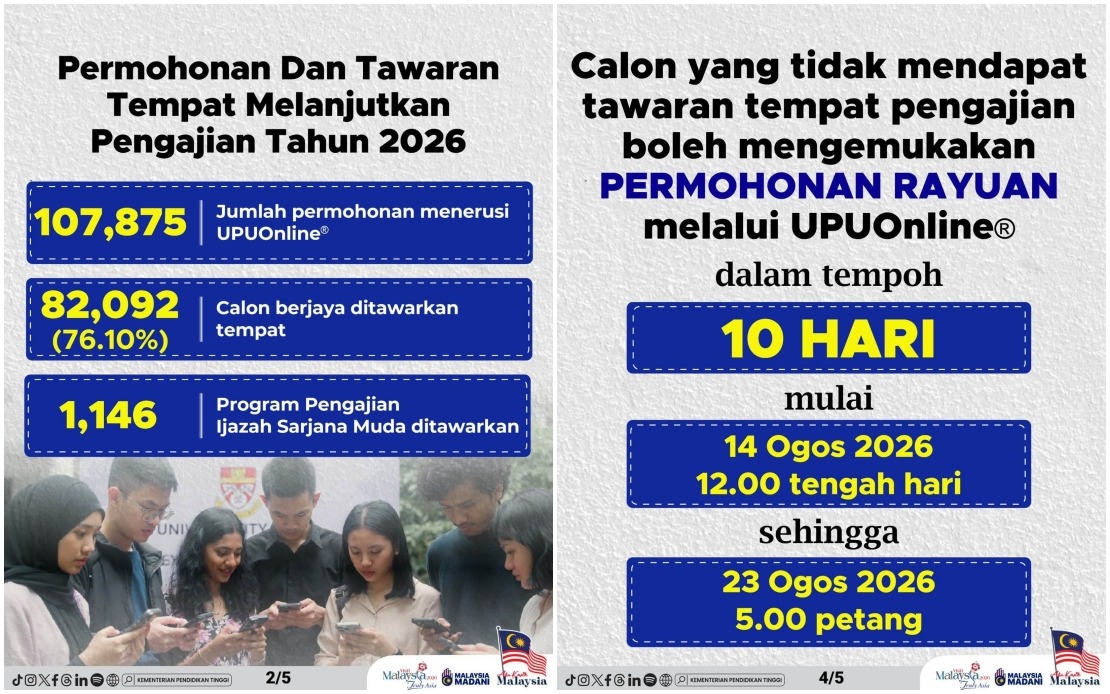
Malaysia's public university system has extended undergraduate offers to 82,092 candidates this year, the Ministry of Higher Education announced on August 14. This represents a substantial intake across the nation's 20 public universities, which collectively provide access to 1,146 bachelor's degree programmes spanning diverse fields of study. The figure accounts for 76.10 per cent of the 107,875 applications deemed eligible under the UPUOnline centralised admission portal.
The admission process operates strictly on a meritocratic basis, with the Ministry emphasizing that all eligible candidates are ranked according to their merit scores from highest to lowest. This transparent, points-based system aims to ensure fairness in the competitive landscape of public university entry, where demand significantly outpaces available places. For context, the acceptance rate of approximately 76 per cent reflects the continued pressure on Malaysia's public tertiary education sector, which serves as the primary pathway for many students from middle and lower-income households seeking degree-level qualifications.
The Ministry of Higher Education's statement extended congratulations to all successful candidates, framing their admission as an opportunity to maximise their academic potential during critical formative years. Public universities in Malaysia remain foundational institutions for developing the nation's professional workforce, contributing graduates across engineering, medicine, business, education, and humanities disciplines. The 1,146 programmes on offer underscore the breadth of specialisations available, though competition remains intense, particularly for high-demand fields.
For the significant cohort of candidates who did not secure places in this first round, Malaysia's higher education system provides a structured second opportunity. The Ministry has announced an appeals and reconsideration window through UPUOnline, running for ten days from noon on August 14 through 5 pm on August 23, 2026. This grace period permits unsuccessful applicants to contest their initial outcomes, potentially identifying alternative programmes or universities where vacancies may exist. Such mechanisms are crucial for maintaining equity in access, particularly as household circumstances and educational preparation vary considerably across Malaysia's diverse student population.
The UPUOnline system itself represents a significant modernisation of Malaysia's university admission framework, centralising applications and standardising evaluation criteria. Previously, the decentralised approach created inconsistencies and administrative burden for both students and institutions. The platform's current iteration enables the Ministry to process applications systematically and communicate outcomes transparently to hundreds of thousands of applicants simultaneously. However, the concentration of Malaysia's undergraduate capacity within public institutions—with private universities offering supplementary pathways—means that many unsuccessful public university applicants must either pursue private education, seek places at international institutions, or defer studies.
The meritocratic admission principle outlined by the Ministry reflects Malaysia's stated commitment to identifying talent regardless of socioeconomic background. However, critics have long noted that merit scores themselves may correlate with prior educational access, creating persistent disparities. Students from well-resourced urban schools typically achieve higher SPM and STPM results than peers from under-resourced rural institutions, potentially reproducing educational inequality despite the formally neutral merit-based system. Policymakers continue debating whether additional contextual factors—such as school quality indicators or socioeconomic status—should supplement pure merit scores.
The distribution of 82,092 places across 20 public universities reflects deliberate capacity planning by the Ministry, though demand patterns vary significantly by institution and programme. Research-intensive universities like Universiti Malaya and Universiti Kebangsaan Malaysia typically attract disproportionate applications, whilst regional universities may face recruitment challenges despite offering quality education. This concentration can distort student choice and limit opportunities for smaller or newer institutions to build academic reputation and attract talented cohorts.
From a regional perspective, Malaysia's public university sector competes within Southeast Asia's increasingly internationalised higher education landscape. Neighbouring countries including Indonesia, Thailand, and the Philippines have expanded public university capacity substantially over recent decades, whilst Singapore's selective model emphasises quality over quantity. Malaysian students increasingly consider studying abroad, particularly in Singapore, Australia, and the United Kingdom, reflecting both aspiration for global credentials and perceptions that local institutions face resource constraints. The admission outcomes announced by the Ministry thus carry implications not only for domestic educational access but also for Malaysia's competitiveness in retaining academic talent within the country.
The appeals process represents a critical juncture for unsuccessful candidates to advocate for reconsideration. Students may argue that their merit scores inadequately reflect their potential, highlighting extenuating circumstances, exceptional achievements in specific domains, or programme-specific suitability. Whilst the appeals mechanism provides important recourse, success rates remain modest, and many disappointed applicants ultimately pivot toward private institutions, international applications, or workforce entry. This bifurcation of pathways—where public university admission largely determines life trajectory for many Malaysians—underscores the stakes embedded in meritocratic selection processes.
Looking forward, the Ministry of Higher Education faces mounting pressure to expand public university capacity whilst maintaining quality standards. Population growth, rising educational aspirations, and policy commitments to increasing tertiary education participation all suggest that demand will continue outpacing supply. Simultaneously, budgetary constraints and competing national priorities limit new institution establishment. The 82,092 places offered this year represent current system limits; addressing the underlying mismatch between aspiration and opportunity remains a central challenge for Malaysian higher education policy.

