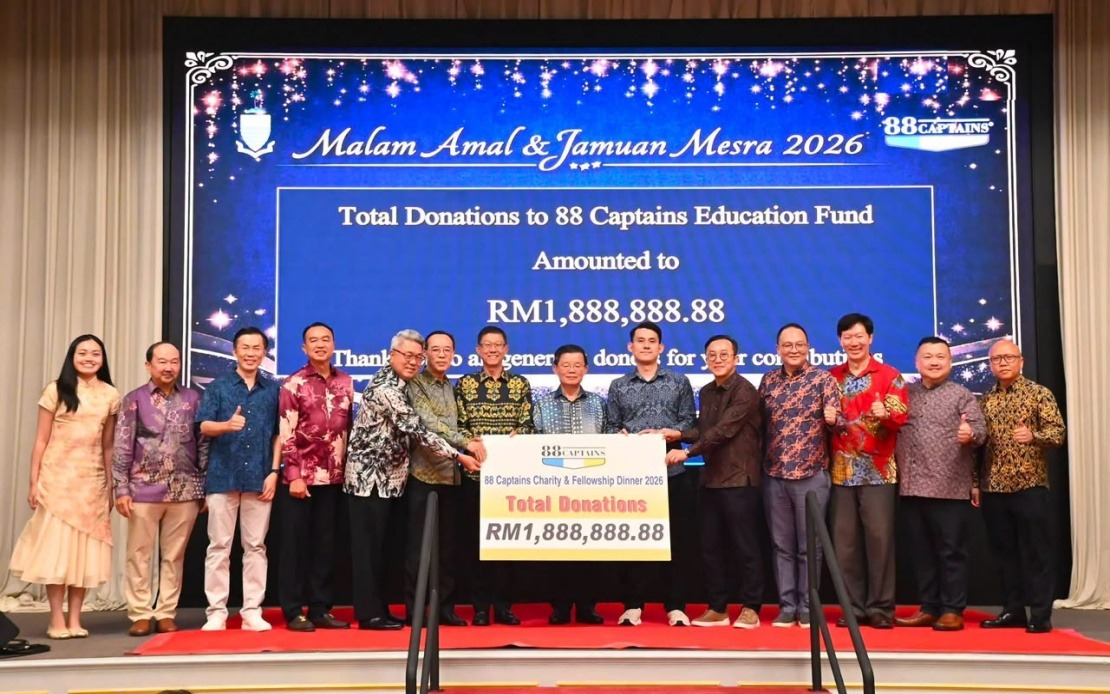
The 88 Captains, a Penang-based charitable organisation, has committed more than RM1 million to scholarship awards benefiting 44 students drawn from five educational institutions in the state and Northern Region. The distribution reflects the organisation's broader mission to nurture emerging talent while simultaneously alleviating financial barriers that often hinder deserving students from pursuing their academic goals. Announced during the 88 Captains Annual Charity Dinner 2026 in George Town, the scholarship initiative underscores a growing recognition among civil society groups in Malaysia that direct financial support must be coupled with mentorship and career development pathways to create meaningful social impact.
Datak Seri Dr Ooi Eng Hock, the organisation's chairman, articulated a vision extending beyond simple financial relief. He emphasised that scholarships serve as catalysts for ambition, encouraging recipients to pursue excellence while cultivating the values and integrity necessary to become productive members of society. This framing reflects an emerging discourse among Malaysian philanthropists who view educational grants not merely as welfare instruments but as investments in character formation and social responsibility. Such an approach acknowledges that sustainable development requires not just skilled workers but principled citizens capable of contributing meaningfully to their communities.
Central to 88 Captains' recent expansion has been the launch of its Apprenticeship, Internship, Reskilling and Upskilling programme, formally introduced last year at Universiti Sains Malaysia. This initiative represents a deliberate effort to dismantle the traditional boundary separating academic preparation from workplace reality, a perennial challenge within Malaysia's education system. By creating structured pathways for students to engage directly with industry leaders and organisational founders, the programme seeks to equip graduates with realistic expectations about employment conditions, career progression, and compensation scales.
The organisation has assembled a dedicated task force comprising outstanding scholars from multiple institutions including ViTrox College, Tunku Abdul Rahman University of Management and Technology, and INTI International University. This cross-institutional approach amplifies the programme's reach and ensures diverse perspectives inform its development. Through systematic engagement with corporate executives, the task force aims to articulate employer expectations whilst simultaneously conveying graduate aspirations, including the growing demand for entry-level positions offering salaries at or above RM4,000 monthly. Such transparency reduces the misalignment that frequently frustrates both employers and early-career professionals in Malaysia.
The charity dinner itself proved remarkably successful in fundraising terms, accumulating RM1.89 million through donor contributions. The event's high-profile attendance—including Penang Governor Tun Ramli Ngah Talib, his wife Toh Puan Raja Noora Ashikin Raja Abdullah, and Chief Minister Chow Kon Yeow—demonstrated substantial governmental endorsement of the organisation's objectives. Such political support carries significance within Malaysia's context, where state-level backing can substantially amplify civil society initiatives' credibility and reach.
Over its four-year operational history since establishment in 2022, 88 Captains has orchestrated more than 50 distinct events and undertaken numerous community-focused projects that extend beyond direct scholarships. The organisation has donated smart televisions to primary and secondary schools, a gesture that bridges the urban-rural digital divide by ensuring students in resource-constrained settings access modern educational technology. Equally significant have been efforts to establish 5G Education Digital Libraries across 88 schools, positioning digital literacy as foundational infrastructure rather than optional enrichment. These initiatives acknowledge that contemporary talent development requires technological fluency alongside traditional academic competencies.
The organisation's engagement with the Special Education Integration Programme reveals attention to inclusive development, ensuring that students with disabilities benefit from mainstream educational advancement rather than being sequestered in parallel systems. This commitment reflects international best practices whilst responding to Malaysia's evolving understanding of educational equity. Such programming demonstrates that comprehensive talent development must encompass diverse learner populations, not merely high-achieving students from privileged backgrounds.
Chief Minister Chow Kon Yeow explicitly connected 88 Captains' work to Penang's broader economic strategy. He recognised the organisation's contributions to developing human capital within sectors identified as crucial for the state's competitive positioning: advanced manufacturing, semiconductors, artificial intelligence, and the digital economy. This alignment between grassroots talent development and state-level strategic planning represents effective synchronisation of civil society efforts with governmental objectives. For Malaysian policymakers and business leaders, such coordination suggests pathways toward addressing skills shortages that currently constrain regional economic growth.
Particularly timely has been 88 Captains' recent launch of the Joint Mental Health Development in Schools with AI Early Education for Responsible Adoption initiative. The programme addresses escalating concerns regarding student wellbeing whilst promoting thoughtful engagement with artificial intelligence technologies from early educational stages. The timing coincides with Malaysia's introduction of the Anti-Bullying Act 2026, positioning educational institutions at the frontline of both protective legislation and proactive mental health intervention. Chief Minister Chow emphasised that legal frameworks provide necessary scaffolding, but genuine protection emerges through coordinated effort among schools, families, and communities.
The responsible AI adoption component reflects sophisticated understanding that technological advancement cannot be decoupled from ethical formation. By introducing students to AI's potential whilst simultaneously encouraging critical evaluation of its societal impacts, 88 Captains positions itself ahead of many institutions still grappling with whether AI should be embraced or restricted. This balanced approach acknowledges that digital literacy increasingly encompasses not merely technical competency but ethical reasoning about technology's proper use.
For teachers implementing these initiatives, 88 Captains recognises that institutional support remains insufficient without individual educator capacity-building. Equipping teachers with mental health awareness, anti-bullying protocols, and competencies in AI ethics requires sustained professional development—an investment area where civil society can meaningfully complement governmental initiatives. The organisation's willingness to undertake such work alongside legislative implementation demonstrates recognition that effective social change rarely emanates from single institutions or stakeholder groups.
Looking forward, 88 Captains' trajectory suggests a maturing Malaysian civil society increasingly sophisticated in its approach to social development. Rather than dispersing charity without strategic framework, organisations are deliberately architecting interventions that address systemic challenges whilst building sustainable capacity within institutions and individuals. For other Malaysian states and civil society groups, the Penang-based organisation's model offers instructive lessons regarding the complementary roles of scholarships, mentorship, technology infrastructure, mental health support, and ethical education in comprehensive talent development systems.
The scale of 88 Captains' operations and ambitions—RM1 million in annual scholarships, 50-plus events yearly, technology deployment across 88 schools, cross-institutional partnerships—demonstrates that regional prosperity increasingly depends not upon government action alone but upon coordinated engagement among private sector, educational institutions, and organised civil society. Within Malaysia's broader context of economic restructuring and technological transition, such multi-stakeholder approaches to talent cultivation may prove decisive in determining which regions successfully navigate coming decades of disruption and opportunity.

