In the small Czech village of Bukovka, nestled 90 kilometres east of Prague, stands an unmistakable monument to football devotion—a three-storey house painted in the unmistakable sky-blue and white of Argentina's national team colours. This is the home of Miloslav "Curby" Urbanec, a 51-year-old music promoter whose life has been shaped by an unwavering commitment to Argentine football that transcends ordinary fandom and ventures into the realm of artistic expression and personal identity.
The exterior of Urbanec's residence reads like an open-air museum dedicated to Argentine football history. A life-size statue of Diego Maradona stands sentinel in the courtyard, while a sprawling mural depicting Lionel Messi adorns the rear wall. The house's architectural features have been deliberately adapted to reflect this passion: a massive sun emblem—the central symbol of the Argentine flag—dominates the upper section of the building. Every architectural detail, every brushstroke, every sculptural element tells a story of unwavering allegiance to La Seleccion.
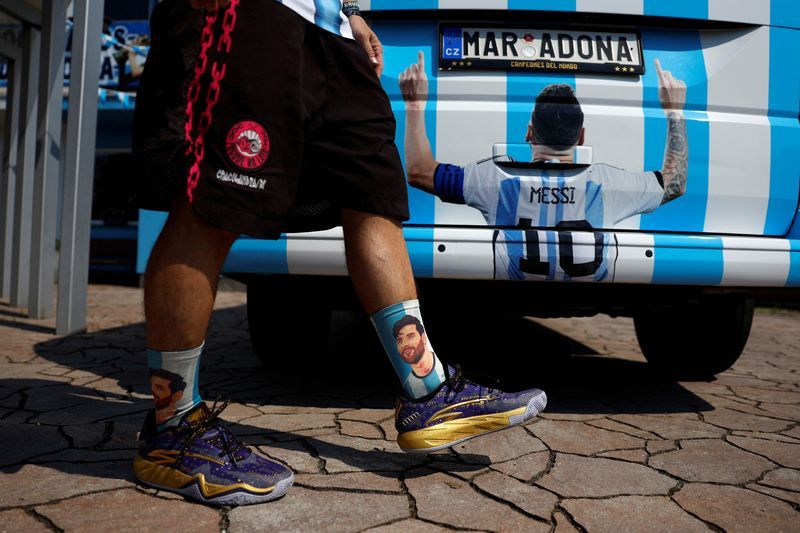
Urbanec's commitment extends far beyond his home's physical appearance. His personal vehicle is customised in matching sky-blue and white, emblazoned with images of both Maradona holding the World Cup and Messi in action. The vanity licence plate reads simply "MARADONA," a daily declaration of his sporting priorities. Inside the vehicle and throughout his life, he lives beneath a slogan that has become something of a personal motto: "In Messi we trust." This phrase, reminiscent of American patriotic expressions, captures the depth of religious-like devotion that characterises contemporary football fandom across Europe and globally.
The genesis of Urbanec's Argentine obsession stretches back to his earliest childhood memories. At just four years old, he sat with his father to watch the 1978 World Cup—Argentina's maiden triumph on the world stage. The experience proved transformative. He recalls being captivated not merely by the victory but by the aesthetic appeal of the players themselves, particularly the long-haired style of Mario Kempes and his teammates. That moment crystallised into a lifetime passion that would shape his purchasing decisions, his leisure time, his home design, and even his family nomenclature.
The depth of this devotion becomes particularly evident in Urbanec's decision regarding his second son. Seven years ago, recognising what he perceived as extraordinary talent emerging from Argentina, he named his child Lionel—a deliberate homage to Messi. For Urbanec, this naming was not a casual choice but rather a calculated declaration that he had witnessed the emergence of "absolutely special" footballer who would define a generation. The decision reflects how deeply football culture permeates Central European life, and how transnational sporting allegiances can supersede geographical proximity and national boundaries.
Behind his residence, Urbanec has constructed an all-weather football pitch—a functional space designed for play rather than mere decoration. Yet even this utilitarian structure has been transformed into an extension of his Argentine shrine. The pitch is surrounded by placards featuring images of Boca Juniors players, honouring one of Maradona's former clubs and reinforcing the connection between Argentine club football and the international stage. This space represents not merely a place to play football but rather a consecrated ground where the values and aesthetics of Argentine football are actively practised and celebrated.
Urbanec's confidence in Argentina's prospects appears unshakeable. Speaking with the certainty of a true believer, he describes the current national squad as "absolutely amazing" and expresses complete conviction that another World Cup victory is inevitable. His optimism is grounded not in statistical analysis or tactical consideration but rather in an almost spiritual faith in Argentine football's superiority. He argues that Argentina "play the most beautiful football," elevating the national team beyond mere sporting excellence into the realm of artistic expression.
This perspective—that Argentine football represents aesthetic perfection—reveals something important about how football transcends sport in global culture. For Urbanec and millions like him across Europe, Asia, and beyond, Argentina represents an ideal: a footballing philosophy that combines technical brilliance with attacking flair and creative expression. The national team becomes a repository for values and aspirations that extend far beyond the ninety minutes of match play.
Urbanec's story also illuminates the peculiar geography of modern football fandom. His Czech village location makes his Argentine allegiance geographically anomalous, yet culturally coherent within the framework of European football culture. The Czech Republic, with its own respectable football tradition, has produced many such transnational fans who have adopted distant football cultures as their own. This phenomenon reflects the globalisation of sports culture and the capacity of football to create emotional bonds that transcend national borders and historical connections.
The practical manifestations of Urbanec's fandom—the renovations, the artwork, the vehicle customisation, the child's name—represent financial and temporal investments that would be impossible to recover or justify on rational economic grounds. Yet this irrationality is precisely the point. Football fandom operates in an emotional and cultural register that supersedes conventional cost-benefit analysis. For Urbanec, these investments represent not expenses but rather expressions of identity and belonging to a global community of Argentine football enthusiasts.
Looking ahead, Urbanec's conviction in Argentine success appears positioned to face its ultimate test. As the team advances through tournament stages, his faith will be publicly validated or challenged in ways that no amount of home decoration can ameliorate. Whether Argentina achieves the success that Urbanec so confidently predicts, his Bukovka shrine stands as testament to football's unique capacity to inspire loyalty, creativity, and devotion that rivals religious commitment in its intensity and expression.

