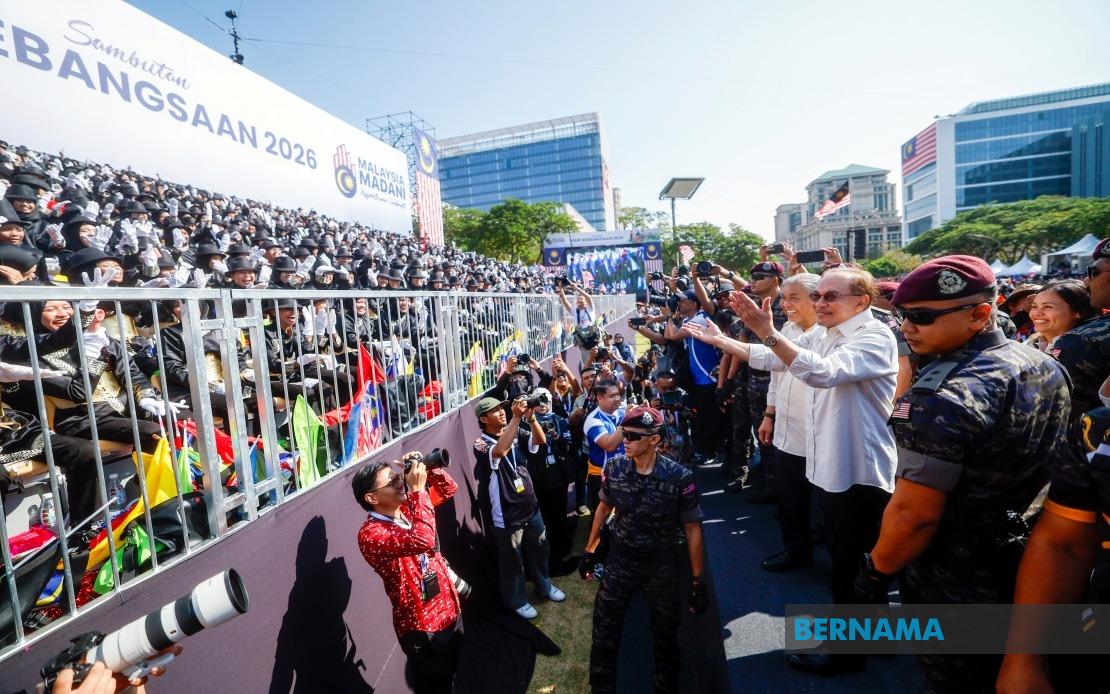
Prime Minister Datuk Seri Anwar Ibrahim expressed heartfelt appreciation for the remarkable turnout and visible enthusiasm displayed by Malaysians during the 2026 National Day commemoration held at Dataran Putrajaya on August 31. Visibly pleased after witnessing the 69th National Day parade and procession, Anwar described the event as a "great, great show", reflecting the collective pride and patriotic fervour that characterised the morning's celebrations. His spontaneous reactions captured the emotional resonance of what has become one of Malaysia's most significant annual occasions, serving as a barometer of national unity and social cohesion.
The scale of public participation underscores the enduring appeal of National Day celebrations in Malaysia's political calendar. More than 100,000 citizens converged on Dataran Putrajaya, with many demonstrating remarkable commitment by camping at the venue since the previous evening to secure prime viewing positions. This level of voluntary engagement suggests deep-rooted attachment to national symbols and values, despite contemporary pressures on social unity. The early arrivals and sustained presence throughout the morning indicate that ordinary Malaysians continue to view the occasion as worthy of personal sacrifice and time investment, a phenomenon often overlooked in discussions dominated by political tribulations.
The ceremonial grandeur reflected meticulous planning and substantial resource mobilisation. The parade itself engaged 10,819 participants organised into 76 distinct contingents, supplemented by 22 marching bands that provided rhythmic accompaniment to the procession. Beyond the human participants, organisers deployed 328 military and civilian assets spanning land, sea, and air dimensions, alongside 112 service animals trained for public pageantry. The inclusion of 22 electric vehicles within the parade sequence carried symbolic weight, signalling governmental commitment to environmental sustainability within the context of national imagery. These logistical details, though technical in nature, reflect the sophisticated apparatus required to maintain Malaysia's ceremonial traditions at appropriate standards.
The thematic framework guiding this year's celebration carried particular policy significance. Designated as "Malaysia MADANI: Kesejahteraan Dinikmati" (Malaysia MADANI: Shared Prosperity), the parade's narrative arc emphasised governmental commitment to prioritising citizen welfare whilst respecting Malaysia's documented diversity. This messaging resonates with Anwar's broader political agenda, which positions economic advancement and social protection as keystones of administrative legitimacy. The theme transcends mere ceremonial rhetoric, embedding governmental philosophy into visual and experiential form accessible to mass audiences, thereby reinforcing policy narratives through cultural channels.
Anwar's post-parade engagement with assembled crowds demonstrated political savvy in translating formal ceremonial participation into personal connectivity with constituents. Walking more than 500 metres through Dataran Putrajaya, he accommodated countless requests for photographs whilst engaging in impromptu conversations with citizens. This accessibility proved particularly valuable when individual members of the public spontaneously expressed gratitude for specific policy interventions, notably the restoration of BUDI MADANI RON95 subsidies from 200 litres to 300 litres monthly. Such unscripted moments of appreciation validate governmental initiatives through authentic testimonial rather than official pronouncements, creating organic advocacy that extends policy communication beyond traditional media channels.
The fuel subsidy announcement itself carries substantial implications for Malaysia's economically vulnerable segments. The BUDI95 programme reaches more than 16 million users of subsidised RON95 fuel, indicating that any modification affects a significant proportion of the driving population. The restoration of the monthly quota to 300 litres represents meaningful relief for households dependent on affordable fuel access, particularly affecting transportation workers, small-business operators, and commuters from lower-income brackets. For these constituencies, the announcement operates as material evidence of governmental responsiveness to living cost pressures, translating abstract policy frameworks into tangible monthly benefits at petrol stations nationwide.
Complementing the RON95 initiative, Anwar's previously announced expansion of diesel subsidies to pickup truck and jeep owners further demonstrates targeted welfare redistribution. Beginning September 1, eligible owners would access up to 400 litres of BUDI Diesel monthly, a measure potentially benefiting more than 500,000 vehicle proprietors. This category encompasses agricultural workers, construction contractors, small traders, and rural entrepreneurs whose occupational requirements mandate diesel-powered vehicles. The tiered approach, distinguishing between petrol and diesel vehicles, suggests segmented policy design recognising differential subsidy needs across occupational and geographic segments.
The ceremonial presence of Their Majesties Sultan Ibrahim and Raja Zarith Sofiah lent constitutional gravitas to proceedings, embodying the institution of the monarchy as custodian of national symbolism and unity. The formal reception accorded by Anwar and his spouse, alongside Communications Minister Datuk Seri Fahmi Fadzil as event chairman, established clear hierarchical deference whilst affirming the Prime Minister's ceremonial prerogatives. This choreography of state occasions carries weight in Malaysia's constitutional framework, where the symbolic authority of monarchy and executive authority must be carefully calibrated and mutually acknowledged. The seamless coordination between royal and executive participation suggested institutional harmony, a valuable signal in a political environment occasionally marked by tensions between different power centres.
The inclusion of human graphics performance on terraces alongside conventional parade elements indicates evolving approaches to national commemoration, incorporating contemporary artistic vocabulary within traditional ceremonial frameworks. This fusion of classical processional forms with modern performance techniques appeals to diverse age cohorts, from elderly citizens invested in continuity to younger Malaysians seeking contemporary cultural expression. The organisational sophistication required to coordinate such varied performance modes demonstrates the institutional capacity of Malaysia's event management apparatus, reflecting investments in creating celebrations that resonate across generational and cultural divides.
For Malaysian policymakers and regional observers, the 2026 National Day celebration illustrated sustained capacity for public mobilisation around civic occasions despite fragmented contemporary political discourse. The convergence of over 100,000 citizens, substantial military and civilian resources, and ceremonial formality generated a collective experience that transcends partisan calculation, at least temporarily uniting disparate constituencies around shared national symbols. This periodic reassertion of national consensus through ceremonial practice provides psychological and political reinforcement for concepts of Malaysian identity and social cohesion that frequently face erosion through everyday political competition and social fragmentation.

