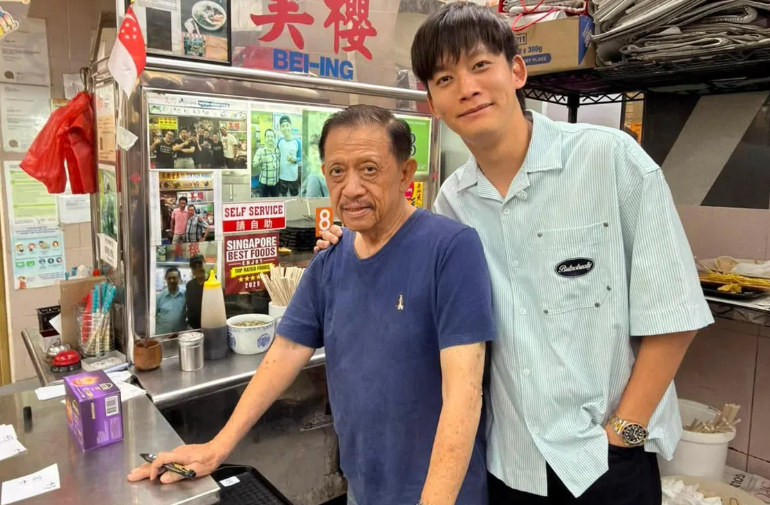
Singaporean actor Noah Yap has publicly rejected suggestions that he exploited a hawker's misfortune for personal gain, responding sharply to online detractors who questioned his motives for visiting the injured elderly vendor at Roxy Square. The controversy arose after the actor posted about his encounter with the stall owner, prompting some commentators to allege that Yap had manufactured concern and orchestrated the meeting primarily to boost his public profile rather than out of genuine compassion.
The criticism, levelled by various social media users, characterised Yap's actions as opportunistic, with one commenter specifically suggesting the actor had "shown concern and gathered publicity" while acting as a "smart actor fighting for limelight immediately before others." Such accusations reflect a broader social media phenomenon where public figures face suspicion whenever they share charitable acts or moments of community engagement, with observers questioning whether documented kindness represents authentic behaviour or calculated personal branding.
Yap's rebuttal centred on the substance of his relationship with the hawker, rather than engaging with broader debates about celebrity and authenticity. He disclosed that he had patronised Bei-Ing Wanton Noodle for more than two decades, a connection stretching back to his primary school years. This lengthy relationship fundamentally reframes the nature of his visit, positioning it not as sudden philanthropic interest in a stranger's suffering but rather as the natural response of a loyal customer to someone he described as integral to his own personal history. The stall owner, referred to as Uncle Yeo, had apparently maintained an ongoing interest in Yap's welfare across the years, regularly inquiring about him whenever he stopped by for a meal.
The incident itself emerged from a tense confrontation at a Roxy Square coffee shop that was captured on video and circulated widely online beginning August 15. According to accounts provided by Yeo and his family members, the conflict originated from a seemingly innocent gesture that escalated dramatically. Yeo recalled noticing a young girl seated nearby, whom he found appealing, and he reached out to pat the child affectionately on the head. The girl's father interpreted this gesture as inappropriate and confronted the elderly vendor, leading to a physical altercation that shocked onlookers.
Securities footage subsequently posted on social media appeared to document the younger man forcibly grabbing Yeo and pushing him forcefully to the ground, a violent response that prompted authorities to intervene. The Singapore Police Force acknowledged receiving a formal report and confirmed that officers were actively investigating the incident. The assault left Yeo injured, though initial reports suggested the hawker was reluctant to pursue medical evaluation, a hesitation that complicated efforts to assess the full extent of his injuries.
Yap visited Yeo the day following the incident, on August 16, and reported finding the hawker maintaining positive morale despite his ordeal. The actor subsequently posted about this interaction on social media, a decision he has now clarified was motivated by raising public awareness about the assault itself rather than self-promotion. In his account, Yap explicitly framed the situation as an opportunity to highlight broader social concerns about violence and its destructive impact on community harmony.
The actor's social media statement carried a forceful message about the unacceptability of physical violence as a means of resolving disputes or responding to perceived transgressions. Yap used the platform to advocate for increased kindness within society, positioning the incident as emblematic of a troubling decline in communal empathy and mutual respect. His emphasis on these values suggests he viewed the documented assault not merely as a personal matter affecting someone he knew but as a symptom of wider social deterioration warranting public commentary.
Yap concluded his rebuttal with a blunt dismissal of his critics' insinuations, telling them to "get a life" and asserting that he lacked the free time to engineer publicity stunts. This pointed response underscores the frustration actors and public figures often experience when transparent attempts at community engagement are subjected to cynical reinterpretation. For Malaysian audiences observing the dispute, the exchange illustrates tensions between social media discourse and authentic human connection, particularly when celebrities become involved in communities beyond the entertainment sphere.
The broader context reveals changing expectations around public figures' social responsibility. A generation ago, celebrities who witnessed community incidents might have remained silent or consulted publicists. Yap's immediate visit and transparent documentation of his concern reflects evolving norms where public figures are increasingly expected to use their platforms for social good. Yet paradoxically, this same visibility exposes them to accusations of opportunism, creating a tension that proves difficult to resolve.
The incident at Roxy Square also raises questions about social cohesion in busy urban environments where transient interactions can trigger violent escalation. Yeo's innocent gesture—inappropriate perhaps by contemporary standards but reflective of different generational norms—resulted in a brutal assault. The disproportionate physical response suggests broader anxieties about child safety and parental protectiveness that may be overriding community courtesy and de-escalation impulses. For Southeast Asian cities experiencing similar demographic shifts and social pressures, such incidents warrant careful examination.
Yap's insistence on his long-standing relationship with the hawker also highlights how transactional daily interactions—customer and vendor—can develop into genuine human bonds transcending commercial exchange. Over twenty years, countless meals consumed at Bei-Ing Wanton Noodle had built emotional connection and mutual regard. The actor's immediate response to Yeo's suffering thus represented not mere celebrity obligation but the natural behaviour expected between acquaintances. By articulating this foundation, Yap effectively dismantled the narrative that his actions were performative or calculated.
The investigation into the assault continues under police supervision, with authorities examining the CCTV footage and witness accounts. The legal proceedings will determine how Singapore's justice system addresses violence emerging from perceived threats to children. Simultaneously, Yap's public stance reinforces that violence remains universally indefensible regardless of circumstance or provocation, a message resonating across Southeast Asia's diverse communities struggling with urban tensions and social fragmentation.

