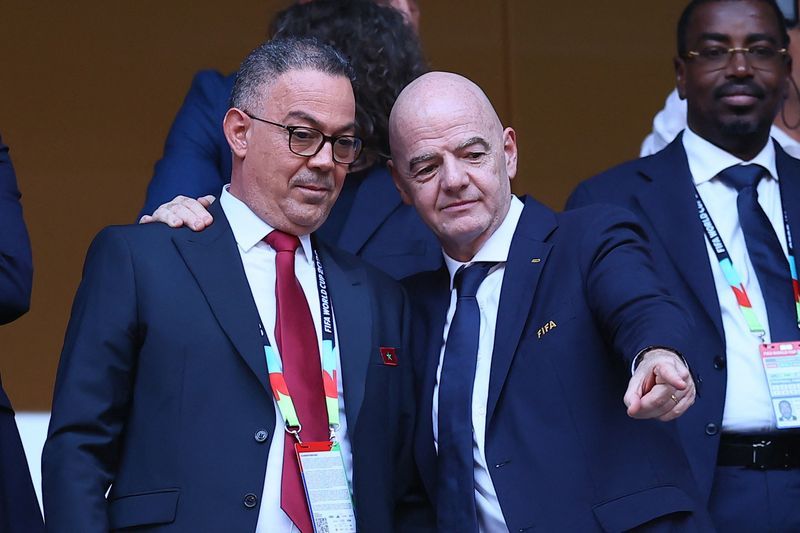
Gianni Infantino's embattled presidency received a crucial lifeline from Africa's football leadership on Wednesday, as senior continental administrators issued statements of support ahead of his re-election bid next March. The backing comes at a critical moment for the FIFA President, who has faced a dramatic loss of confidence from football's governing bodies across Asia, Europe, and the North American and Caribbean confederation in recent days. However, the Confederation of African Football and its member associations have maintained a noticeably more measured stance, offering Infantino hope that the continent's 54-strong voting bloc could prove decisive in his battle to retain control of world football.
The show of solidarity from Africa's football elite centres on a decision that Infantino made on Friday to abandon his controversial FIFA Forward Enterprise initiative, a commercial restructuring scheme designed to generate $4.2 billion from future World Cup broadcasting rights. The proposal had triggered immediate and coordinated opposition from football administrators worldwide, prompting the FIFA President to shelve the plan within days of its announcement. Leading African football figures, including CAF Vice President Fouzi Lekjaa of Morocco, Egyptian FIFA Council member Hany Abo Rida, Niger's Hamidou Djibrilla, and Mauritania's Ahmed Yhaya, have since released similarly worded messages welcoming Infantino's decision to withdraw the scheme.
Veron Mosengo-Omba, the newly elected president of the Democratic Republic of Congo's football federation and a former CAF general secretary who studied in Switzerland alongside Infantino, has also publicly endorsed the FIFA President. These declarations represent a deliberate pivot away from the continent's initial caution when CAF issued only a terse statement last Wednesday promising to study Infantino's initiative before ultimately abandoning it under pressure. The continental body's measured response contrasts sharply with swift and emphatic rejections from other regions, suggesting that African football administrators recognised an opportunity to leverage the moment politically.
The foundation of Infantino's popularity across Africa rests squarely on his financial largesse toward the continent's football associations. Since his 2016 election victory, which was substantially enabled by African votes secured through his promises to dramatically expand development funding, Infantino has exponentially increased the FIFA Forward programme—a renamed and substantially expanded version of the Goal Project originally introduced by his predecessor Sepp Blatter. The FIFA baseline funding mechanism now guarantees each of the organisation's 211 member associations a minimum of $8 million over a four-year cycle, a guarantee that has become critical for many African nations whose football development depends heavily on these transfers rather than domestic government support.
For economically struggling African countries, FIFA's financial support has become the lifeblood of competitive football. The Football Association of Malawi's president, Fleetwood Haiya, articulated this reality with striking candour, noting that his nation faces an acute shortage of basic infrastructure and medical resources that must be addressed before football development can be prioritised. Similarly, Saïd Ali Athouman, president of the Comoros Football Federation, highlighted the structural disadvantage that African nations face in global competition. Without external funding, African countries cannot provide their athletes with the training facilities, medical care, and equipment that wealthy European and developed nations take for granted, creating a widening competitive gap that money alone from FIFA cannot bridge.
Infantino's financial strategy builds directly on precedent established by Blatter, who pioneered the practice of using FIFA money to secure political support from developing nations. When Blatter contested the 1998 FIFA presidency election against UEFA President Lennart Johansson, he secured victory largely through the backing of African countries who had previously received no direct financial assistance from world football's governing body, despite the continent's substantial membership within FIFA. This model proved so effective that it has become the foundation of FIFA's internal political economy, with subsequent leaders recognising that financial generosity toward member associations translates directly into electoral support when leadership contests arise.
The CAF executive committee meeting scheduled for Thursday was set to discuss the abandoned revenue-sharing scheme, though the continental body has given no indication whether it will formally declare support or opposition to Infantino's re-election campaign. This ambiguity reflects the delicate political balance that African football administrators must navigate. Publicly supporting Infantino before a formal continental decision risks appearing complicit in any future financial schemes, while withdrawing support entirely would antagonise a leader who has proven extraordinarily generous to African football development. The absence of a unified CAF statement also provides member associations with political flexibility, allowing them to maintain friendships with Infantino while distancing themselves if his political fortunes deteriorate further.
Infantino's position has deteriorated considerably across other footballing regions. Asia, Europe, and CONCACAF—the governing body for North American and Caribbean football—all announced confidence votes against the FIFA President over the weekend. This coordinated regional opposition creates unprecedented political pressure for the March election, yet Infantino retains distinct advantages within the African context. The financial architecture he has constructed means that many African member associations have direct economic interests in his continued leadership, as a change in FIFA's presidency could potentially alter the generous funding mechanisms that have become central to their operations.
The complexity of Infantino's relationship with African football extends beyond simple financial transactionalism. Mosenpo-Omba's endorsement demonstrates how personal networks and historical connections reinforce political alignments within FIFA governance structures. His reference to never betraying those who have shown loyalty captures a distinct organisational culture within African football administration, where personal relationships and concepts of reciprocal obligation carry significant weight. This contrasts with European and Asian football governance, which tends to operate through more formal institutional channels and explicit performance metrics.
The timeline of the World Cup revenue controversy reveals strategic calculation by African football leaders. When Infantino first announced the FIFA Forward Enterprise initiative, CAF deliberately refrained from immediate public response, avoiding alignment with either supporters or critics until the political trajectory became clearer. Once it became apparent that the scheme would face worldwide opposition, African administrators quickly repositioned themselves as supporters of Infantino's withdrawal, effectively claiming credit for his retreat while maintaining their relationship with the FIFA President. This tactical flexibility suggests that African football's stance on the March presidential election remains genuinely undecided, contingent on how Infantino manages the political crisis and what assurances he can provide regarding continued financial support.
As the presidential election approaches, the African confederation's cautious approach and the selective endorsements from individual administrators suggest that Infantino cannot assume automatic continental support despite his substantial financial investments. Rather, his re-election prospects depend on his ability to navigate the current crisis, maintain the FIFA Forward programme's funding trajectory, and prevent the emergence of an alternative candidate who might offer comparable financial incentives to African member associations. The continent's football leaders are watching carefully to determine whether Infantino can stabilise his position globally or whether his weakened political standing might justify reconsidering their allegiance.

