Agrobank has successfully channelled more than RM8 million in financing applications through a series of direct engagement sessions held with hawkers and small-scale entrepreneurs, reflecting growing momentum in the bank's strategy to bring financial services closer to grassroots business operators. The development underscores a strategic shift in how development finance institutions are approaching credit accessibility, moving beyond traditional branch-based applications to meet traders where they work and operate.
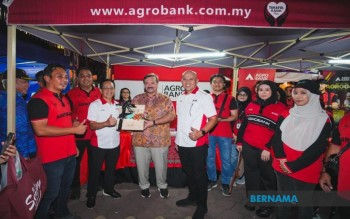
The agricultural development bank has now extended this on-the-ground initiative to Sabah, conducting targeted sessions at the Api-Api Night Market along Jalan Gaya in Kota Kinabalu and the Papar Tamu Farmers' Market. These sessions build on earlier successful engagement activities held across multiple farmers' markets in the Klang Valley region, suggesting the model is proving effective across different markets and geographies. The expansion into East Malaysia represents a significant geographical milestone, demonstrating Agrobank's commitment to serving small business communities beyond the traditional economic heartland of Peninsular Malaysia.
The Kota Kinabalu engagement session proved particularly productive, with Agrobank representatives meeting 153 individual hawkers and entrepreneurs at the Api-Api Night Market to assess their specific financing requirements. Meanwhile, the Papar farmers' market gathering attracted participation from 95 traders, indicating substantial interest from the agricultural supply chain and produce sectors. These venues were deliberately chosen because night markets and farmers' markets function as essential economic engines within their respective communities, generating employment and supporting livelihoods for hundreds of families while contributing meaningfully to local economies.
The sessions themselves were structured around practical identification of individual business needs, with particular emphasis on working capital requirements and capital for business expansion. Many small traders struggle to access conventional bank financing due to stringent collateral requirements and formal documentation standards, making specialized outreach programmes potentially transformative for this segment. By bringing financing advisors directly to market locations, Agrobank addresses a fundamental accessibility barrier that has historically excluded informal and semi-formal traders from credit systems.
Finance Minister II Datuk Seri Amir Hamzah Azizan attended the Kota Kinabalu session, signalling high-level government support for grassroots financing initiatives. This ministerial presence reflects the strategic importance the government places on channelling capital to street-level entrepreneurs and small traders, whose collective contribution to employment and economic resilience is often underestimated in macroeconomic discussions. The attendance also suggests alignment between Agrobank's operational strategy and broader government policy directives on financial inclusion.
Agrobank Group President and Chief Executive Officer Datuk Tengku Ahmad Badli Shah Raja Hussin emphasized that the expansion into Sabah represents a fundamental commitment to understanding and serving communities beyond major metropolitan areas. He articulated that different business environments and trader communities face distinct challenges requiring localized solutions rather than standardized approaches. This acknowledgment reflects growing recognition that small business finance cannot be uniformly designed but must account for regional variations in market structure, supply chains, and operational constraints.
The bank's leadership stressed that on-the-ground engagement enables provision of financial advisory services and non-financial support tailored to how small traders actually operate. Beyond simply offering loan products, Agrobank appears to be positioning itself as an institution capable of providing business development support alongside capital, recognizing that many micro-entrepreneurs lack formal management training or structured business planning experience. This holistic approach potentially increases repayment sustainability and success rates compared to transactional lending models.
The initiative directly aligns with a directive from Prime Minister Datuk Seri Anwar Ibrahim requiring financial agencies to intensify outreach efforts and accelerate disbursement of RM5 billion in financing earmarked specifically for small traders. This government-level commitment represents official recognition that small traders require dedicated financial infrastructure and cannot be effectively served through conventional banking channels. The RM8 million generated through engagement sessions so far represents approximately 0.16 percent of the RM5 billion target, suggesting substantial room for scaling these programmes across additional markets and regions.
For Malaysian small traders and entrepreneurs, particularly in Sabah and other less-urbanized areas, these sessions address a persistent constraint on business growth and formalization. Access to working capital has historically been cited as a primary limitation preventing informal traders from expanding operations, hiring additional workers, or investing in equipment and inventory. By removing geographical and procedural barriers to credit applications, Agrobank's approach potentially enables thousands of small business operators to access growth capital previously unavailable to them.
The engagement model also carries broader implications for financial inclusion policy across Southeast Asia, where many countries face similar challenges in extending credit access to informal and semi-formal business sectors. Malaysia's approach through specialized development institutions like Agrobank offers a template potentially applicable in neighbouring countries grappling with comparable financial access constraints. The success of direct market-based engagement suggests that understanding local business contexts and reducing application friction are more effective than increasing loan product complexity or collateral requirements.
Looking forward, the expansion to Sabah suggests Agrobank intends to replicate this engagement model across additional state markets and potentially extend into other regions of East Malaysia and other parts of Peninsular Malaysia not yet covered. Scaling these sessions requires significant institutional commitment in terms of staffing, logistics, and financial advisory capacity, but the demonstrated success in generating applications and evident ministerial support suggest this investment is considered justified. The real test will be in application approval rates, disbursement timelines, and ultimate loan performance metrics, which will determine whether engagement success translates into meaningful capital access for the target population.

