Deputy Prime Minister Datuk Seri Dr Ahmad Zahid Hamidi has offered his congratulations to Datuk Onn Hafiz Ghazi following the latter's formal appointment as Johor Menteri Besar, marking the conclusion of the transition period after Barisan Nasional's commanding victory in the recent state elections.
Ahmad Zahid, who chairs the BN coalition, shared his remarks through a Facebook post shortly after Onn Hafiz completed the official swearing-in ceremony. The Deputy Prime Minister framed the appointment as a validation of public confidence in Onn Hafiz's capabilities, emphasising that the electoral mandate represents a significant responsibility to advance Johor's development agenda with renewed vigour. The statement reflects the importance BN leadership places on continuity and stability within the crucial southern state.
In his public message, Ahmad Zahid highlighted three key pillars that should guide Onn Hafiz's tenure as chief minister: ensuring the welfare and prosperity of Johor's citizens, maintaining political stability within the state, and driving sustainable economic and social development. These priorities underscore BN's broader positioning heading into what many analysts view as a critical period for strengthening party control at the state level ahead of the federal general election cycle.
The Deputy Prime Minister expressed confidence in Onn Hafiz's ability to lead, citing the latter's demonstrated leadership qualities, accumulated political experience, and proven commitment to public service. Ahmad Zahid invoked a religious blessing, stating his conviction that under Onn Hafiz's stewardship, Johor will achieve further successes that benefit all residents. This framing seeks to position the new administration as inheritor of BN's established legacy in the state.
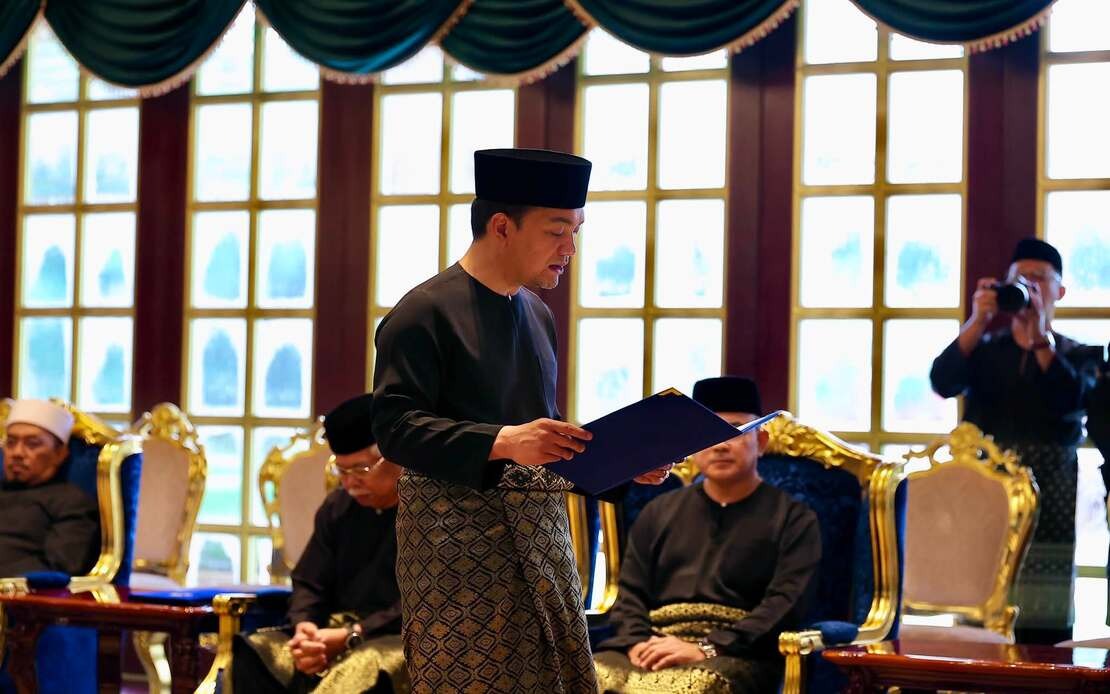
Onn Hafiz, who represents the Machap state assembly seat and previously served as Johor BN chairman, formally took the oath of office before Tunku Ismail Sultan Ibrahim, the Regent of Johor. The ceremony took place at Balai Mengadap within Istana Bukit Serene, Johor Bahru's palace complex, following the constitutional procedures required for state leadership transitions. His appointment concludes a transition period that began immediately after the 16th Johor state election results were announced.
The pathway to Onn Hafiz's appointment was secured by BN's overwhelming electoral performance just one day prior, when voters delivered the coalition a commanding two-thirds supermajority. The coalition captured 48 out of 56 available seats in the state assembly, demonstrating substantial public support and providing the new administration with considerable legislative flexibility for implementing its agenda without relying on opposition cooperation. This decisive mandate is relatively rare in contemporary Malaysian state politics, where most states feature more competitive electoral dynamics.
For Malaysian observers and regional watchers, the Johor result carries significant implications beyond the state itself. As Malaysia's second-largest state economy and a strategic location adjacent to Singapore, Johor's political direction influences broader regional stability and economic performance. The strong BN showing suggests that the coalition's recovery narrative—pursued since the 2022 federal election—continues gaining traction among voters, particularly in key constituencies.
Onn Hafiz assumes leadership at a time when Johor faces multiple development pressures, from infrastructure modernisation to strengthening manufacturing competitiveness amid regional competition from neighbouring Singapore and Thai provinces. His administration will need to balance rapid growth imperatives with sustainability concerns that increasingly influence investment decisions by foreign and domestic corporations. The state's role as a gateway to the ASEAN region amplifies the significance of policy choices made over the coming years.
The appointment also reflects internal BN dynamics and succession planning within the coalition's Johor structure. Onn Hafiz's elevation represents a generational shift, as he succeeds leaders from earlier political eras. How effectively he consolidates support among BN's diverse component parties—particularly UMNO and its Sabah-Sarawak partners—will influence whether the coalition can sustain its current electoral momentum through the next general election cycle. His performance will be watched closely by party strategists assessing whether state-level victories translate into federal-level gains.
Looking forward, the new Menteri Besar's administration must navigate complex fiscal pressures, infrastructure investment needs, and social demands from an increasingly urbanised state population. The two-thirds majority provides political cover for controversial decisions but does not eliminate the underlying economic and social challenges that will test his leadership throughout his tenure. Success in addressing these issues could reinforce BN's perceived competence, while shortcomings might erode the goodwill demonstrated by voters in the recent election.

