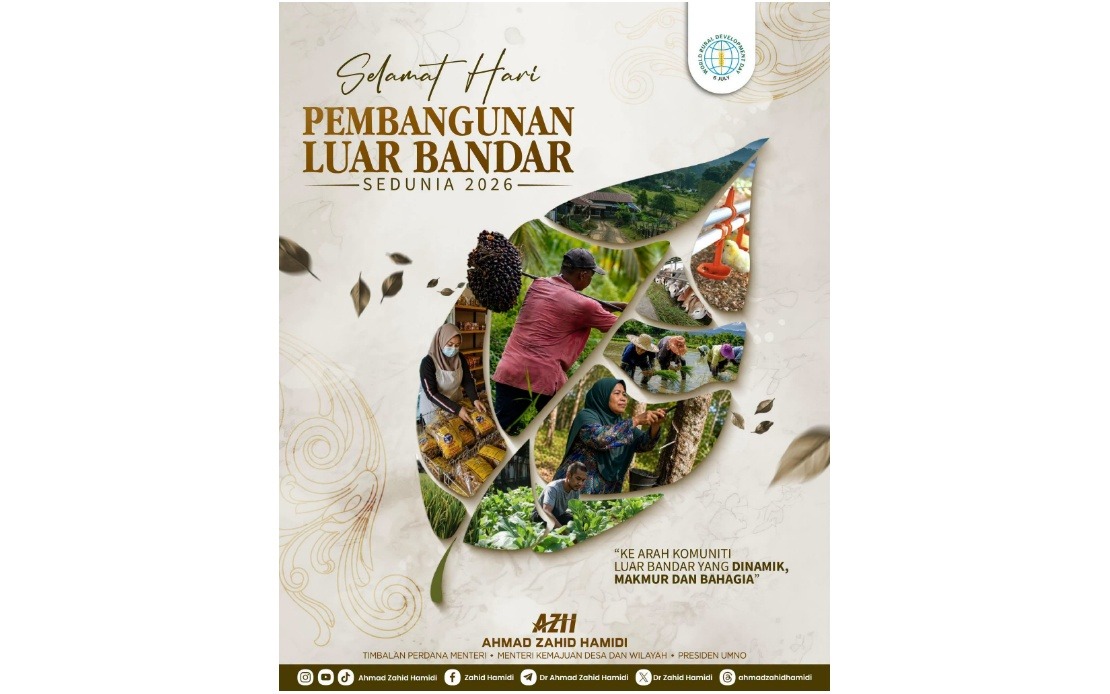
Deputy Prime Minister Datuk Seri Dr Ahmad Zahid Hamidi has spotlighted the Ministry of Rural and Regional Development (KKDW) as central to advancing rural prosperity across the nation. Speaking on the occasion of Malaysia's inaugural celebration of World Rural Development Day, Ahmad Zahid stressed that the ministry bears a crucial responsibility for implementing comprehensive rural development strategies that extend tangible benefits to communities beyond urban centres.
The Rural and Regional Development Minister articulated a vision where rural populations gain meaningful access to economic opportunities, robust infrastructure, and improved living standards that align with Malaysia's broader national development trajectory. This commitment reflects an acknowledgment that rural areas remain fundamental to the country's socioeconomic fabric, requiring sustained government attention and resources to prevent widening disparities between urban and regional communities.
Beginning in 2026, July 6 will serve as an annual focal point for recognising the contributions and potential of rural communities within Malaysia's development narrative. By designating this specific date, the government aims to elevate rural concerns from peripheral consideration to a centrepiece of national discourse. The timing reflects deliberate symbolism, as July 6 marks the founding of the Centre on Integrated Rural Development for Asia and the Pacific (CIRDAP), an institution that has shaped regional approaches to rural advancement for decades.
CIRDAP's establishment carries particular significance for Southeast Asia, as the organisation has pioneered methodologies and knowledge-sharing that have influenced rural policy across multiple countries in the region. By aligning Malaysia's observance with CIRDAP's foundation date, the government positions itself within a broader continental movement toward rural transformation. This connection also suggests Malaysia's willingness to engage with international best practices and collaborative frameworks that can enhance domestic rural development initiatives.
The inaugural World Rural Development Day celebration took place at the Tun Abdul Razak Stadium in Jengka, near Maran, Pahang, anchoring the event in a location symbolic of rural Malaysia. The choice of venue underscores the government's intention to conduct these celebrations within communities themselves rather than exclusively in capital cities, thereby fostering direct engagement with rural constituents and demonstrating tangible commitment to regional development.
Three interconnected pillars structure Malaysia's rural development strategy as articulated through the 2026 celebration framework. Community innovation represents the first pillar, recognising that rural populations possess distinctive knowledge, skills, and creative capacity that, when properly supported, can generate locally appropriate solutions to development challenges. This approach departs from top-down models that historically imposed urban-centric solutions on rural areas, instead respecting the agency and ingenuity of rural communities themselves.
Rural digitalisation forms the second pillar, acknowledging that technological access increasingly determines economic participation and quality of life. Bridging the digital divide in rural Malaysia remains an essential prerequisite for enabling farmers, small business operators, and service providers to access markets, information, and financial services. Without deliberate intervention to extend connectivity and digital literacy programmes to peripheral regions, rural communities risk falling further behind in an economy increasingly dependent on technological proficiency.
Rural entrepreneurship development constitutes the third pillar, recognising that sustainable prosperity emerges through economic diversification and locally rooted business activity rather than dependence on government transfers or single-sector employment. Supporting rural entrepreneurs requires targeted access to credit, business training, market linkages, and regulatory frameworks adapted to the scale and nature of rural enterprises. This focus reflects growing recognition that rural areas possess untapped entrepreneurial potential that, when activated, can generate employment and wealth creation within communities.
The thematic framing of the celebration—'Toward Vibrant, Prosperous and Happy Rural Communities'—encapsulates aspirational language that extends beyond purely economic metrics to encompass quality of life dimensions. Prosperity in this formulation encompasses not merely income levels but also social cohesion, cultural preservation, environmental sustainability, and individual wellbeing. This holistic perspective acknowledges that development divorced from happiness and community vitality produces hollow achievements that fail to enhance lived experience.
For Malaysian readers, particularly those in rural constituencies, this inaugural celebration signals potential shifts in government prioritisation. The elevation of rural development to commemorative status suggests budgetary and policy attention may follow. However, implementation challenges remain substantial. Translating rhetorical commitment into effective programmes requires sustained funding, skilled personnel deployment, and coordination across multiple ministries whose activities profoundly affect rural prosperity—including agriculture, transport, health, and education sectors.
Regionally, Malaysia's formalisation of World Rural Development Day participation positions the country within broader Southeast Asian conversations about rural futures. As the region grapples with urbanisation, agricultural transformation, and technological disruption, shared frameworks for addressing rural challenges become increasingly valuable. Malaysia's demonstrated commitment can facilitate knowledge exchange with neighbouring nations navigating similar rural development imperatives.
The success of this initiative will ultimately depend on whether annual observances translate into concrete policy reforms and resource allocation shifts. Rural communities require not ceremonial recognition but sustained institutional support, competitive agricultural pricing mechanisms, youth retention strategies, and infrastructure investment that makes rural life genuinely attractive. Ahmad Zahid's emphasis on KKDW's responsibility implicitly acknowledges that government agencies must deliver tangible outcomes rather than merely commemorate rural contributions to national development.

