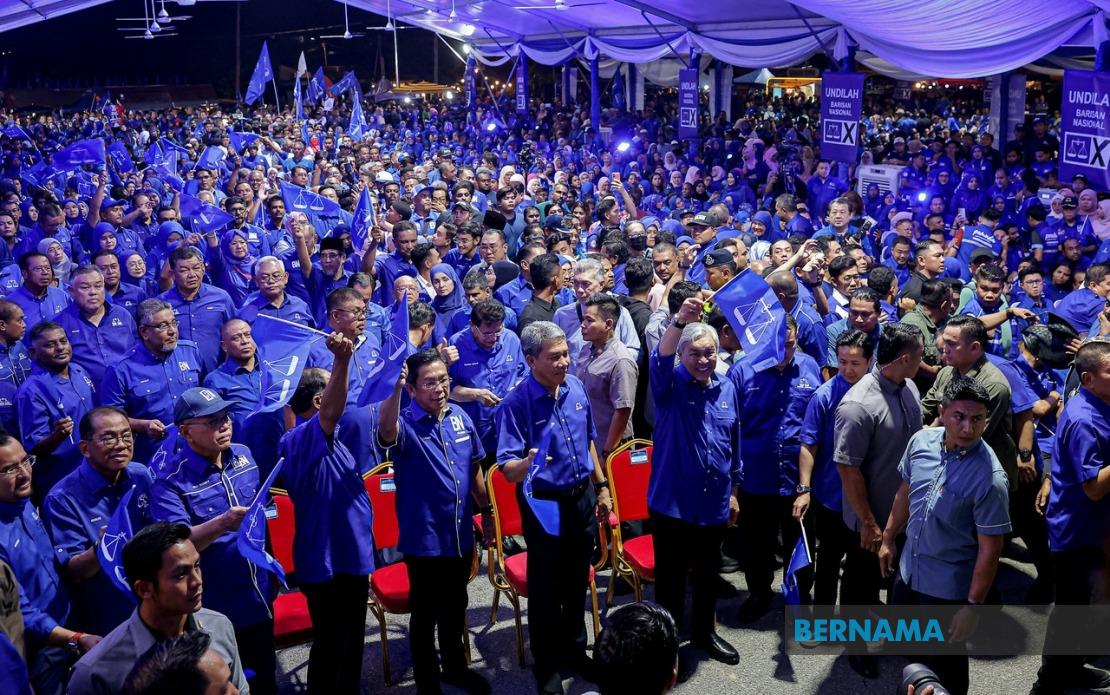
Barisan Nasional's dominant showing in Johor should provide momentum for a decisive victory in Negeri Sembilan's upcoming state election, according to coalition chairman Datuk Seri Dr Ahmad Zahid Hamidi. Speaking at the launch of BN's campaign machinery and candidate announcement in Seremban on July 15, Ahmad Zahid framed the coalition's recent Johor performance as evidence of public appetite for stable governance and economic development—qualities he argued BN was uniquely positioned to deliver across Malaysia's political landscape.
The Johor result, which delivered BN control of 48 of 56 state seats and nearly 60 per cent of the popular vote, represented the coalition's strongest showing in that state's electoral history. Ahmad Zahid characterized this outcome not merely as a regional success but as validation of BN's broader political model. He contended that voters rewarded the coalition for demonstrating competent administration, economic stewardship, and political reliability—factors likely to remain salient in other state contests. The Negeri Sembilan election, scheduled for August 1 with nomination day on Saturday and early voting on July 28, presented an immediate opportunity to extend this winning streak.
Central to Ahmad Zahid's message was the necessity of immediate, intensive ground operations. He directed party machinery to begin systematic voter engagement through door-to-door canvassing, a traditional but labor-intensive approach designed to personalize BN's appeal and identify potential supporters across diverse communities. This emphasis on organizational hustle reflected recognition that electoral victories, particularly in smaller states like Negeri Sembilan, often hinge on the efficiency and commitment of party cadres at constituency level. Ahmad Zahid's call for acceleration suggested BN leadership believed the window for campaign preparation, though narrow, remained sufficient to build decisive advantage.
The chairman attributed Johor's success fundamentally to internal coalition cohesion. He emphasized that BN's component parties—UMNO, MCA, MIC, and others—functioned as an integrated team rather than competing factions, with members trusting one another and leveraging complementary strengths. This framing carried implications for Negeri Sembilan, where historical tensions between UMNO and other BN partners had occasionally complicated campaign unity. Ahmad Zahid's explicit invocation of the Johor formula suggested leadership recognized that transferring momentum required replicating the conditions that had enabled it elsewhere, particularly the subordination of intra-coalition rivalries to collective electoral purpose.
A notable dimension of Ahmad Zahid's address involved managing internal party expectations around candidacy selection. He cautioned members against becoming consumed by speculation or grievance concerning who would represent constituencies or secure the menteri besar nomination. This injunction implied that candidate announcement processes had generated friction or disappointment within BN ranks. By reframing candidacy concerns as secondary to the overarching goal of coalition victory, Ahmad Zahid sought to redirect energy away from internal recrimination toward external campaign activities. His message essentially told aspiring candidates that organizational contribution and campaign intensity mattered regardless of selection outcomes.
The Deputy Prime Minister's confidence that BN would exceed its 2023 Negeri Sembilan performance—when it secured 14 seats—was notable given the coalition's general recovery trajectory under his leadership. That 2023 result had represented substantial underperformance relative to BN's historical dominance in Negeri Sembilan, suggesting the coalition had lost ground to opposition competitors during the post-2018 period when BN was in greater disarray. Improvement on that benchmark, while ambitious, appeared achievable if Johor momentum could be channeled effectively and if opposition consolidation remained incomplete.
For Malaysian political observers, Ahmad Zahid's strategic emphasis illuminated BN's playbook for the broader election cycle ahead. Rather than relying primarily on administrative performance or policy announcements, the coalition appeared to prioritize narrative construction around governance competence combined with intensive grassroots mobilization. The Johor victory provided both psychological advantage and practical template—evidence that BN's model worked when properly executed. Translating this into Negeri Sembilan success required demonstrating that the coalition's appeal transcended regional particularities and extended across Malaysia's diverse electoral landscape.
The timing of the Negeri Sembilan election within Malaysia's broader political calendar held strategic significance. A decisive BN victory would strengthen Ahmad Zahid's authority within UMNO and the coalition while providing psychological momentum ahead of eventual federal-level contests. Conversely, a disappointing result would invite questions about whether Johor represented sustainable resurgence or merely regional exceptionalism. The state's relatively modest size meant the contest was unlikely to reshape national political arithmetic dramatically, yet the symbolic weight attached to it by coalition leadership suggested internal stakeholders viewed it as consequential for demonstrating continued BN viability.
Among Malaysian voters, particularly in Negeri Sembilan, Ahmad Zahid's emphasis on political stability and economic growth resonated with demographic segments seeking predictable governance and material progress. The coalition's challenge lay in translating these aspirational messages into sufficient electoral support across socioeconomically and ethnically diverse constituencies. BN's performance in Johor among various demographic cohorts—Malay-Muslim voters, urban middle-class constituencies, and rural communities—would inform strategic targeting in Negeri Sembilan, where similar voter composition allowed lessons from the peninsula's southern state to apply with particular relevance.
The broader implication of Ahmad Zahid's Seremban address was that BN, having recovered substantial ground following the 2022 Ismail Sabri period and 2023 general election, was positioning itself for sustained resurgence across multiple electoral contests. The coalition under his stewardship appeared to believe it had identified an effective formula combining organizational discipline, narrative messaging around governance, and tactical campaign intensity. If Negeri Sembilan validated this approach, it would reinforce confidence among BN stakeholders and potentially attract fence-sitters viewing the coalition as ascendant. Should results disappoint, however, questions about the durability of BN's recovery and the transferability of regional successes would inevitably resurface among both party members and the broader electorate.

