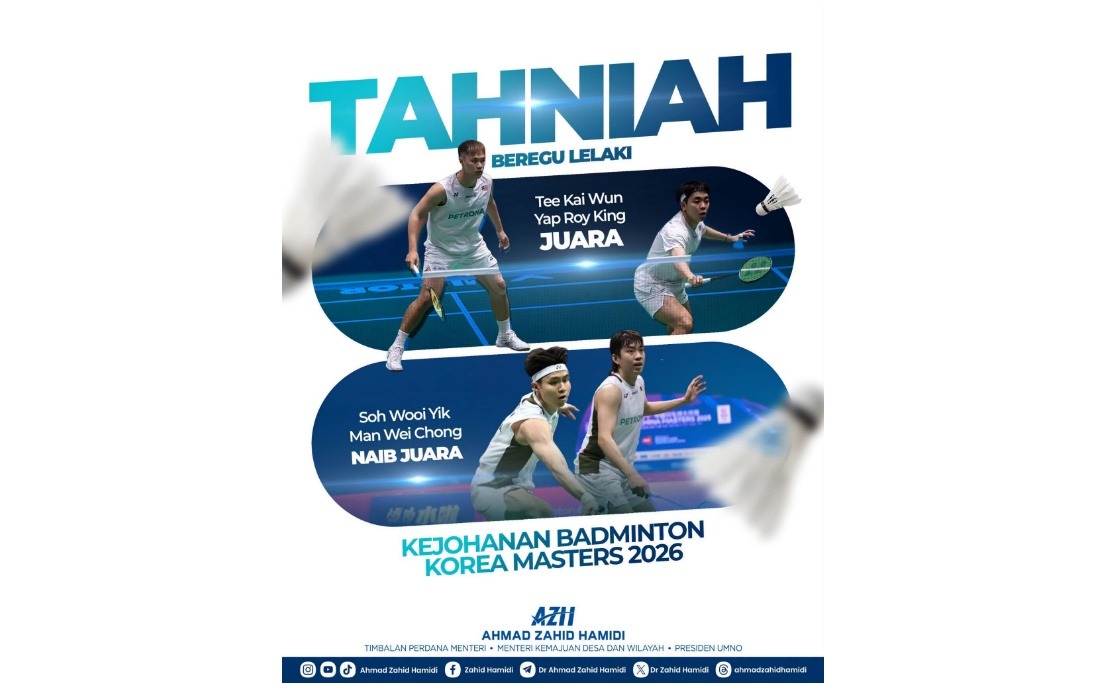
Malaysia's badminton contingent has captured both the championship and runners-up medals in the men's doubles category at the 2026 Korea Masters, prompting Deputy Prime Minister Datuk Seri Dr Ahmad Zahid Hamidi to voice his appreciation for the achievement. The tournament, held at the Yi Sun-sin Gymnasium in Asan, witnessed an all-Malaysian final that showcased the depth of talent within the national badminton programme, with Tee Kai Wun-Yap Roy King emerging as champions and their compatriots Soh Wooi Yik-Man Wei Chong settling for second place.
In his public acknowledgement, Ahmad Zahid expressed confidence that the successful performances would serve as encouragement for the athletes to persist in delivering international success for the nation. His remarks underscore the government's continued investment in sports development and the importance placed on badminton as a flagship sporting discipline in Malaysia's global representation. The Deputy Prime Minister's intervention reflects the political significance attributed to sporting victories, particularly in a discipline where Malaysia has historically commanded respect and competitive advantage across the world's major tournaments.
The winning pair of Kai Wun-Roy King recorded a dominant performance in their Korea Masters debut, dispatching their fellow Malaysians with a convincing straight-games victory of 21-13, 21-18 in just 31 minutes. The decisive margin in both sets demonstrated the pair's sharp execution and tactical superiority on the day, establishing them as emerging forces in the competitive men's doubles landscape. This inaugural appearance at the Korean tournament has now secured them a place among the international badminton elite, validating the selection and preparation strategies employed by the Badminton Association of Malaysia.
The runners-up finish by Wooi Yik-Wei Chong, though yielding to their teammates, still represents a creditable outcome that affirms Malaysia's competitive standing in the tournament. For many nations, securing both medal positions in a major international championship would constitute a significant diplomatic achievement in sports. The absence of non-Malaysian opposition in the final raises questions about the depth and resilience of badminton programmes in other countries, particularly regional rivals who have traditionally competed strongly in Southeast Asian competitions.
Malaysia's historical record at the Korea Masters now stands at two titles, with the first championship won in 2024 when Soh Wooi Yik partnered with Aaron Chia to claim the men's doubles crown. The expansion of championship-winning combinations within a relatively short timeframe suggests that the national coaching infrastructure and player development systems are yielding tangible results. The 2024 success provided a template and confidence boost that enabled the federation to field competitive pairs across multiple tournaments, spreading the success across different partner combinations rather than relying on a single dominant duo.
The significance of the Korea Masters extends beyond mere tournament rankings within the professional badminton circuit. Major tournaments in East Asia serve as crucial testing grounds for players from the region, offering exposure to different styles of play and pressure situations that characterise world-class competition. For Malaysian players, success in Korea carries particular weight given South Korea's own legendary badminton heritage and the consistent competitiveness of Korean shuttlers across both singles and doubles categories.
The badminton achievements arrive at a time when Malaysian sports administration faces broader questions about resource allocation and strategic planning. Investment in badminton has traditionally enjoyed strong government support, given the sport's cultural resonance and consistent medal returns compared to other disciplines. The Korea Masters result will likely strengthen arguments from badminton officials seeking continued or enhanced funding for player development, coaching staff, and international competition schedules.
From a regional perspective, Malaysia's domination of the Korea Masters men's doubles final carries implications for competitive balance in Southeast Asian badminton. Nations such as Indonesia and Thailand have historically fielded competitive players across multiple disciplines, yet the Malaysian pair's one-sided victory suggests potential gaps in the development pipelines of rival countries. This could reflect different strategic choices about resource concentration, demographic factors influencing player recruitment, or shifts in coaching methodology and training intensity across the region.
The public recognition from Ahmad Zahid also signals the government's acknowledgment of grassroots and youth badminton programmes that funnel talent into elite competition. The emergence of new champion pairs indicates that player development systems are functioning effectively at multiple levels, from junior tournaments through regional championships to international circuits. This pipeline approach ensures that Malaysia maintains a renewable source of competitive talent rather than depending solely on established stars.
Looking forward, the success of Kai Wun-Roy King at their Korea Masters debut sets expectations for sustained performance at comparable tournaments. Malaysian badminton typically targets major championships such as the Thomas Cup, Sudirman Cup, and All England Open, where men's doubles specialists play crucial roles in team success. Performances at secondary but prestigious tournaments like the Korea Masters thus serve as important barometers of player form and readiness for major competitions that determine national rankings and team selection.
The all-Malaysian final also provides valuable preparation data for the Badminton Association's coaching and administrative staff. Match analysis from competitive encounters between Malaysian pairs at international tournaments offers insights into relative strengths, technical gaps, and tactical innovations that individual players might employ when facing foreign opposition. Such domestic competition within the elite tier strengthens the overall competitive environment and pushes players to continuously refine their game.
Ahmad Zahid's message of gratitude to all parties involved in supporting the athletes reflects the collaborative nature of modern sports achievement, encompassing coaches, physiotherapists, medical staff, administrators, and family support systems. Public acknowledgment of this broader ecosystem reinforces cultural attitudes towards sports as a legitimate avenue for national pride and personal achievement, potentially encouraging young Malaysians to pursue badminton seriously.

