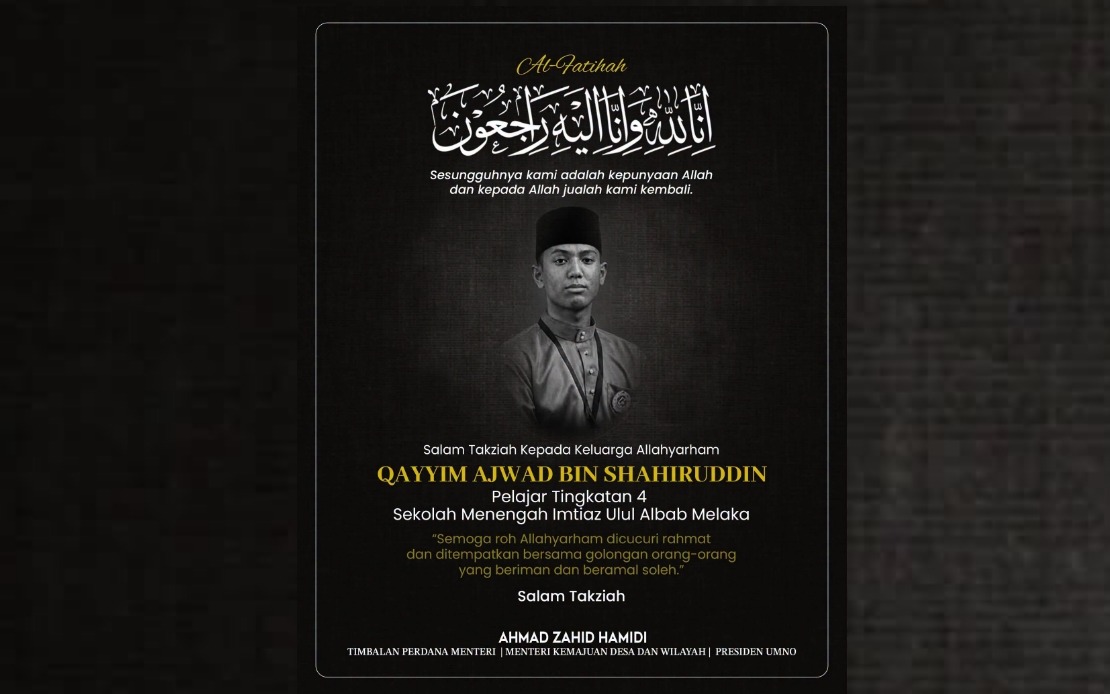
Deputy Prime Minister Datuk Seri Dr Ahmad Zahid Hamidi has offered his condolences to the family of Qayyim Ajwad Shahiruddin, a student from SM Imtiaz Ulul Albab in Melaka, who passed away on July 26 from complications arising from a road accident that occurred earlier in the month. The young man's death marks a tragic conclusion to an incident that claimed one life among a school group and left others struggling with ongoing treatment for injuries sustained in the collision.
In a statement posted on social media, Ahmad Zahid characterised the student's death as a significant and deeply felt loss, emphasising the emotional weight of such tragedies affecting the school community. Beyond expressing his personal sorrow, he extended his hopes for the complete recovery of the remaining victims who continue to receive medical care following the incident. His remarks reflected both official sympathy and a personal connection he maintains with the institution.
The Deputy Prime Minister drew attention to his relationship with the school by highlighting the bond between himself and its student population. He portrayed the students as occupying a special place in his affections, suggesting that developments concerning their welfare hold particular significance for him. This characterisation underscored the emotional dimensions of his response beyond standard condolence messaging, positioning the tragedy within a framework of personal investment in the school community's wellbeing.
Ahmad Zahid called upon members of the broader community to observe religious observances in memory of the deceased student. His invocation of al-Fatihah, the opening chapter of the Quran traditionally recited for the deceased in Islamic tradition, represented a spiritual dimension to his condolence message. He prayed that divine mercy would encompass the departed soul, that transgressions would be forgiven, and that righteous deeds would be recognised and rewarded in the afterlife according to Islamic belief.
The road accident that precipitated this tragedy occurred on July 8 in Solok Duku, Melaka, during what was described as a return journey from a table tennis competition. The incident involved a collision between a private vehicle and a lorry, affecting a group that comprised not only students but also an accompanying teacher from the school. The particular vulnerability of the group—composed primarily of young people and an educator—added another layer of concern to what was already a serious traffic incident.
The competition had been hosted at Sekolah Jenis Kebangsaan Cina (SJKC) Cheng, suggesting this was an inter-school sporting engagement involving multiple educational institutions across the region. Such tournaments are common features of Malaysian school calendars and typically represent cooperative efforts among educational establishments to promote student engagement in sports and healthy competition. The incident serves as a stark reminder of the risks inherent in transporting groups of students over distances, however routine such journeys may be.
SM Imtiaz Ulul Albab itself operates as a secondary-level Islamic institution in Melaka, serving as an educational centre within the state's broader schooling landscape. The school's particular focus and character make it distinct within Malaysia's diverse educational ecosystem, which encompasses various types of institutions serving different communities and offering differentiated curricula. The involvement of staff and multiple students from the same institution in a single accident created a concentrated impact on the school's population.
The incident and its fatal outcome underscore ongoing concerns within Malaysia regarding road safety, particularly concerning the transportation of vulnerable populations such as schoolchildren. While regulatory frameworks exist governing vehicle operations and road use, enforcement and adherence remain persistent challenges across the country. Deaths resulting from road accidents, especially those involving young people during organised school activities, continue to generate discussion about preventative measures and risk mitigation strategies.
For the Melaka community and the broader Malaysian education sector, this tragedy represents a painful reminder of the fragility of life and the devastating consequences that can result from road incidents. Schools nationwide conduct various activities and excursions as part of their educational programming, with such undertakings generally considered routine components of school life. However, incidents like this collision force reassessment of safety protocols and risk assessment procedures surrounding student transportation.
The response from high-level government figures such as the Deputy Prime Minister reflects institutional acknowledgement of such tragedies and the importance placed on public acknowledgement of grief within affected communities. Such gestures, while symbolic, serve to validate the loss experienced by families and school communities while potentially spurring broader discussions about prevention and safety improvement. Ahmad Zahid's comments positioned the incident within frameworks of both personal sympathy and potential catalyst for systemic reflection on student safety protocols.

