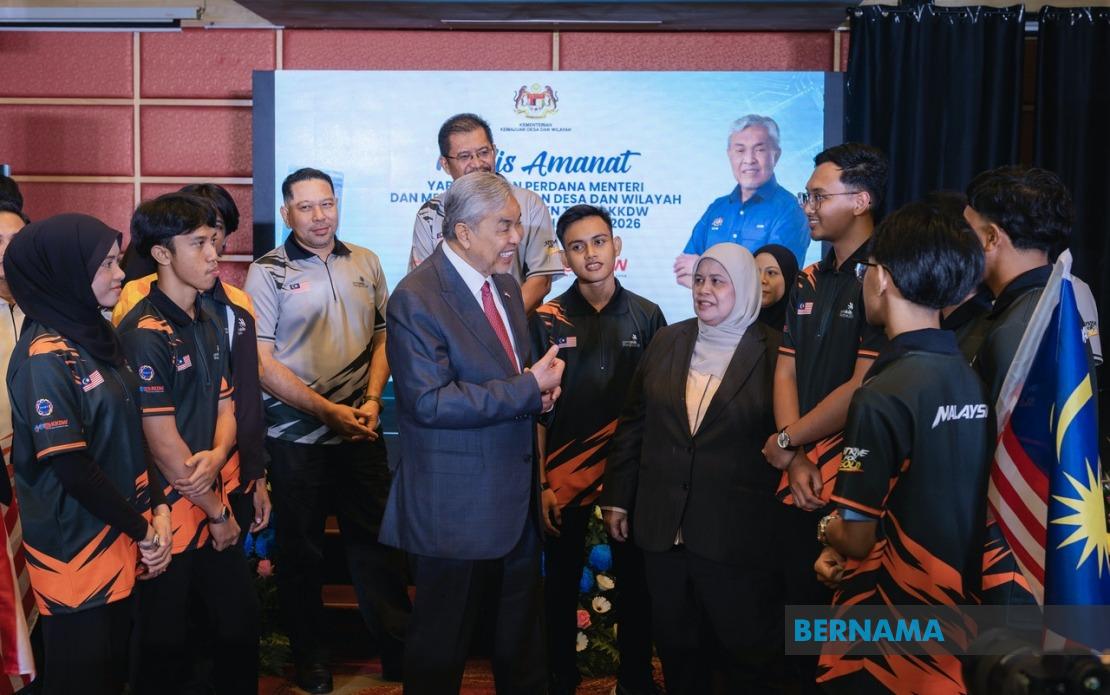
Deputy Prime Minister Datuk Seri Dr Ahmad Zahid Hamidi has made an ambitious personal pledge to underwrite umrah pilgrimages for Malaysian technical and vocational students who achieve gold medals at the WorldSkills Competition 2026 in Shanghai, China, scheduled for September 22 to 27. The commitment represents a notable incentive structure designed to galvanise the nine TVET representatives selected to compete across various skill disciplines at the international event.
Ahmad Zahid, who simultaneously holds the Rural and Regional Development portfolio, announced that the sponsorship programme would extend beyond the medallists themselves to encompass their parents, with funding sourced entirely from his personal resources. Speaking at a briefing with the TVET@KKDW contingent here, the Deputy Prime Minister emphasised that the gesture constitutes a tangible expression of gratitude for the participants' dedication and the pride they bring to Malaysia through international competition. The announcement underscores official recognition of technical vocational excellence as a national priority warranting ministerial-level acknowledgment.
The scope of Ahmad Zahid's pledge becomes particularly significant when contextualised against Malaysia's nine-strong delegation to Shanghai. Should every representative secure gold medals in their respective categories, the Deputy Prime Minister would finance umrah pilgrimages for eighteen individuals—the nine competitors and their parents combined. This all-or-nothing framing suggests confidence in the calibre of Malaysia's TVET talent pipeline, though it also reflects the considerable investment the government places in these international technical showcases.
WorldSkills competitions serve as crucial benchmarks for vocational education systems across Asia-Pacific and beyond. Malaysia's participation in these biennial events has historically provided international exposure for technical expertise developed within the TVET ecosystem. The Malaysian contingent competing in Shanghai encompasses a diverse skill portfolio spanning fashion technology, automotive refinishing, electronics, cybersecurity, rail vehicle maintenance, cabinetmaking, digital construction methodologies, electrical installation, and mechanical engineering design—sectors representing both traditional and emerging technical disciplines.
The nine participants represent distinct TVET institutions within the Ministry of Rural and Regional Development's purview. Nadratulliyana Ab Malek competes in Fashion Technology, while Haziq Syahmi Nazri brings expertise in Automobile Painting. The cybersecurity portfolio falls to Mohammad Ezaly Iman Ramli, addressing the digital skills gap increasingly recognised across Southeast Asian economies. Electronics expertise is represented by Amirul Sharif Sharifudin, and rail vehicle technology by Wan Hamiz Ozai Wan Hamidzi. Complementing this technical breadth, Khairul Idham Bahari specialises in Cabinetmaking, Muhamad Nashrul Zulkifli in Digital Construction, Muhammad Haziq Lailla Zamri in Electrical Installations, and Muhammad Huzairy Mohamad Thes in Mechanical Engineering CAD.
Deputy Rural and Regional Development Minister Datuk Rubiah Wang's presence at the announcement underscores institutional commitment to supporting the delegation. The Ministry of Rural and Regional Development has positioned TVET education as instrumental to inclusive economic development, particularly in addressing skills deficits in provincial and peripheral regions. WorldSkills participation aligns with this mandate by elevating technical vocational pathways as career alternatives to traditional academic trajectories.
For Malaysian TVET students, international competition platforms like WorldSkills 2026 offer unprecedented visibility and validation within global technical communities. Success at such venues generates international credentials that enhance employment prospects both domestically and in regional labour markets. The umrah sponsorship, beyond its religious and cultural significance for Muslim participants and their families, functions as tangible recognition that technical excellence receives acknowledgment comparable to achievements in academic or sporting domains.
The timing of this announcement—months before the Shanghai competition—serves strategic purposes beyond immediate incentivisation. It signals to prospective TVET students that technical vocational pathways attract ministerial-level support and lead to opportunities for recognition and reward. This messaging proves particularly important in the Malaysian context, where perceptions of TVET as a secondary educational choice relative to university pathways persist despite growing employer demand for technical skills across manufacturing, construction, and digital sectors.
WorldSkills competitions also function as quality assurance mechanisms for TVET curricula and instructor training. International judging standards expose gaps between Malaysian technical education outputs and global industry benchmarks. Success at Shanghai would validate current pedagogical approaches within the Ministry's TVET institutions, while any shortcomings would provide diagnostic information for curriculum refinement. Ahmad Zahid's pledge implicitly expresses confidence that Malaysian TVET training meets competitive international standards.
Regionally, Malaysia's performance at WorldSkills 2026 carries implications for Southeast Asian technical education positioning. Competing nations increasingly view these competitions as indicators of vocational system health and workforce preparedness for manufacturing and technology sectors. A strong Malaysian showing would reinforce the country's credentials as a regional technical skills hub, potentially attracting regional student exchange programmes and facilitating collaboration agreements with partner economies.
The personal nature of Ahmad Zahid's funding commitment distinguishes this incentive structure from routine government-sponsored awards. By channelling sponsorship through his individual resources rather than ministerial budgets, the Deputy Prime Minister creates a more immediate and direct relationship with recognising achievement. This approach may also circumvent bureaucratic procurement processes that typically accompany government-funded religious pilgrimages, enabling speedier disbursement should gold medals materialise.
Looking forward, the WorldSkills 2026 Shanghai competition will test whether Ahmad Zahid's optimism regarding Malaysian TVET capacity translates into medal-winning performances. The contingent carries elevated expectations following this high-profile pledge. Regardless of outcomes, the announcement reflects Malaysia's continued commitment to positioning technical vocational education as a cornerstone of human capital development, with senior political figures actively championing excellence in this increasingly vital economic domain.

