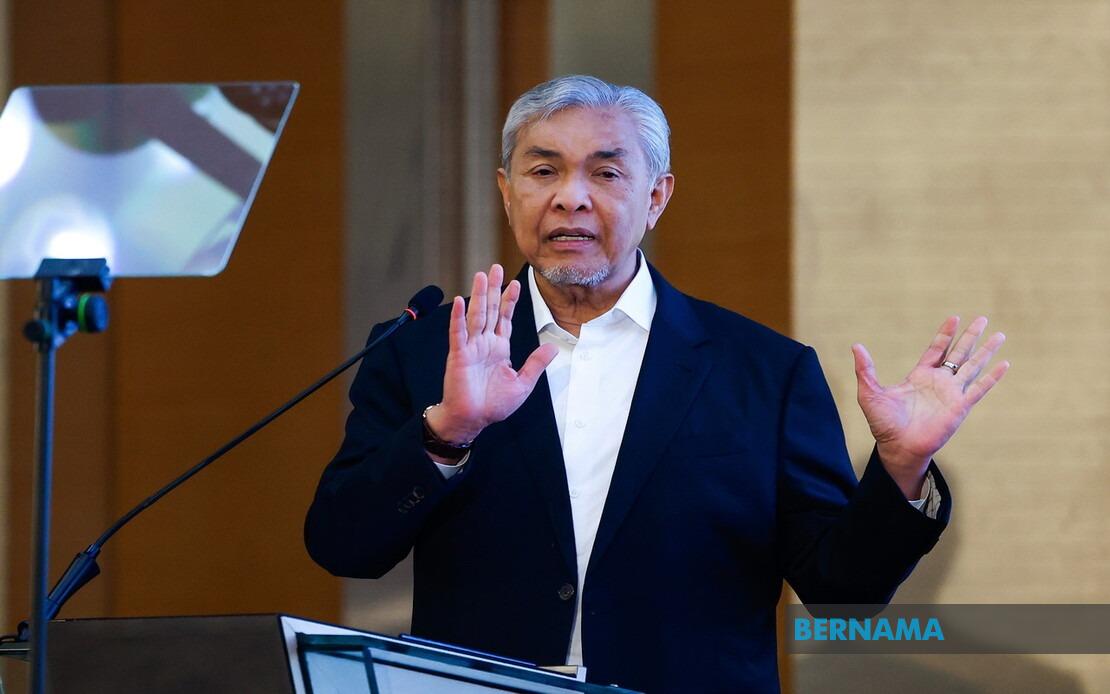
Deputy Prime Minister Datuk Seri Dr Ahmad Zahid Hamidi has issued a direct appeal to all political parties involved in the Negeri Sembilan state election to uphold respect for the monarchy and steer clear of contentious matters pertaining to race, religion, and royalty throughout their campaign activities. Speaking in Seremban on July 27, Ahmad Zahid stressed that the guidance issued by the Negeri Sembilan Palace should be treated with the utmost seriousness and observed by every contesting party, setting a clear expectation for the conduct of the electoral process in the state.
The Deputy Prime Minister's statement came in response to a palace advisory directing all participating political coalitions to refrain from incorporating the royal institution into their ceramah sessions and campaign messaging. This pre-emptive reminder from the Palace reflects longstanding constitutional conventions in Malaysia that seek to maintain the separation between electoral politics and the revered institution of the Malay Rulers. The directive carries significant weight, as it establishes a moral and institutional boundary that transcends normal party-political competition and appeals to the broader principle of protecting Malaysia's foundational constitutional pillars.
Ahmad Zahid underscored Barisan Nasional's consistent approach to electoral campaigns, asserting that the coalition has maintained a principled stance of never weaponising issues related to race, religion, or the monarchy for political gain. He emphasised the fundamental importance of preserving the constitutional framework surrounding the institution of the Malay Rulers, noting that this principle applies with particular force to Negeri Sembilan's specific institutional arrangements involving the Undang Yang Empat. By positioning BN's conduct as inherently respectful towards these institutions, Ahmad Zahid sought to establish a moral framework that might influence the behaviour of other contesting parties.
The remarks suggest an awareness within the coalition that certain parties might be tempted to venture into sensitive territory during campaigning. Ahmad Zahid's cautionary tone appears calibrated to discourage such approaches without naming specific parties, though observers may read implicit reference to opposition groups that have occasionally navigated close to controversial ground in previous electoral contests. The Deputy Prime Minister's framing implies that raising 3R issues serves no constructive electoral purpose and merely damages the social fabric without advancing genuine policy debate.
The Negeri Sembilan Palace's intervention is itself noteworthy, representing an unusual but not unprecedented instance of the royal institution stepping forward to establish campaign parameters. In the Malaysian constitutional context, the rulers occupy a position of significant symbolic authority, and their guidance carries weight that extends beyond formal legal structures. The palace's proactive stance suggests concern about the potential for electoral competition to encroach upon matters that ought to remain outside the realm of partisan contestation. This approach reflects broader institutional concerns about maintaining boundaries between democratic politics and the constitutional monarchy.
Ahmad Zahid also moved to dismiss speculation about tensions between Barisan Nasional and Perikatan Nasional that allegedly prevented the two major coalitions from forging an electoral alliance for the Negeri Sembilan contest. The BN chairman characterised suggestions of conflict between the coalitions as inaccurate, instead describing their relationship as fundamentally cordial and grounded in mutual understanding. This denial appears designed to project an image of stability within Malaysia's political establishment, even as the two coalitions compete against each other in electoral contests.
The framing of inter-coalition relations as harmonious despite electoral competition reflects a particular vision of Malaysian politics where major political groupings maintain pragmatic working relationships while contesting for power in specific elections. Such an arrangement, while perhaps unusual in other democracies, aligns with Malaysia's Westminster-influenced system where coalitional flexibility and consensus-building among major players has historically characterised governance arrangements. Ahmad Zahid's assertion that no substantive dispute exists between BN and PN suggests that electoral competition can occur within a framework of fundamental institutional agreement about Malaysia's constitutional structures and democratic processes.
The emphasis on avoiding 3R issues carries particular resonance in Negeri Sembilan, where the state has traditionally maintained relatively harmonious communal relations and where the role of the Undang Yang Empat represents a distinctive institutional feature. The state's electoral politics have generally avoided the polarisation seen in other states, and the palace's reminder serves to reinforce this tradition. For campaign strategists, the directive effectively constrains the tactics available to parties, redirecting electoral competition towards policy platforms, economic performance, and administrative competence rather than identity-based messaging.
From a broader Southeast Asian perspective, Malaysia's approach to maintaining boundaries around sensitive constitutional matters during electoral competition offers an instructive model, albeit one that depends heavily on elite consensus and institutional respect. The palace's role in establishing campaign parameters demonstrates how constitutional monarchies can exercise soft institutional influence to shape political behaviour without resorting to formal legal sanctions. However, such arrangements also rely on sufficient political maturity and institutional confidence among competing parties, factors that cannot be guaranteed indefinitely.
The Negeri Sembilan election thus unfolds within a carefully demarcated institutional framework designed to protect core constitutional arrangements from electoral contestation. Ahmad Zahid's public reinforcement of these boundaries aligns Barisan Nasional with the palace's expectations while potentially placing other parties under implicit pressure to observe the same conventions. Whether all contesting groups will respect these parameters throughout the campaign period remains to be seen, though the pre-emptive nature of both the palace's advisory and the Deputy Prime Minister's statement suggests institutional determination to maintain these boundaries. The approach reflects confidence in Malaysia's democratic institutions while simultaneously acknowledging that certain matters warrant protection from the ordinary processes of electoral competition.

