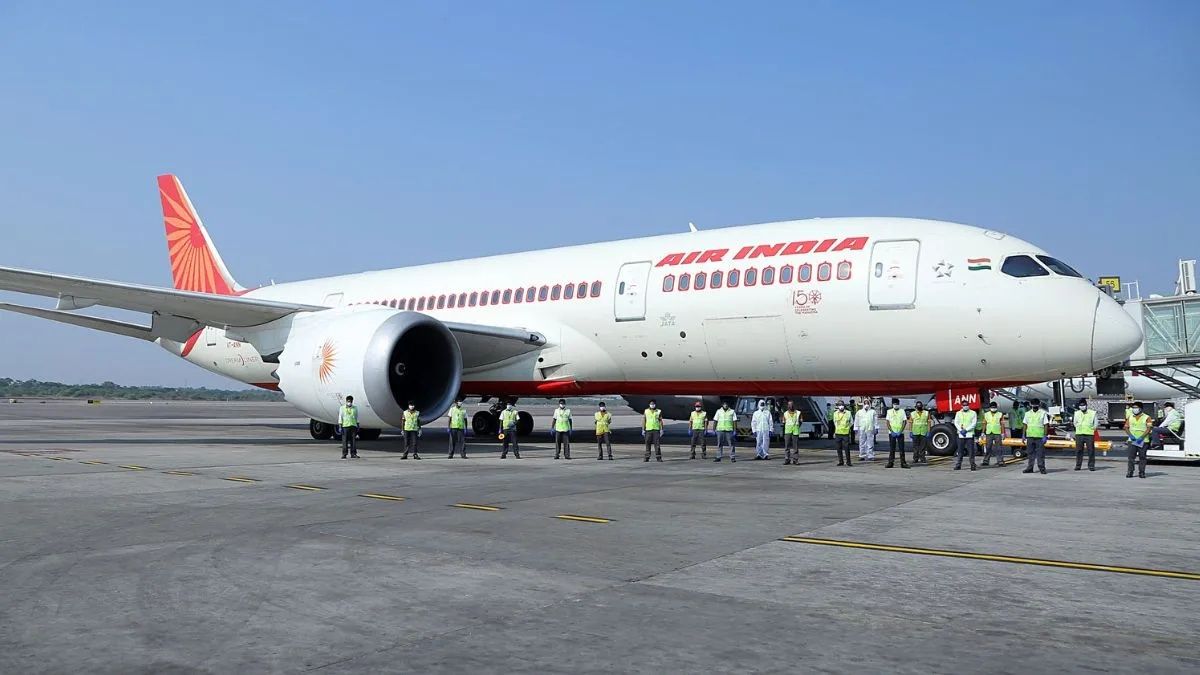
A navigation system failure caused an Air India flight to briefly penetrate Pakistani airspace on Monday night, prompting swift coordination between Indian and Pakistani air traffic authorities to ensure the aircraft's safe return to Indian territory. Flight AI-463, an Airbus A321 operating the Delhi-Amritsar service, encountered the technical malfunction shortly after departing from New Delhi's Indira Gandhi International Airport at 9.18pm on June 22, with aviation officials confirming the incident to the media on Wednesday, June 24.
The technical snag disrupted the aircraft's onboard navigation capabilities, causing the flight path to drift westward across the international border separating the two nations. Rather than remaining undetected, the deviation was quickly identified by Pakistani Air Traffic Control, whose personnel immediately coordinated with the flight crew to communicate the airspace breach. The pilots responded swiftly to the alert, correcting their course and guiding the Airbus back across the boundary into Indian airspace without further complications, according to a senior airport official who spoke on condition of anonymity.
The incident underscores the critical importance of real-time communication between neighbouring air traffic authorities, particularly in the densely trafficked South Asian region where flight corridors intersect with geopolitical sensitivities. The prompt Pakistani alert system and professional conduct of both Pakistani and Indian air traffic personnel prevented what could have escalated into a more serious diplomatic or operational incident. Such cooperation, though routine in international aviation, remains noteworthy in the context of India-Pakistan relations, where military and civilian aviation operates under heightened scrutiny.
However, the aircraft's problems did not end with its return to Indian airspace. As the flight approached Sri Guru Ram Dass Jee International Airport in Amritsar around 10.30pm, controllers discovered that the airport's airspace was experiencing significant traffic congestion, leaving no immediate landing slot available. The combination of the navigation failure, the westward deviation, and the subsequent course correction had already consumed additional time, putting the flight further behind schedule. Air traffic controllers, operating under strict safety protocols, instructed the pilot to divert the aircraft back to Delhi rather than hold it in a holding pattern over congested airspace.
The decision to return to the capital reflected both operational prudence and the need for additional inspection of the aircraft's systems following the navigation malfunction. Upon landing in Delhi, the Airbus underwent mandatory technical inspection to identify the precise nature of the navigation system failure and to verify that all other aircraft systems remained fully operational. This delay, while frustrating for passengers, represents standard procedure in international civil aviation, where safety considerations invariably take precedence over schedule adherence.
After receiving the necessary clearances from maintenance personnel and air traffic authorities, the flight was released to resume its journey to Amritsar. The aircraft departed Delhi again in the early morning hours and finally touched down safely at Amritsar airport at approximately 2.20am on Tuesday, June 23, completing a journey that had extended nearly four hours beyond its originally scheduled arrival time. Throughout the extended ordeal, the aircraft's flight crew maintained operational composure and followed prescribed protocols, contributing to the incident's safe resolution.
As of the time of reporting, neither Air India nor India's Directorate General of Civil Aviation (DGCA) has released formal statements detailing the specific technical nature of the navigation system failure. The absence of immediate official disclosure is not unusual, as aviation authorities typically conduct thorough investigations before making public statements about technical incidents. Such investigations serve multiple purposes: identifying the root cause of the malfunction, determining whether systemic issues exist across the wider fleet, and establishing whether maintenance or procedural improvements are necessary.
Aviation authorities have initiated a routine investigation into the exact circumstances surrounding the route deviation, examining factors ranging from the initial system malfunction through the crew's response and the broader operational context. These investigations typically involve reviewing flight data recorders, maintenance logs, and personnel interviews to construct a comprehensive understanding of the sequence of events. For Malaysian and Southeast Asian aviation professionals and observers, such incidents provide valuable learning opportunities about navigation system vulnerabilities and the importance of redundant safety systems.
The Delhi-Amritsar route, while relatively short, operates within a region where airspace management remains complex due to multiple air traffic flows and proximity to international boundaries. The incident highlights the continuous challenges that regional carriers and air traffic authorities face in maintaining safe operations while managing increasing passenger volumes and maintaining strict adherence to flight corridors. The professional response from both Indian and Pakistani authorities demonstrates that despite occasional tensions between the two nations, aviation safety cooperation remains functional and effective.
This event follows a similar incident approximately one month prior, when a Pakistan International Airlines flight briefly entered Indian airspace due to adverse weather conditions. That earlier occurrence saw Indian air traffic controllers successfully guide the aircraft back to its designated flight path, establishing a pattern of professional mutual cooperation in airspace management. These incidents, while relatively minor in terms of outcomes, collectively illustrate the inherent challenges of operating commercial aviation in the India-Pakistan region and the critical importance of maintaining robust communication channels and professional standards among air traffic authorities.