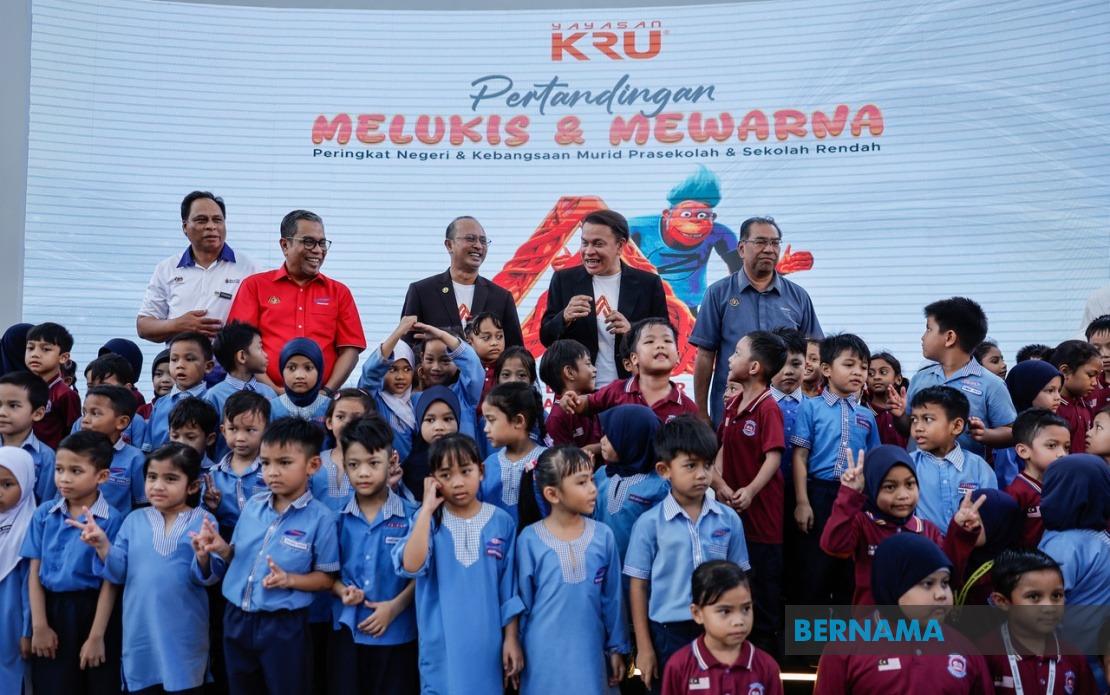
Yayasan KRU's latest initiative, the 2026 Kreatif Aspirasi Reka (AKAR) Awards, has achieved recognition from the Malaysia Book of Records by mobilising the largest cohort of preschool children ever recorded in a nationwide colouring competition. The achievement underscores Malaysia's capacity to coordinate large-scale educational and creative programmes across diverse institutional networks, bringing together more than 153,000 young participants from KEMAS and Unity kindergartens in simultaneous events throughout the country.
The scale of participation reflects substantial organisational coordination involving multiple government agencies and development bodies. The Education Ministry (MOE), Community Development Department (KEMAS), National Higher Education Fund Corporation (PTPTN), and the Department of National Unity and National Integration (JPNIN) collaborated to support the initiative. This multi-stakeholder approach demonstrates how creative and developmental programmes can harness existing early childhood infrastructure to achieve national participation milestones whilst maintaining quality and simultaneity across states.
Beyond the recordbreaking numbers, the AKAR 2026 competition integrates environmental education with artistic development through its "I Love Orangutans" campaign. This thematic approach introduces preschool children to conservation concepts during formative years, aligning creative activities with Malaysia's environmental commitments. Orangutan protection resonates particularly strongly in the Malaysian context given the species' presence in Borneo and the nation's biodiversity heritage, making the campaign locally relevant whilst embedding ecological awareness in early childhood programmes.
Yayasan KRU Board of Trustees president Datuk Norman Abdul Halim positioned the achievement as a watershed moment for the foundation, emphasising that the programme's success reflected coordinated support across institutional partners. His remarks highlighted how nurturing childhood creativity serves broader national development objectives, particularly in developing capabilities needed for competitive advantage in increasingly knowledge-driven economies. The framing suggests that early creative expression development is being treated as strategic human capital investment rather than peripheral enrichment activity.
A distinctive feature of AKAR 2026 lies in its financial incentivisation structure, which directly benefits participating children and their families. Prize allocations totalling approximately RM100,000 will be distributed across state and national levels, with winnings deposited into the National Education Savings Scheme (SSPN) accounts of recipients. This mechanism transforms the competition from merely recognitional into economically meaningful for participants, whilst leveraging SSPN infrastructure to reinforce long-term educational savings behaviour among preschool families.
The competition's advancement pathway culminates in national finals scheduled for August 29 in Putrajaya, where state-level champions compete for additional recognition and prizes. The top-placing participant receives RM3,000, a substantial sum for a preschool-level competition that underscores the initiative's commitment to meaningful reward structures. This tiered progression from state to national levels mirrors formal education competition frameworks, potentially introducing children to structured advancement pathways during their early developmental years.
MOHD Hanafiah Man, KEMAS director-general, situated the programme within broader national skills development discourse, asserting that creativity constitutes an essential competency for cultivating competitive generations. His perspective reflects evolving educational thinking that moves beyond traditional academic metrics to encompass creative and innovative capacities. For Malaysian early childhood educators, this institutional validation of creativity's developmental importance may influence curriculum emphases and pedagogical approaches across KEMAS facilities nationwide.
The programme's simultaneity across jurisdictions demonstrates Malaysia's technical and organisational capacity to execute coordinated national initiatives. Orchestrating 153,000 preschool children to participate in synchronised activities requires substantial logistical coordination, training of educators, supply chain management, and quality assurance protocols. This operational achievement merits recognition as evidence of system maturity in translating centralised policy directives into decentralised execution across diverse geographical and institutional contexts.
For Southeast Asian observers, AKAR 2026 illustrates how developing nations can leverage existing institutional infrastructure—preschool networks, development agencies, education systems—to create high-impact programmes that simultaneously serve multiple policy objectives. The initiative advances early childhood development, environmental consciousness, financial literacy through SSPN participation, creative expression, and social cohesion through the nationwide participation element. This multivalent approach maximises return on institutional investment and demonstrates policy integration across traditionally siloed government functions.
The Malaysia Book of Records recognition carries significance beyond prestige, as it formalises the achievement within national record-keeping systems and creates comparable benchmarks for future initiatives. Other nations' early childhood programmes now possess a quantified target, potentially inspiring replication or adaptation across the region. The record itself becomes a source of institutional pride for participating agencies and might influence policy support trajectories for comparable programmes.
Looking forward, the AKAR model's success raises questions about sustainability and expansion. Maintaining 153,000-participant participation levels annually requires sustained funding, institutional commitment, and ongoing educator capacity development. Whether Yayasan KRU and partner agencies intend AKAR 2026 as a singular achievement or inaugural annual programme remains unclear, but the Malaysia Book of Records milestone establishes a significant baseline against which future iterations will be measured. The programme's environmental education component also positions it within Malaysia's broader climate action and biodiversity conservation frameworks, potentially attracting enhanced support from agencies prioritising environmental goals.

