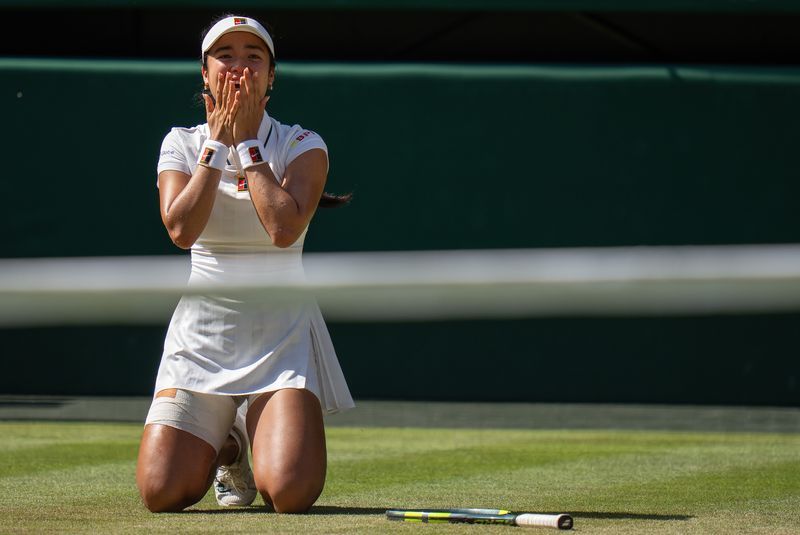
Alexandra Eala's breakthrough at Wimbledon represents a watershed moment not just for Philippine tennis, but for the nation's broader sporting ambitions. The 21-year-old's stunning victory over Poland's Iga Swiatek on Saturday catapulted the 29th seed into the fourth round of a Grand Slam tournament, marking her deepest run at the sport's most prestigious championships. For a country where Manny Pacquiao's legendary boxing career has long dominated the conversation around international sporting success, Eala's emergence signals that excellence across diverse athletic disciplines is within reach for aspiring Filipino competitors.
The magnitude of Eala's accomplishment extends well beyond the grass courts of the All England Club. Swiatek arrives at major tournaments as one of tennis's elite competitors, yet Eala dispatched her with the fearless precision that has become her hallmark. The victory follows a trajectory of steady improvement that has captured the imagination of audiences at successive Grand Slams, where growing crowds have gathered to observe not merely her technical proficiency but her composed demeanor away from competition. In an age when athlete personalities often overshadow their performances, Eala has constructed a compelling narrative around authenticity and genuine connection with supporters.
What distinguishes Eala's message from conventional sporting inspiration is her explicit rejection of the imitation model. Rather than positioning herself as a template for replication, she challenges younger athletes to identify their own unique pathways to excellence. During her post-match press conference, she articulated this philosophy with striking clarity, emphasizing that she wished to inspire others to become the first version of themselves rather than the next iteration of her. This philosophy carries particular resonance in Philippine sports culture, where pathways to international prominence have historically felt singular and restricted. By deliberately encouraging individuality and self-directed ambition, Eala implicitly critiques the notion that only one dominant figure can represent a nation's sporting prowess.
The emotional intensity of her victory underscored the significance of the moment. Eala collapsed to the court in tears immediately after securing the win, a visceral expression of the weight she carries as a rising figure in Philippine sports. Yet this emotional catharsis did not translate into complacency or satisfaction with the achievement. Even as she wiped away tears during her courtside interview, she maintained the mental compartmentalization necessary for continued competition, recognizing that celebrating too extensively risked undermining her focus for the upcoming challenge against 2024 runner-up Jasmine Paolini.
Eala's psychological approach to tournament progression reveals a maturity that distinguishes elite competitors from merely talented ones. She describes her capacity to transition from celebration to concentration as an almost instinctive skill, though one requiring deliberate cultivation. This framework suggests that her success derives not merely from raw technical ability but from a disciplined approach to managing the emotional demands of high-level sport. For Philippine athletes often competing against more established international rivals with superior training infrastructure, this emphasis on psychological resilience offers valuable insight into how competitive advantages can be constructed through mental fortitude rather than exclusive material resources.
The broader implications for Philippine sports extend beyond tennis. Eala's prominence on the international stage provides tangible evidence that Filipino athletes can compete at the highest echelons of individual sports against the world's finest competitors. Her journey challenges historical narratives suggesting that Philippine sporting success remains confined to boxing and team sports. By establishing herself on the women's professional tennis circuit, she opens conceptual space for future generations to pursue excellence across diverse athletic fields without feeling compelled to follow established pathways.
For Malaysian and Southeast Asian observers, Eala's trajectory offers instructive lessons regarding talent development and athlete management. Her ascent has occurred within a relatively nascent professional framework for Philippine tennis, suggesting that systematic investment in infrastructure and coaching can yield remarkable returns. Nations across the region investing in tennis development programs might observe how Eala's combination of technical training, mental conditioning, and strategic tournament selection has accelerated her progression toward elite status.
The commercial and cultural dimensions of Eala's emergence merit consideration as well. Traditional sporting heroes in the Philippines have typically emerged from boxing or basketball, both fields with established international pathways and substantial global audiences. Tennis, while globally prestigious, has maintained a more limited following in the region. Eala's success potentially catalyzes broader interest in the sport, creating commercial opportunities and inspiring infrastructure investment that might previously have seemed unjustified. This expansionary effect could establish tennis as a serious sporting pursuit in the Philippines alongside established disciplines.
Looking ahead to her next round confrontation with Paolini, Eala faces a formidable opponent who reached the Wimbledon final the previous year. Yet having demonstrated her capacity to defeat top-seeded competitors and manage the psychological dimensions of high-pressure matches, she arrives at this encounter with genuine competitive credentials. Her stated ability to compartmentalize emotions and refocus on upcoming challenges positions her favorably for extended tournament progression.
Ultimately, Eala's Wimbledon breakthrough transcends the immediate context of tennis competition. She represents a broader assertion that Philippine sporting excellence encompasses diverse disciplines and individual pathways rather than adherence to established templates. Her explicit encouragement for others to forge independent identities and pursue authentic ambitions challenges limiting narratives about what Filipino athletes can achieve. As she continues her tournament campaign, the millions watching back home recognize in her performance not merely personal accomplishment but symbolic possibility—evidence that the national sporting horizon extends far beyond Pacquiao's incomparable legacy into uncharted territory where new icons might emerge on their own terms.

