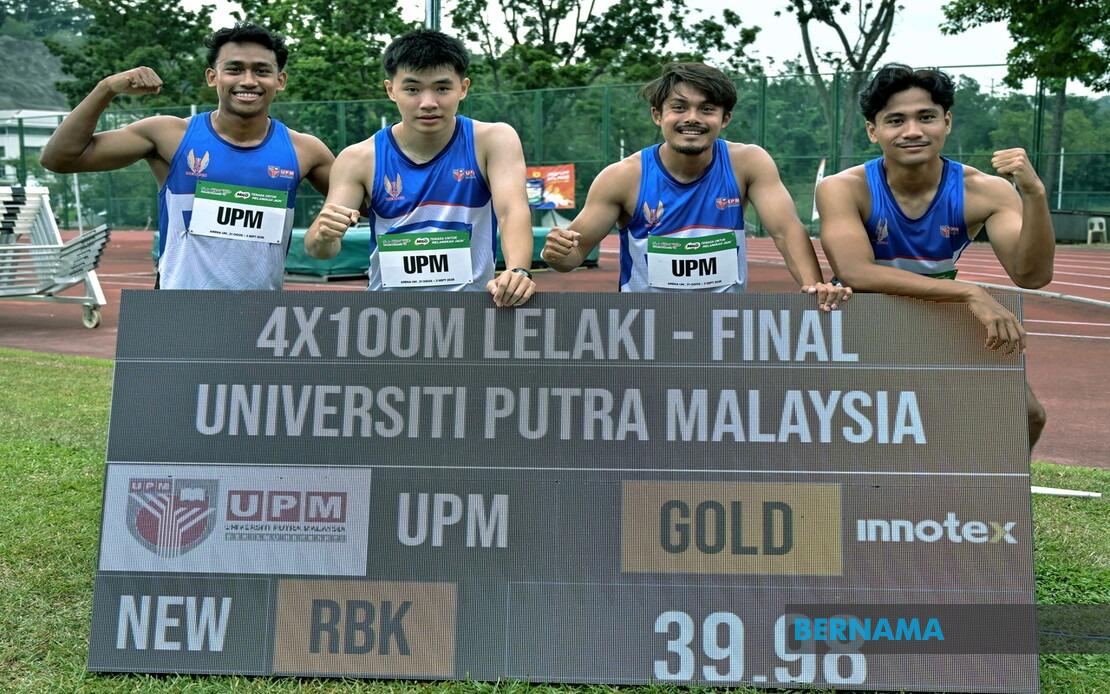
Universiti Putra Malaysia (UPM) has achieved a significant milestone in Malaysian university athletics by becoming the first team to break the 40-second barrier in the men's 4x100-meter relay at the 2026 Higher Education Institutions Sports Games (SUKIPT), completing the race in a record-shattering 39.98 seconds to claim the gold medal.
The accomplishment represents more than just a numeric achievement—it symbolizes the successful transition of UPM's athletics programme to a new generation of sprinters. The previous games record of 40.98 seconds stood as a benchmark for nearly a decade, making UPM's breakthrough a watershed moment in Malaysian university sports. The performance demonstrated that with proper planning and athlete development, Malaysian institutions can sustain competitive excellence across generational cycles rather than relying solely on individual star performers.
At the heart of this triumph was Aliff Iman Mohd Fahimi, a veteran sprinter who made his final SUKIPT appearance carrying the responsibility of anchoring a team composed entirely of younger runners competing in the championship for the first time. Aliff Iman's presence in the lineup carried symbolic weight beyond his individual contribution; he represented a conscious effort by UPM to create a bridge between its established athletics legacy and the emerging talent pool. His selection reflected a deliberate coaching strategy to leverage senior experience and mentorship within the relay format itself, rather than attempting to field a purely youth-oriented team without institutional memory.
Aliff Iman emphasized the significance of his role in facilitating this transition, particularly in preserving the legacy established by previous UPM champions Jonathan Nyepa and Zulfiqar Ismail. He acknowledged the substantial responsibility placed upon him to ensure that the institutional knowledge and championship mentality of earlier eras would transfer successfully to athletes who had no previous SUKIPT experience. This generational handoff challenge resonates across Malaysian universities, where many athletic programmes struggle to maintain consistency when decorated athletes retire from competition.
The technical foundation for UPM's record-breaking performance rested on meticulous preparation and realistic goal-setting. Aliff Iman revealed that the team established their target based on individual 100-meter times, with teammates demonstrating average splits of 10.4 and 10.5 seconds respectively. This data-driven approach to relay strategy—calculating cumulative times and identifying the threshold for breaking 40 seconds—illustrates the professionalization of university athletics in Malaysia. Rather than relying on intuition alone, the UPM coaching staff and runners engaged in precise analysis of what their individual capabilities could achieve in aggregate.
The human elements underlying this technical success added layers of interest to the performance. Reeve Kua, one of UPM's relay members, competed while recovering from a severe fever contracted the previous day. His determination to participate despite significant physical setback, managing his condition with rest and medication, demonstrated the mental resilience required in competitive sports. Such contributions often remain unrecognized in official records but speak to the dedication that athletes bring to championship events, particularly when representing their institutions in front of large crowds.
The relay competition itself reflected the strengthening quality of university athletics nationwide. Universiti Pendidikan Sultan Idris (UPSI) secured second place with a time of 40.16 seconds, demonstrating that the competitive field has tightened significantly. UPSI's lineup benefited from the inclusion of national runner Danish Iftikhar Muhammad Roslee, who anchored their effort. This concentration of national-level talent among the top finishers indicates that Malaysia's university sports system is effectively channeling elite athletes through institutional programmes, creating pathways that connect campus competition with national representation.
Ahmad Amir Aiman Mohd Kamaruddin, who ran as UPM's final anchor leg, faced the considerable pressure of competing directly against UPSI's Danish Iftikhar in the closing stages of the race. Despite this high-pressure duel between the two anchor runners, Ahmad Amir Aiman's confidence in the baton exchange and the execution of his teammates' efforts proved decisive. The relay format's inherent drama—where individual performances compound across four exchanges—creates moments where trust in teammates and precise technical execution determine victory.
The bronze medal went to the Malaysian Polytechnics team with a time of 41.75 seconds, completing a podium that reflects Malaysia's post-secondary education landscape. The inclusion of polytechnic athletes in SUKIPT alongside university competitors demonstrates the games' role as a comprehensive platform for developing talent across different educational institutions. This structure contrasts with some regional systems where university and polytechnic competitions remain segregated, potentially limiting exposure and competitive opportunities for elite students in non-university pathways.
UPM's achievement carries implications for Malaysian athletics development more broadly. The record-breaking performance arrives during a period when Southeast Asian countries are increasingly emphasizing sports development as a cornerstone of educational and national policy. Malaysia's university relay team competing at sub-40 second levels positions local athletic talent within recognizable international performance benchmarks, suggesting that Southeast Asian university athletes possess capabilities comparable to regional counterparts in other nations. This parity challenges any perception that Malaysian campus athletics exists in isolation from competitive developments in neighboring countries.
Aliff Iman's decision to publicly commemorate his final SUKIPT appearance by wearing wristbands inscribed with 'Papa' and 'Mama'—demonstrating his return to competition following a mandatory six-month injury recovery period—added a personal narrative to the technical achievement. Such individual touches humanize sports reporting and remind observers that behind every record and medal stand personal journeys of rehabilitation, doubt, and ultimately perseverance. His successful comeback at a championship event serves as an inspirational arc for other athletes managing career interruptions.
The SUKIPT 4x100-meter relay result ultimately validates the investment that Malaysian universities commit to athletics programmes and the coaching expertise that develops competitive sprinters. The under-40 second barrier, now breached, will likely establish a new competitive standard that other institutions will pursue in subsequent championship cycles. This elevation of performance benchmarks throughout the university system reflects the healthy competitive ecosystem that emerges when resources, talent identification, coaching quality, and athlete motivation converge effectively. For Malaysian sports administrators and university leadership, UPM's achievement demonstrates that sustained excellence in athletics remains achievable through strategic planning and intentional generational transition strategies.

