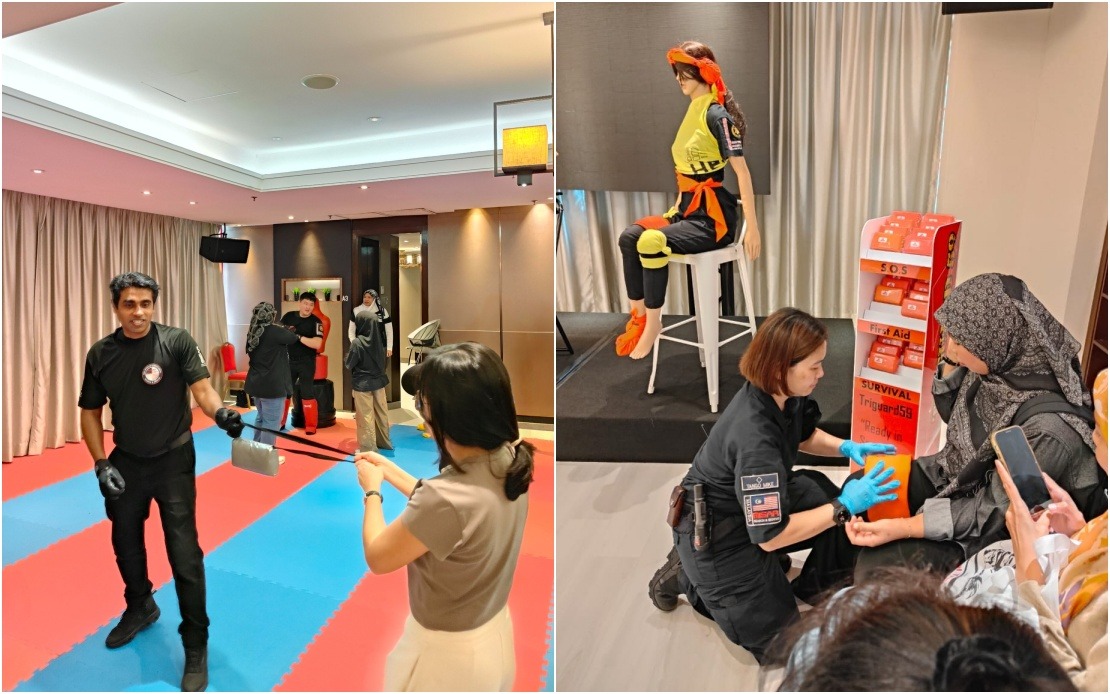
The partnership between Allianz Malaysia Berhad and Kelab Marshal Keselamatan Jalan Raya Kuala Lumpur (RSMC) has reached a milestone with the ninth iteration of its flagship Women's Street Crime Awareness Campaign, underscoring the persistent demand for practical safety education among Malaysian women. Held at Wisma Huazong YTL Hall in Seri Kembangan, Selangor, the initiative brought together 200 women to absorb hands-on knowledge covering everything from personal security to emergency preparedness, reflecting growing recognition that awareness and preparedness are essential tools in combating urban crime.
The programme targeted women aged 16 and above, deliberately casting a wide net to ensure that safety education reaches girls transitioning into independent adulthood and women at all life stages. By framing crime prevention not as a matter of individual vulnerability but as a community-wide responsibility, organisers sought to shift mindsets away from victim-blaming towards collective action. The breadth of topics addressed—ranging from home intrusions and bag snatching to road fraud and carjacking—suggests that threats to women's safety in Malaysia remain multifaceted and deeply embedded in everyday urban life.
What distinguished this year's iteration was the addition of structured dialogue sessions alongside traditional demonstrations and lectures. Participants gained the opportunity to engage directly with RSMC specialists, transforming what might otherwise be a one-way transfer of information into genuine conversation. These interactive components proved valuable because they allowed attendees to contextualise abstract safety principles within their own lived experiences, asking questions about scenarios they had witnessed or feared. This conversational approach acknowledges that women often possess intuitive knowledge about risks in their environment but may lack frameworks for articulating or responding to those threats.
The curriculum encompassed self-defence training, a component that carries particular symbolic weight in discussions of women's safety. While physical techniques matter, the emphasis here appeared to extend beyond martial effectiveness to include confidence-building and mental preparedness—the ability to recognise danger signals early and respond assertively rather than passively. Road safety and accident response training reflected the specific hazards women encounter as commuters, passengers, and drivers, acknowledging that some of the most significant safety risks materialize in transit. The inclusion of stalking and carjacking awareness recognised contemporary forms of crime that disproportionately affect women and that existing public safety campaigns often overlook.
Allianz Malaysia's chief executive officer Sean Wang emphasised that the campaign's true measure of success extends far beyond the 200 women who attended. His remarks about community leaders seeking to replicate the programme in their neighbourhoods point to a ripple effect where knowledge accumulates across networks. This observation carries particular relevance in Malaysian society, where informal networks and community structures often drive social change more effectively than top-down government initiatives. The appetite demonstrated by leaders to bring similar training to their own areas suggests that women-centred safety education fills a genuine gap in public provision.
The corporate social responsibility framing through which Allianz Malaysia engages in this work reflects broader trends among Malaysian businesses seeking to demonstrate commitment to community wellbeing. For an insurance company, sponsoring crime prevention education arguably aligns with commercial interests—reducing victimisation rates potentially reduces claims and builds customer loyalty—but it simultaneously addresses a genuine social need. This alignment of profit motive and public good, while sometimes contested, can drive sustained commitment where purely altruistic models might fade.
RSMC founder and president Captain K. Balasupramaniam articulated a philosophy centred on empowerment rather than fear. His framing of street crime awareness as a means to equip individuals with decision-making capacity reflects modern thinking about safety that moves away from cautionary tales and restriction. Instead of telling women what they cannot do, the approach focuses on building competence and confidence so women can navigate urban spaces more deliberately. This philosophical stance matters because it respects women's agency and acknowledges that mobility and participation in public life are rights, not privileges to be curtailed by fear.
The timing of the ninth campaign offers a moment to reflect on what sustained engagement with women's safety looks like in Malaysia. Nine years suggests continuity and institutional commitment, yet the scale—200 participants per year—indicates that only a tiny fraction of Malaysian women receive this training annually. While this points to genuine reach and impact through multiplier effects, it also highlights the vast gap between need and supply. For perspective, Malaysia's female population exceeds 15 million, meaning even with generous assumptions about community diffusion, millions of women remain untouched by such initiatives.
The specific crimes highlighted throughout the campaign narrative resonate with documented patterns in Malaysian cities. Bag snatching, home burglaries, and vehicle-related offences remain persistent public safety concerns that disproportionately affect women who often carry valuables for work or family needs and may be at home alone during vulnerable hours. By addressing these tangible, recognisable threats rather than abstract stranger danger, the campaign maintains credibility and relevance. Participants can immediately apply lessons to their daily routines rather than relegating safety training to theoretical exercises.
The expansion to include dedicated dialogue sessions suggests organisers recognised that effective safety education requires psychological and emotional components alongside practical skills. Women benefit from spaces where they can articulate fears without judgment, receive validation that concerns are reasonable, and access expert guidance tailored to personal circumstances. This holistic approach—combining information delivery, skills training, and emotional support—represents sophistication in programme design that reflects best practices in adult education and trauma-informed approaches.
Looking forward, the enthusiastic response from community leaders indicates potential for organic expansion of this model. Rather than Allianz Malaysia and RSMC attempting to scale centrally to reach millions of women, they may be catalysing a decentralised movement where neighbourhood associations, religious organisations, schools, and workplaces adopt and adapt the curriculum. This bottom-up dissemination could eventually reach far more women than any single campaign could, creating a culture where street crime awareness and personal safety competence become normalised community values.
The campaign ultimately reflects a social contract question: who bears responsibility for women's safety in Malaysian cities? By positioning corporate entities and volunteer-led safety organisations as key players alongside government, the initiative suggests that safety is a shared responsibility requiring multiple stakeholders. This distributes burden while acknowledging that no single institution can ensure women's security. For Malaysian readers, the campaign serves as both practical resource and reminder that collective action around safety concerns remains possible and necessary in an evolving urban landscape.

