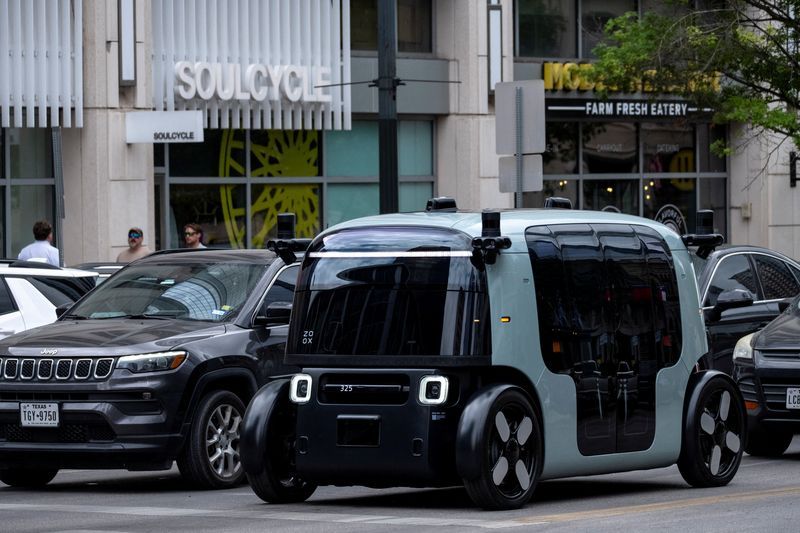
Amazon's autonomous vehicle subsidiary Zoox is entering the commercial phase of its robotaxi operations, launching paid passenger rides in Las Vegas from Monday following regulatory approval from American safety authorities. The move represents a significant inflection point for the autonomous mobility sector, which has shifted from years of testing to actual revenue-generating operations across major metropolitan areas. Zoox's transition to paid services, announced on Wednesday, arrives just days after the National Highway Traffic Safety Administration granted the company clearance to deploy its custom-built vehicles without human safety operators—a regulatory milestone that distinguishes it from competitors who have adapted conventional automobiles for driverless operation.
The Las Vegas launch marks only the second city where Zoox will charge passengers, demonstrating the measured pace at which even well-funded autonomous companies proceed toward full-scale commercialisation. Prior to this week, Zoox had been conducting free trial services across Las Vegas, San Francisco, Austin, and Miami to gather real-world operational data and refine its systems. This extended testing phase reflects the cautious approach regulators and manufacturers are taking with a technology that remains relatively untested at commercial scale. The company has not specified when it intends to introduce paid services in other cities where it currently operates, suggesting that each market will require separate regulatory navigation and operational validation.
Zoox's pricing strategy positions its service in the premium segment of ride-hailing markets, operating at rates comparable to comfort-tier options offered by traditional companies like Uber and Lyft. These premium tiers typically command fares 20 to 40 percent higher than standard ride-hailing, reflecting the newer vehicles and additional space that characterise this service category. By adopting this pricing approach, Zoox signals confidence in its value proposition while avoiding direct price competition with established ride-hailing platforms. The company's fare model incorporates a base fee combined with time and distance charges calculated using optimal routing, with destination-specific surcharges—such as airport pickup fees—disclosed transparently to users before booking. Notably, Zoox guarantees that passengers incur no additional charges if the vehicle selects a longer route than originally anticipated, a passenger protection measure designed to build consumer confidence.
The regulatory approval that enables Zoox's commercial expansion carries significant restrictions reflecting ongoing government caution about autonomous vehicle safety. The NHTSA exemption permits deployment of only 2,500 vehicles during each of the next two years, a production cap that prevents Zoox from flooding markets with its fleet while safety oversight continues. The agency determined that Zoox's purpose-built vehicle meets federal safety standards equivalent to conventional automobiles, yet imposed supplementary reporting obligations requiring disclosure of crashes, safety incidents, and instances of inappropriate road stopping. This layered regulatory approach attempts to balance innovation acceleration with public safety by allowing expanded deployment while maintaining heightened monitoring and transparency requirements.
Zoox's regulatory pathway differs fundamentally from competitors pursuing autonomous mobility through adapted conventional vehicles. Waymo, operated by Alphabet, has already established paid driverless services across multiple American cities, leveraging modified Chrysler Pacificas and other base vehicles. Tesla has commenced rolling out its autonomous ride-hailing service, similarly working from existing vehicle architectures. By contrast, Zoox engineered its offering from the ground up as a purpose-built driverless vehicle featuring distinctive inward-facing seating in two rows, optimised entirely for autonomous operation without human controls. This architectural choice enabled Zoox to become the first company receiving the NHTSA exemption, potentially offering competitive advantages through vehicle design specifically suited to autonomous functionality rather than adapted from traditional automotive platforms.
The competitive landscape for autonomous ride-hailing services in the United States has intensified considerably as multiple well-capitalised companies move toward simultaneous commercialisation. Waymo's established presence across markets gives it first-mover advantages in customer acquisition and operational learning. Tesla's expanding robotaxi rollout leverages its massive existing customer base and manufacturing infrastructure. Zoox's entry with proprietary vehicle technology and Amazon's backing creates a three-way rivalry that will shape how autonomous mobility services evolve. For consumers, this competition may drive service quality improvements and more aggressive pricing, though regulatory constraints on fleet sizes may limit immediate competitive intensity.
Safety considerations remain paramount in public discourse surrounding autonomous vehicles, and Zoox faces particular scrutiny given its vehicle design removes human operators entirely. The company has issued multiple software recalls during the past two years, demonstrating that safety vulnerabilities continue emerging even after extensive testing. Most significantly, a July recall followed an incident where a Zoox robotaxi failed to properly detect heavy smoke at an emergency scene, highlighting challenges autonomous systems face in recognising and responding appropriately to hazardous conditions. Such incidents underscore why regulators impose the additional reporting requirements and deployment caps that characterise Zoox's approval, ensuring graduated expansion that allows identification of systemic issues before fleet-wide problems develop.
Emergency response scenarios represent one of the most challenging aspects of autonomous vehicle operation, particularly interactions with emergency personnel, accident scenes, and other unpredictable roadway events. Robotaxi operators worldwide face intense regulatory scrutiny focused on how their vehicles navigate these high-stakes situations. Zoox's software vulnerabilities in detecting emergency conditions suggest that autonomous systems require continued refinement before handling such scenarios with human-level reliability. Regulators appear cognisant of these limitations, hence the measured approach to authorised deployment numbers and the enhanced reporting requirements that provide early warning of systemic safety gaps.
For the broader Asia-Pacific region and Malaysia specifically, Zoox's Las Vegas launch carries implications for autonomous vehicle development trajectories. As American regulatory frameworks establish precedents for autonomous commercialisation, Asian regulators and manufacturers will likely reference these standards and experiences when formulating their own policies. Malaysia's automotive sector, which includes significant vehicle manufacturing and a growing technology ecosystem, should monitor how autonomous ride-hailing develops internationally. The regulatory models, safety requirements, and deployment approaches established in the United States will influence regional strategies for integrating autonomous vehicles into transport systems.
Zoox's transition from testing to paid operations demonstrates that autonomous ride-hailing technology has achieved sufficient maturity for limited commercial deployment under regulatory oversight. However, the deployment caps, enhanced reporting requirements, and ongoing safety recalls indicate that the technology remains in early commercialisation phases rather than achieving mass-market readiness. The next phase of autonomous vehicle development will likely focus on expanding deployment numbers while maintaining rigorous safety oversight, gradually accumulating operational evidence about real-world performance. Zoox's Las Vegas launch represents one step in a gradual journey toward potentially transforming mobility services, rather than an imminent wholesale shift from human-driven transportation to autonomous systems.

