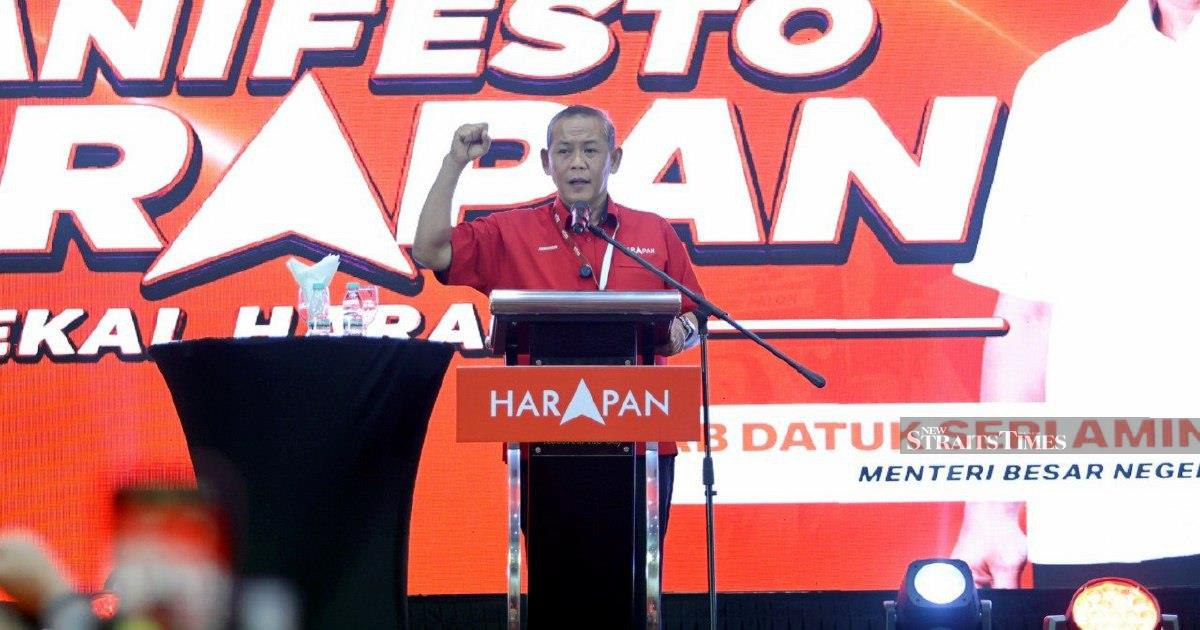
Speaking in Port Dickson, Datuk Seri Aminuddin Harun levelled accusations at Barisan Nasional for what he characterised as wholesale adoption of policy platforms that the Pakatan Harapan administration had already rolled out and demonstrated during its tenure governing Negri Sembilan. The opposition leader's remarks underscore growing tensions as the state gears up for its electoral contest, with both coalitions positioning their visions for the state's future development and governance.
Aminuddin's assertion touches on a recurring pattern in Malaysian politics where opposition parties and ruling coalitions often occupy overlapping policy ground, particularly on initiatives addressing bread-and-butter issues affecting voters. The allegation carries particular weight in Negri Sembilan, where the PH government had implemented various programmes intended to improve public services, support small businesses, and enhance social welfare provisions before losing power in recent political developments. By framing BN's manifesto as derivative rather than original, Aminuddin seeks to position PH as the authentic architect of popular policies rather than a latecomer to proven ideas.
The context of this dispute reflects broader dynamics within Malaysian electoral competition. When coalitions alternate in power, incumbent governments frequently face the awkward position of campaigning on continuation of existing programmes, while opposition parties must articulate why they represent superior governance despite lacking current administrative responsibility. For voters, distinguishing between genuine policy innovation and refinement of existing initiatives becomes increasingly difficult, particularly when manifestos address similar objectives across coalition lines.
Aminuddin's challenge to BN's manifesto credibility attempts to reset the narrative around ownership of popular initiatives. In Negri Sembilan specifically, programmes related to education support, business development assistance, and social safety nets had gained recognition during the PH administration's stewardship. By publicly asserting that BN has replicated these frameworks, Aminuddin hopes to convince voters that supporting PH represents continuity of proven approaches rather than experimenting with BN's untested promises. This rhetorical positioning matters significantly in an electorate that may have grown accustomed to PH's governance record.
The accusation also illuminates how Malaysian political coalitions conduct policy borrowing and adaptation. Rather than dismissing BN's proposals outright, Aminuddin specifically claims the ruling coalition has essentially copied existing work, a charge that differs from simple policy convergence. Such allegations require substantive evidence to resonate with voters—specific examples of how BN's proposals mirror PH's implemented programmes with minimal modification or enhancement. Without detailed comparisons, the assertion risks appearing as partisan rhetoric rather than factual critique.
For swing voters in Negri Sembilan, evaluating such competing claims demands engagement with actual policy details rather than coalition talking points. Voters should examine whether BN's manifesto commitments represent genuine improvements over PH's track record, straightforward continuation of existing programmes under new management, or merely rhetorical repositioning of established initiatives. The distinction matters for assessing which coalition is likely to deliver more effective governance rather than simply reshuffling existing administration.
Aminuddin's intervention also reflects PH's broader challenge as an opposition force seeking to remind voters of its administrative accomplishments. Malaysian voters often demonstrate short memories regarding previous governments' achievements, particularly when media coverage and political messaging emphasise present administration rather than past records. By actively highlighting his government's initiatives and contrasting them with BN's allegedly derivative approach, Aminuddin attempts to maintain PH's visibility and credibility during a period when he lacks the megaphone of incumbency.
Both coalitions face particular scrutiny in Negri Sembilan because the state represents a meaningful battleground where neither formation holds overwhelming dominance. Voters possess genuine choice between competing visions of governance, and such elections often turn on subtle differences in implementation capacity, track record, and persuasive articulation of future direction. Accusations of manifesto copying thus carry heightened significance in this competitive environment, as voters assess which coalition genuinely understands state challenges and possesses commitment to addressing them.
The manifesto dispute also raises questions about policy development processes within Malaysian political coalitions. Whether BN independently developed similar proposals addressing identical challenges, or whether officials consulted previous policy approaches while developing new initiatives, remains unclear from public statements. In governance, learning from predecessors' successes and failures represents standard practice rather than intellectual dishonesty, though presenting borrowed ideas as novel innovations certainly constitutes problematic political communication.
Moving forward, both BN and PH face pressure to articulate precisely how their respective approaches would advance Negri Sembilan's development trajectory beyond existing frameworks. Voters increasingly demand specificity regarding implementation timelines, budgetary allocation, and measurable outcomes rather than general policy pronouncements. Aminuddin's challenge to BN's manifesto authenticity gains credibility only if PH simultaneously offers clear articulation of how it would enhance or accelerate programmes it previously initiated, demonstrating that experience managing Negri Sembilan translates into superior future performance.

