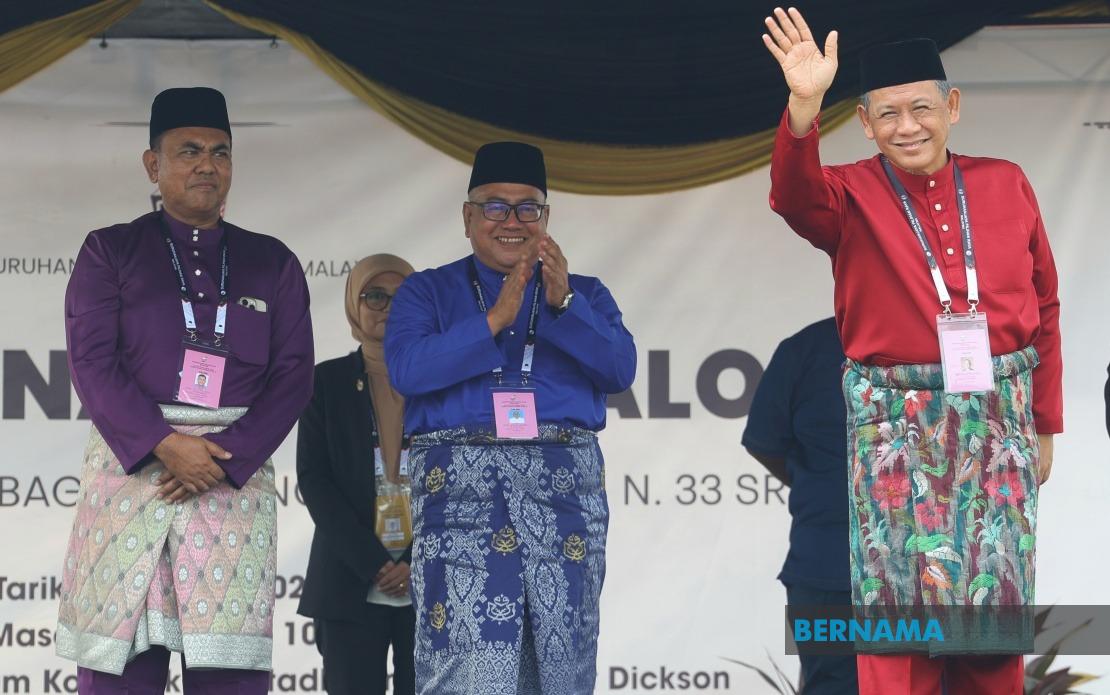
Negeri Sembilan Menteri Besar Datuk Seri Aminuddin Harun of Pakatan Harapan will navigate a three-way battle for the Linggi seat in the 16th state election scheduled for August 1, facing stiff competition from both the establishment Barisan Nasional and the increasingly assertive Bersatu faction. The Returning Officer Nurhazelin Makli confirmed the electoral lineup after nominations closed on July 18 at the Port Dickson District Administration Complex, setting the stage for what promises to be one of the more closely watched contests in Negeri Sembilan's forthcoming polls.
Aminuddin's challengers represent distinct political forces. Incumbent Datuk Mohd Faizal Ramli, representing Barisan Nasional, will seek to retain the seat he currently holds, while Bersatu candidate Datuk Zamri Md Said enters the fray as a third significant contender. This triangular configuration reflects the increasingly fragmented opposition landscape in Negeri Sembilan, where traditional two-cornered fights have given way to more complex electoral scenarios. For the Menteri Besar, retaining his constituency seat while leading his coalition at state level represents a crucial test of both personal political strength and Pakatan Harapan's grassroots appeal in the state.
The broader electoral picture across Negeri Sembilan reveals similarly competitive dynamics elsewhere. In Sri Tanjung, Pakatan Harapan's incumbent Dr G. Rajassekaran must defend against Barisan Nasional's A. Achutan and a Bersatu newcomer in Leevineshwaraan Murugan, suggesting that the pro-Mahathir faction's parliamentary representatives are investing significant resources in capturing state seats. The Lukut constituency will see Pakatan Harapan incumbent Choo Ken Hwa contending with both a Perikatan Nasional candidate in Sathes Kumar Nilameham and independent Teo Seng Lee, indicating fractures within anti-government opposition blocs.
PAS's presence in state politics is particularly evident in the Bagan Pinang seat, where incumbent Abd Fatah Zakaria will defend his position against Pakatan Harapan's Nasir Raman and Bersatu's Sheikh Junaidy Jamaludin. This contest encapsulates the tensions within Malaysia's broader opposition ecosystem, where Islamist-focused PAS, the progressive coalition Pakatan Harapan, and the Mahathirist Bersatu maintain uneasy positioning. The presence of multiple opposition candidates potentially splitting anti-incumbent votes underscores the complexity facing unified opposition strategies ahead of the August poll.
Meanwhile, the Chuah seat represents an anomaly in this election cycle, presenting a relatively straightforward two-cornered contest between Pakatan Harapan incumbent Yew Boon Lye and Barisan Nasional's Pau Jeou Ching. Such binary matchups have become less common across Malaysian state elections, making this seat notable primarily for its simplicity. The concentration of contests into three or more-way races across much of Negeri Sembilan reflects the state's particular political fractures and the fluidity of coalition-building since the 2018 political realignment.
The Election Commission has established August 1 as polling day, with early voting permitted on July 28 for eligible military personnel, police officers, and their families. This staggered approach has become standard practice in recent Malaysian elections, accommodating uniformed service members' operational schedules. The commission registered 889,490 eligible voters across Negeri Sembilan, comprising 867,151 ordinary voters alongside 16,884 military personnel and spouses and 5,455 police personnel and spouses. The relatively modest size of the uniformed services' voting bloc suggests their electoral impact, while not negligible, remains limited compared to the general civilian electorate.
The electoral configuration in Negeri Sembilan carries significance for understanding post-2020 Malaysian political realignment. Bersatu's emergence as a competitive third force in multiple constituencies—despite not commanding federal-level political dominance—demonstrates the faction's continued capacity to mobilize support at state level, particularly where local personalities carry established credibility. This pattern differs markedly from peninsular states where Bersatu has struggled to establish viable candidate bases, suggesting Negeri Sembilan's particular political culture accommodates multi-factional competition more readily than neighboring constituencies.
For Pakatan Harapan at state level, the August poll represents a critical juncture in consolidating its position as the legitimate governing alternative to Barisan Nasional within Negeri Sembilan. While Aminuddin's continued presence as Menteri Besar suggests the coalition maintains enough internal cohesion to present unified leadership, the emergence of multiple three-cornered contests indicates the regional opposition alliance faces ongoing pressure from both reconstituted Barisan Nasional efforts and Bersatu's calculated intervention. The outcome will likely shape coalition dynamics heading toward potential federal-level political movements.
The campaign period, running from July 18 through August 1, will test how effectively each political faction mobilizes support within their respective constituencies. For Aminuddin specifically, his electoral performance in Linggi will serve as a barometer of both his personal political capital and broader Pakatan Harapan sentiment in his home district. Three-way contests typically disadvantage incumbents if vote fragmentation favors unified opposition movements, making Aminuddin's navigation of this particular battle especially consequential for his continued political standing within both Negeri Sembilan and the broader national coalition framework.

