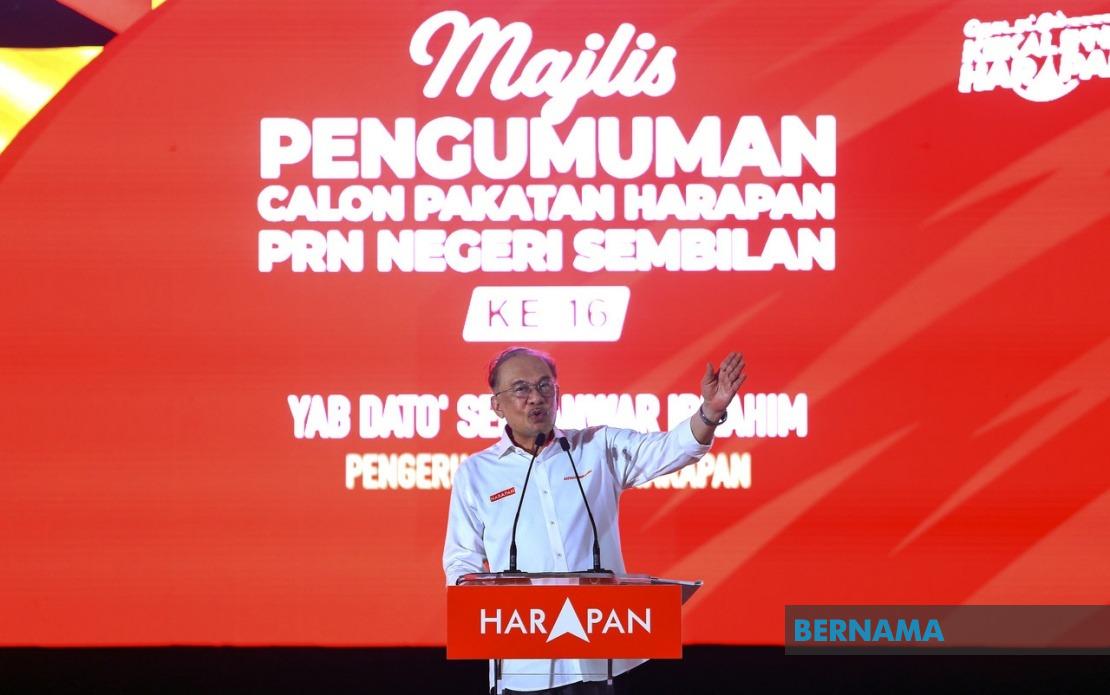
Prime Minister Datuk Seri Anwar Ibrahim formally announced Pakatan Harapan's key candidates for the upcoming 16th Negeri Sembilan State Election, signalling the coalition's determination to consolidate control in a state it has governed since 2018. The announcement came during a candidate launch ceremony in Kuala Pilah, where Datuk Seri Aminuddin Harun, the incumbent Negeri Sembilan Menteri Besar, was named to contest the Linggi seat under the PH banner.
Aminuddin's nomination represents a strategic shift from his current Sikamat constituency, which he has represented for four consecutive state election cycles since 2008. As both the Menteri Besar and chairman of Pakatan Harapan's Negeri Sembilan division, Aminuddin commands significant political capital within the coalition and has been central to the state government's administrative operations over the past six years. His move to Linggi signals PH's intention to strengthen its position in constituencies beyond his traditional stronghold, leveraging his executive experience and established voter networks.
Joining Aminuddin on the PH ticket is DAP secretary-general Anthony Loke, who will seek re-election in the Chennah seat. Loke has maintained an unbroken electoral presence since first winning Chennah in 2013, making him one of the more durable opposition-turned-government representatives in the state. His retention as a candidate underscores DAP's continued importance within the Pakatan Harapan coalition framework in Negeri Sembilan, despite the party's secondary status compared to PKR in state-level politics.
The ceremony drew substantial participation from PH's senior leadership ranks, reflecting the coalition's emphasis on presenting a unified front ahead of the state election campaign. In attendance were Amanah president Datuk Seri Mohamad Sabu, whose party holds several state assembly seats, and key executive figures including PH communications director Datuk Seri Fahmi Fadzil and coalition election director Datuk Seri Amirudin Shari. The presence of multiple coalition partners underscored the collaborative nature of PH's campaign strategy across Malaysia's three-party arrangement of PKR, DAP, and Amanah.
Negeri Sembilan represents a critical electoral battleground for Pakatan Harapan's national political standing. The state has emerged as a PH stronghold since the 2018 general election, with the coalition winning substantial representation in the state assembly. However, the state electorate has demonstrated volatility in recent years, with various demographic and economic shifts affecting voting patterns in both urban and rural constituencies. The decision to field sitting Menteri Besar Aminuddin in a constituency outside his established base suggests party confidence in his personal appeal, but also reflects calculations about where PH faces the most competitive contests.
The timing and scale of the candidate announcement carried symbolic weight within Malaysian political discourse. By personally presiding over the ceremony, Prime Minister Anwar Ibrahim signalled his direct investment in Negeri Sembilan's outcome and the broader PH campaign narrative. This level of personal involvement from the national party leader demonstrates how state elections, while technically provincial affairs, carry implications for federal coalition stability and parliamentary arithmetic. Any significant shift in PH's Negeri Sembilan representation could theoretically affect the coalition's overall parliamentary standing.
Loke's continued candidacy in Chennah reflects DAP's strategy of retaining experienced legislators who have built local constituencies and demonstrated electoral viability. The DAP secretary-general role carries significant internal party weight, and his re-nomination affirms the party's confidence in his dual responsibilities of national leadership and state-level representation. Within the Malaysian political context, where parties often field senior national figures in local elections to boost credibility, Loke's candidacy serves multiple functions for the coalition.
For Negeri Sembilan voters, the announcement crystallises PH's commitment to continuity in state administration. Both Aminuddin and Loke represent stability and accumulated political experience within their respective parties. This contrasts with how opposition parties typically position their campaigns, usually emphasizing change and reform. The incumbent coalition's strategy hinges on voter satisfaction with current governance delivery and the perceived competence of established political figures.
The Negeri Sembilan state election represents one of several state-level contests that will shape Malaysian electoral momentum in coming months. As a PH-governed state with relatively stable governance, the election will partly function as a referendum on PH's administrative record. Strong performance would bolster the coalition's narrative of effective governance, while any reversals could embolden opposition narratives about PH's decline. For Malaysian political observers and regional analysts tracking the stability of Southeast Asia's largest democracy, Negeri Sembilan's outcome carries disproportionate significance relative to the state's population and economic weight.

