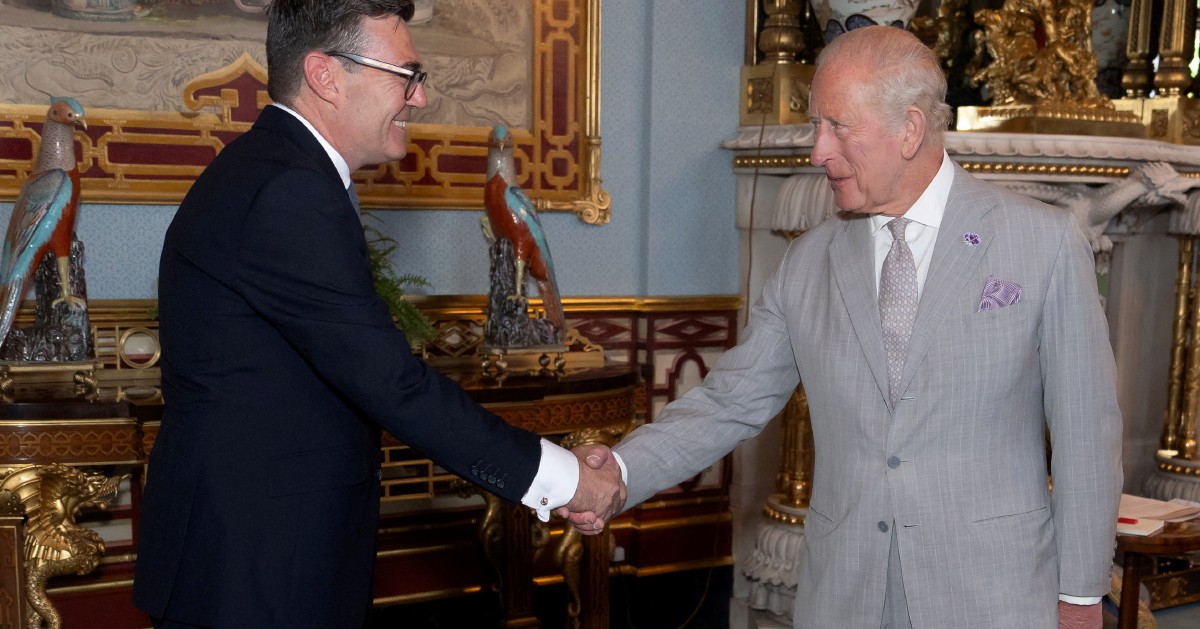
Andy Burnham has assumed the office of British prime minister on Monday, following a formal audience with King Charles III at Buckingham Palace, where the constitutional transfer of power was formally executed. The politician, who previously served in various ministerial roles, succeeds Keir Starmer in the top job and is now positioned to reveal his governing priorities for the nation in the coming weeks. The transition marks a significant moment in British politics, with Burnham now tasked with leading the government through a complex domestic and international landscape.
The meeting between Burnham and King Charles III represents the ceremonial finale of the leadership transition process, a constitutional requirement that formalises the new prime minister's appointment and their mandate to govern on behalf of the monarch. At Buckingham Palace, the king formally accepted the resignation of the previous administration and invited Burnham to form his government. This ritual, steeped in British constitutional tradition, underscores the continuity of parliamentary democracy even as governments change.
Burnham's appointment comes at a juncture when the United Kingdom faces mounting economic pressures, including persistent inflation concerns, labour market challenges, and ongoing debates over public service funding. His transition into office requires him to address these interconnected issues whilst navigating a complex political environment. The new prime minister inherits a government that must balance fiscal responsibility with public expectations for improved services in healthcare, education, and infrastructure.
The change in leadership also carries implications beyond Britain's borders. For Southeast Asian nations, including Malaysia, shifts in British political leadership can affect bilateral relationships, trade negotiations, and regional security arrangements. As a significant trading partner and historical ally in the region, Britain's policy direction under new leadership matters for countries managing their strategic interests across the Indo-Pacific.
Burnham's background and previous experience in government positions him with certain policy inclinations that may reshape departmental priorities. His track record in various roles suggests particular interest in regional development and public service reform, areas that could influence how the UK engages with international partners and manages its overseas commitments. Understanding these tendencies provides important context for governments assessing how bilateral relationships might evolve.
The transition from Starmer to Burnham also reflects broader patterns within British politics, where leadership changes often signal shifts in party direction or responses to changing public sentiment. Whether Burnham's tenure represents continuity or represents a meaningful departure from his predecessor's approach will become clearer as his cabinet appointments and initial policy announcements materialise. These early decisions will substantially influence the trajectory of his premiership and his government's relationship with both domestic constituencies and international partners.
For Malaysian observers of British politics, Burnham's appointment opens a fresh chapter in bilateral relations. The UK remains an important partner in various spheres including education, where thousands of Malaysian students pursue tertiary qualifications, defence cooperation through existing agreements, and investment flows that benefit both economies. Changes in British political leadership can influence the prioritisation of these relationships and the energy devoted to maintaining existing partnerships.
The timing of Burnham's ascension to office coincides with a period when democratic nations worldwide are grappling with economic management, institutional trust, and effective governance. His administration will be scrutinised both domestically and internationally for how it tackles these universal challenges. For Southeast Asia, a stable and competently administered Britain remains preferable to one consumed by internal political turmoil, as British stability facilitates predictable international engagement.
Burnham now faces the immediate task of forming his cabinet, selecting key ministers for major departments and signalling through these appointments his priorities and vision for the nation. The composition of his ministerial team will provide crucial insight into whether his government intends to pursue continuity with previous policies or implement substantive changes. These decisions, made within days of his assumption of office, will shape perceptions of his leadership among both the British public and international observers.
The prime minister's first weeks in office traditionally involve establishing relationships with key international leaders, reaffirming Britain's commitment to existing alliances, and signalling the nation's position on pressing global issues. Burnham's diplomatic engagements during this honeymoon period will indicate whether his government maintains the previous administration's stance on major geopolitical questions or charts a different course. For Malaysia and other Commonwealth members with whom Britain maintains historical ties, these early signals matter considerably.
As Burnham embarks on his premiership, the attention of both British citizens and the international community will focus on his ability to translate campaign promises and political ideology into concrete governance outcomes. The proof of any administration lies not in rhetoric but in measurable results, whether in economic management, public service delivery, or international standing. Malaysia and other nations will watch with interest to discern what direction the Burnham government takes and how those choices affect their respective interests and relationships with Britain.

