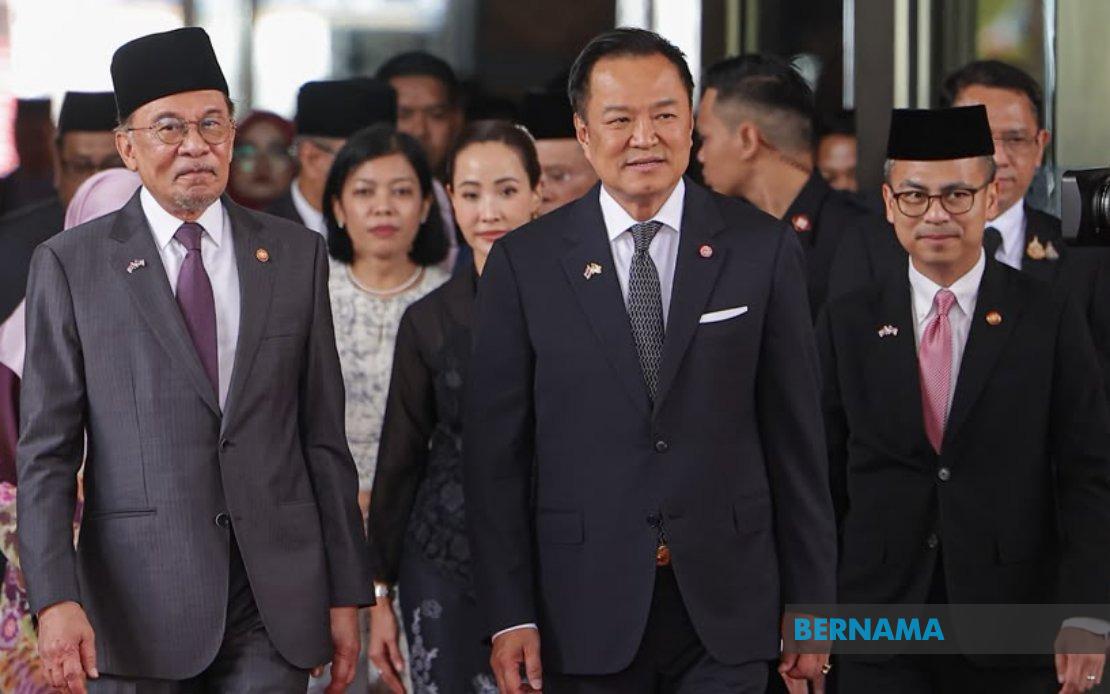
Prime Minister Datuk Seri Anwar Ibrahim and Thailand's Prime Minister Anutin Charnvirakul convened at the Perdana Putra Complex in Putrajaya on July 9 to assess the trajectory of bilateral relations and map out avenues for deepening cooperation across multiple sectors. The high-level engagement underscores the priority both governments place on strengthening ties at a moment when regional integration and cross-border collaboration remain central to Southeast Asian stability and prosperity.
Anutin arrived in Malaysia for an official two-day visit at Anwar's invitation, touching down at Kuala Lumpur International Airport at 11.11 am where he received a formal welcome before the delegation travelled to the capital. The ceremonial reception and immediate progression to substantive talks signal the significance Malaysia and Thailand attach to elevating their partnership, reflecting shared interests in managing transnational challenges and expanding mutual benefit in trade and investment corridors.
The agenda encompassed several interconnected domains crucial to both economies. Trade and investment cooperation featured prominently, given the two nations' position as major economic players in Southeast Asia and their complementary industrial bases. Border connectivity discussions held particular weight, as improved transport links and streamlined cross-border procedures directly affect logistics efficiency, tourism flow, and regional supply chain integration. The discussion extended to security collaboration, a perennial concern given transnational threats including trafficking, terrorism, and maritime disputes that affect both kingdoms.
Agriculture emerged as another substantive focus area, with both countries recognising their capacity to enhance food security through coordinated production strategies and knowledge exchange. Tourism and education figured prominently as well, reflecting growing people-to-people interactions and the economic multiplier effects of expanded cultural exchange. The inclusion of people-to-people exchanges signals intention to deepen civil society connections beyond government-to-government channels, fostering grassroots understanding that underpins durable diplomatic relations.
Particularly significant was the anticipated discussion of regional and international developments within ASEAN and related frameworks. As both nations navigate shifting geopolitical currents—including great power competition and transnational climate challenges—coordinated positions within ASEAN institutions prove increasingly valuable. Malaysia and Thailand's dialogue on these matters influences the bloc's collective approach to maintaining centrality in regional affairs and advancing shared interests in Southeast Asian prosperity and stability.
The Malaysian delegation represented virtually all major economic and security portfolios. Deputy Prime Minister Datuk Seri Fadillah Yusof and Foreign Minister Datuk Seri Mohamad Hasan anchored the team, while sectoral expertise came through Transport Minister Anthony Loke, Agriculture and Food Security Minister Datuk Seri Mohamad Sabu, and Investment, Trade and Industry Minister Datuk Seri Johari Abdul Ghani. The inclusion of the Home Minister Datuk Seri Saifuddin Nasution Ismail underscored security dimensions of the engagement. Thailand's representation mirrored this comprehensiveness, with three deputy prime ministers covering foreign affairs, transport, and finance alongside specialised ministers across defence, agriculture, labour, and tourism—demonstrating Bangkok's equal commitment to comprehensive bilateral advancement.
The bilateral meeting's centrepiece involved execution of a Memorandum of Understanding on agricultural cooperation, a tangible commitment transcending rhetorical acknowledgment. This accord formalises collaborative mechanisms in a sector where both nations possess substantial expertise and face common challenges: climate change impacts on crop yields, the imperative for sustainable farming practices, and the necessity of ensuring food security amid growing regional populations. The agreement provides institutional scaffolding for ongoing technical exchanges, research partnerships, and potentially joint ventures that can enhance productivity across both agricultural sectors.
The formal luncheon hosted by Anwar following the bilateral meeting extended engagement into less structured settings, historically valuable for candid dialogue on sensitive topics and for building personal rapport among senior officials. Such informal moments frequently generate understandings that facilitate implementation of jointly agreed initiatives and create channels for addressing unforeseen obstacles. The ceremonial dimension also reinforces the gravity with which Malaysia regards Thai partnership in an era demanding reliable regional alignment.
For Malaysian stakeholders, this engagement carries several implications. Enhanced Malaysia-Thailand cooperation strengthens ASEAN's internal coherence at a time when external pressures test regional solidarity. Improved agricultural collaboration addresses Malaysian food security concerns while providing market access for Thai producers. Border connectivity gains promise reduced logistics costs for businesses operating across both markets. Elevated educational and tourism exchanges boost Malaysian institutions' international profiles while generating foreign exchange earnings. Security cooperation, though less publicly articulated, addresses transnational challenges—human trafficking, weapons smuggling, and terrorist movements—that threaten stability in both nations and require intelligence sharing and coordinated law enforcement.
The bilateral framework also reflects Malaysia's broader strategy of deepening ties with immediate neighbours while maintaining broader regional engagement. Thailand, as a major Southeast Asian economy and ASEAN chair in recent years, possesses outsized influence on regional agendas. Strengthening bilateral relations enhances Malaysia's diplomatic leverage within ASEAN while creating bilateral mechanisms that transcend the bloc's sometimes-cumbersome consensus processes. For Thailand, partnering strategically with Malaysia addresses similar objectives: ensuring stability along shared borders, facilitating trade growth, and maintaining alignment with a key neighbour as Bangkok navigates its own regional and international priorities.
Looking forward, the substantive outcomes from these talks—particularly the agricultural accord and any additional memoranda potentially announced—will prove significant only insofar as implementation mechanisms prove robust. Both nations must ensure that government-to-government commitments translate into enabling frameworks for private sector participation, streamlined regulatory procedures, and sustained political support across successive administrations. The appointment of focal points and regular review mechanisms becomes essential for maintaining momentum and ensuring that initial enthusiasm crystallises into concrete benefits for both Malaysian and Thai citizens and businesses.
The timing of Anutin's visit also reflects broader regional dynamics. ASEAN states increasingly recognise that economic integration and security cooperation require sustained bilateral engagement beyond multilateral forums. Malaysia and Thailand's bilateral deepening contributes to regional stability while demonstrating that ASEAN members can pursue strategic partnerships without contradicting collective interests. As regional challenges from climate change to technological disruption to great power competition intensify, such bilateral pillars become ever more critical to regional architecture.

