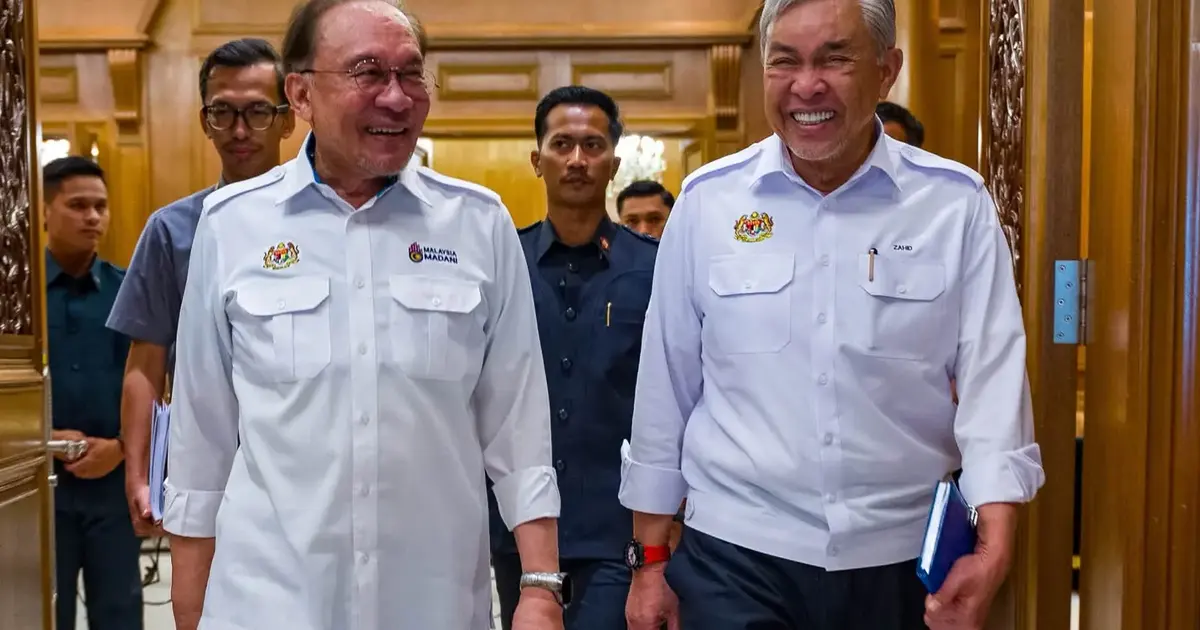
The public display of cordiality between Prime Minister Anwar Ibrahim and Barisan Nasional chairman Ahmad Zahid Hamidi underscores the delicate balancing act required to maintain Malaysia's governing coalition. The two leaders appeared relaxed and smiling during their latest encounter, a deliberate show of unity that comes against a backdrop of simmering tensions within the ruling partnership. This carefully choreographed appearance suggests both men recognise the political costs of allowing disagreements to fester in public view, particularly when the stability of the federal government depends on the fragile cooperation between their respective blocs.
The backdrop to this warm greeting is Zahid's pointed challenge issued just twenty-four hours earlier. The BN chairman had bluntly suggested that if Prime Minister Anwar Ibrahim harboured any displeasure with the eight ministers allocated to Barisan Nasional within the cabinet, he retained the authority to remove them from their posts. This statement, while framed as a technical observation about executive prerogative, carries unmistakable implications about the balance of power between the Prime Minister's own party and the coalition partner. Zahid's remark effectively tested the boundaries of the governing agreement and signalled BN's willingness to assert its ministerial entitlements within the administration.
For Malaysian observers of coalition politics, such tensions represent a familiar pattern in the country's power-sharing arrangements. The Pakatan Harapan-Barisan Nasional government that emerged following the 2022 general election was never designed as a harmonious partnership. Instead, it reflects the arithmetic of a fragmented parliament where no single bloc commands an absolute majority. Anwar's coalition controls the government only through the combined support of his own faction and the strategic participation of BN's representatives, a configuration that naturally breeds friction over ministerial portfolios, policy direction, and resource allocation. The test of any such arrangement lies not in the absence of disagreement but in the willingness of coalition partners to manage conflicts through private negotiation rather than public confrontation.
Zahid's provocative comment about ministerial dismissals must be understood within the context of broader coalition management dynamics. By publicly stating the obvious—that the Prime Minister retains constitutional authority to reshuffle his cabinet—Zahid was simultaneously reminding Anwar of an implicit understanding: that any such action would carry political consequences for the coalition's stability. In the language of Malaysian coalition politics, this constitutes a gentle warning wrapped in ostensible deference to executive authority. The statement serves to protect BN's interests within the cabinet while avoiding the appearance of direct confrontation with the Prime Minister.
The subsequent smiling encounter between the two leaders represents a mutual recognition that escalating such disputes into the public domain serves neither party's interests. For Anwar, maintaining coalition harmony is essential to governing effectively with razor-thin parliamentary margins. A public rift with BN could embolden opposition lawmakers and potentially trigger defections that would undermine his administration's legislative capacity. For Zahid and Barisan Nasional, the visibility and resources that come with ministerial representation in a federal government offer tangible benefits to the coalition's political base. Both leaders therefore have powerful incentives to resolve tensions through private channels rather than through pointed public remarks.
This dynamic reflects a broader reality about Malaysian governance in the post-2022 era. The rise of coalition-based government, born from electoral fragmentation, has fundamentally altered how power is exercised in the country. Cabinet positions are no longer simply appointments made on merit or party loyalty but have become explicit bargaining chips in inter-party negotiations. Zahid's recent statement, and the warm response it received, illustrate how senior political figures must constantly navigate between asserting their party's interests and maintaining the cooperative arrangements necessary for governing.
The ministerial allocation itself—eight posts for Barisan Nasional within a larger cabinet—represents a carefully calculated compromise reflecting the respective sizes and electoral performance of coalition members. These positions carry genuine executive authority over significant portfolios and budgets, making them valuable assets in intra-coalition negotiations. When Zahid references Anwar's theoretical ability to remove these ministers, he is implicitly defending BN's claim to these positions while also signalling that any breach of the allocation agreement would have consequences for coalition functioning.
For Southeast Asian observers, Malaysia's coalition government offers instructive lessons about power-sharing arrangements in systems where electoral outcomes produce fragmented legislatures. The willingness of rival factions to govern together, despite obvious tensions, demonstrates both the practicality and the limits of consensus-based administration. Thailand, Indonesia, and other regional democracies grapple with similar challenges of coalition formation, and Malaysia's experience illustrates how such governments can function despite underlying disagreements about policy and resources.
Looking ahead, the health of the Anwar-Zahid coalition will likely depend on whether such tensions remain manageable through private negotiation or whether they eventually spill over into public disputes that erode coalition unity. The smiling encounter between the two leaders suggests both men understand the stakes involved in maintaining their arrangement. Yet the frequency of such clarifying moments—where one coalition partner must remind another of their mutual dependence—suggests that comfort and genuine unity remain elusive. This is coalition governance in practice: not a partnership based on ideological alignment or genuine affinity, but rather a pragmatic arrangement sustained by the political costs of alternatives.

