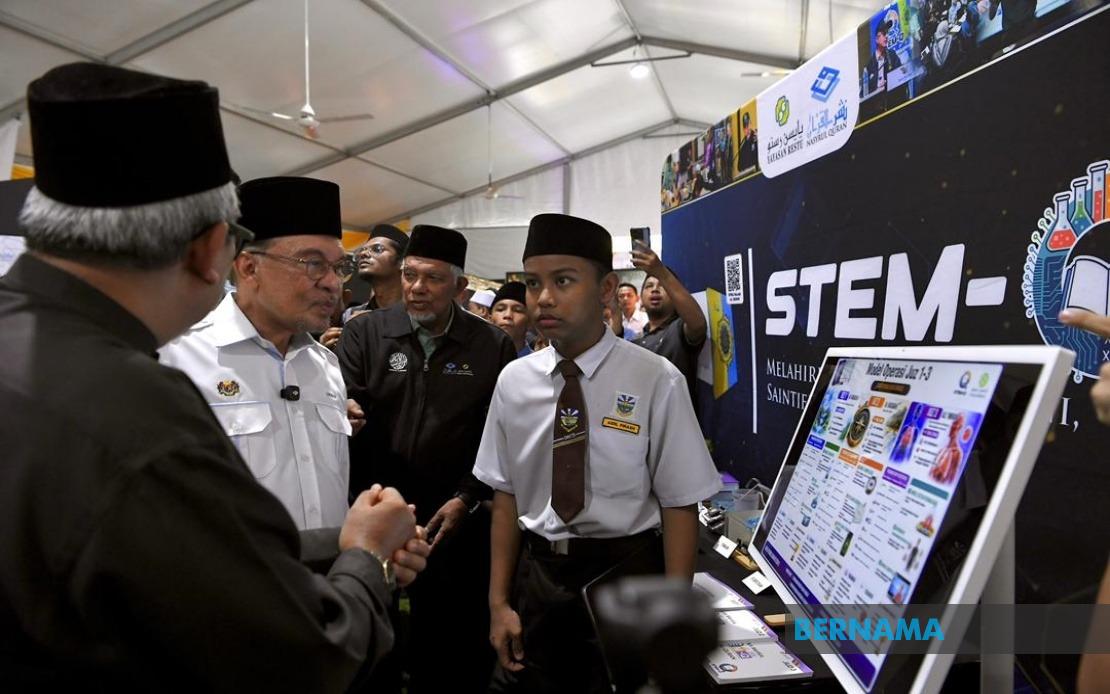
Prime Minister Datuk Seri Anwar Ibrahim has greenlit an additional RM4.6 million in funding for this financial year to enhance basic infrastructure across 27 Islamic educational institutions throughout Penang. The decision, announced during the National Tadabbur Perdana and Maidah Wanita MADANI Permatang Pauh programmes at Masjid Muhajirin in Butterworth, represents a significant acceleration in government support for religious education facilities in the state.
This year's allocation marks a substantial increase compared to the previous year's commitment. In 2023, the government disbursed RM2.11 million to support upgrading work at 11 Islamic educational institutions in Penang, meaning the current year's announcement more than doubles both the funding amount and the number of institutions receiving support. The expanded scope indicates a deliberate policy shift toward more comprehensive investment in the state's Islamic education ecosystem.
Anwar, who concurrently serves as Finance Minister, outlined the breadth of infrastructure projects the allocation would fund. The money will be channeled toward diverse upgrading initiatives at participating institutions, encompassing structural improvements such as wall and fence repairs, renovations at madrasahs and schools, construction of new kindergarten facilities, and establishment or enhancement of tahfiz academies. This multifaceted approach reflects recognition that Islamic education encompasses varying age groups and specialisations requiring differentiated infrastructure investments.
The Prime Minister emphasised that strengthening Islamic education remains a cornerstone of the government's broader policy framework. He underscored the commitment to continuously address the infrastructure and operational needs of people's religious schools and Islamic educational institutions, framing such investment as essential to fortifying the overall religious education ecosystem within Malaysia. This positioning situates the Penang allocation within a nationwide programme rather than as an isolated state-level gesture.
Beyond physical infrastructure, Anwar articulated a vision for Islamic education that embraces modern technological advancement. He advocated for integrating artificial intelligence into Quranic and Islamic studies, recognising that contemporary education systems must evolve alongside technological transformation. This forward-looking stance attempts to reconcile traditional Islamic learning with digital innovation, addressing concerns that religious education institutions might lag behind in technological adoption compared to secular counterparts.
However, Anwar introduced a critical caveat to technological integration. He stressed that artificial intelligence and other technological tools must be underpinned by robust ethical frameworks and moral principles. Rather than viewing technology as a neutral instrument for skill and knowledge development, the Prime Minister insisted that AI implementation must incorporate values-based foundations, preventing the potential misuse of powerful tools divorced from moral guidance. This reflects broader anxieties about deploying advanced technology without adequate safeguards.
Anwar's remarks on AI and morality carry particular resonance for Malaysian stakeholders. As Southeast Asia's most developed digital economies accelerate AI adoption, questions about ethical governance and cultural alignment with Islamic principles become increasingly pertinent. Malaysia's position as a Muslim-majority nation with significant Islamic institutions necessitates frameworks ensuring technological advancement serves rather than undermines religious and cultural values—a tension Anwar's comments seek to address.
Beyond infrastructure and technology, Anwar encouraged the public to utilise the freedoms available within Malaysia's democratic framework to organise expanded religious programming. He advocated for continuous scheduling of Quranic classes, tadabbur sessions—intensive Quranic reflection activities—and religious lectures as mechanisms for deepening public religious understanding and appreciation. This exhortation positions community-led religious engagement as complementary to institutionalised Islamic education.
The emphasis on continuous religious programming reflects concern that formal education alone may prove insufficient for comprehensive Islamic knowledge transmission. By encouraging decentralised, community-based religious activities, Anwar's approach recognises that learning occurs across multiple channels and formats. This diversified educational ecosystem could potentially strengthen religious understanding more effectively than relying solely on schools and madrasahs, particularly given Malaysia's varied demographic landscape and differing levels of Islamic literacy across communities.
For Penang specifically, the announcement carries implications beyond immediate funding benefits. The state has maintained significant Islamic institutional presence serving its diverse population, and enhanced infrastructure investment may strengthen these institutions' capacity to serve broader constituencies. Enhanced facilities and technological integration could improve educational quality and accessibility, potentially attracting greater participation from students previously underserved by existing institutions.
The funding announcement also reflects evolving federal-state dynamics regarding religious education oversight. While Islamic affairs traditionally fall partly under state jurisdiction, the federal government's direct allocation and the Prime Minister's personal announcement of specific figures demonstrates centralised prioritisation of this sector. This approach suggests potential consolidation of religious education policy direction at the national level, with implications for state-level religious administrators and institutional autonomy.
Stakeholders across Malaysia's Islamic education sector will likely scrutinise implementation mechanisms and disbursement timelines. The transition from allocation announcement to actual infrastructure improvement requires coordinated planning between federal authorities, state religious departments, and individual institutions. Successful execution could validate the government's commitment to religious education modernisation, while delays or misallocation might undermine confidence in the policy framework.
Moving forward, the Penang allocation may establish a precedent for similar investments in other states. If this initiative yields measurable improvements in institutional capacity and educational outcomes, pressure may mount for comparable federal support elsewhere. Such scaling would represent substantial financial commitment but potentially significant returns in strengthened Islamic education infrastructure across Malaysia's increasingly diverse society.

