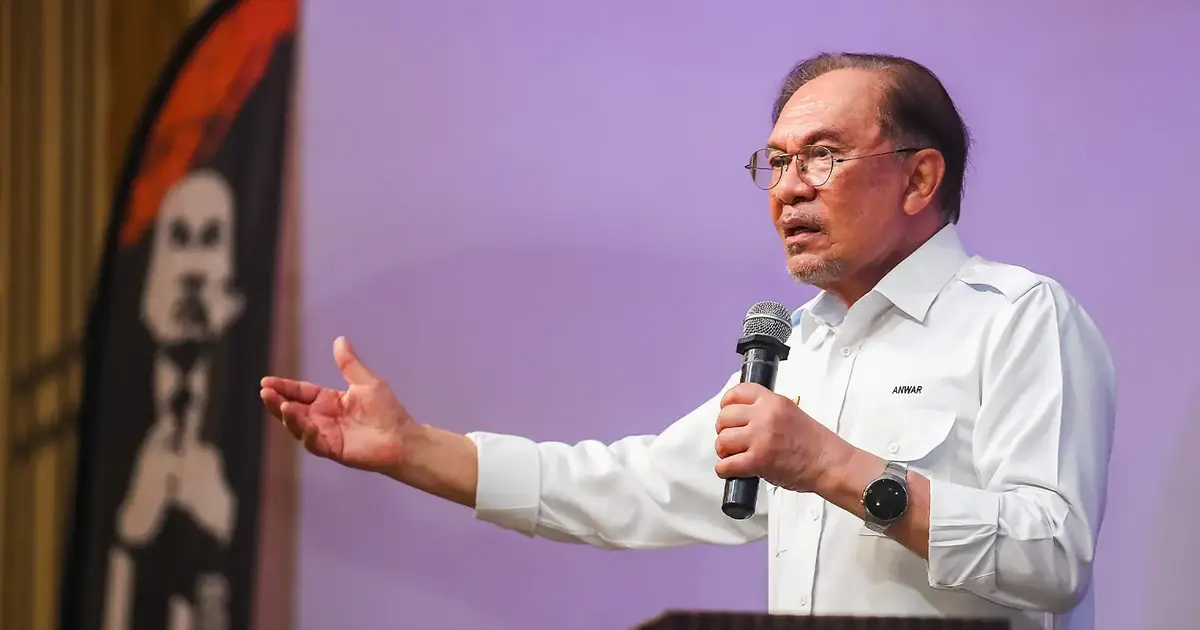
Prime Minister and Pakatan Harapan chairman Anwar Ibrahim has pointed to the 'Free Najib' movement as the driving force behind the early dissolution of the Johor state assembly, arguing that the decision to trigger a snap election lacked any reasonable political foundation.
According to Anwar, the coalition had maintained stable governance in the state and faced no pressing circumstances that would ordinarily necessitate cutting short the legislative term. His remarks underline the tension between Putrajaya's coalition partners and those aligned with former Prime Minister Najib Razak, whose imprisonment on corruption charges continues to energize a vocal segment of supporters seeking his release through various political channels.
The push for an early poll in Johor reflects broader political realignment in Malaysia's southern heartland, where UMNO's position has undergone significant shifts in recent years. The decision to hold elections ahead of the constitutionally mandated schedule suggests that internal pressure from factions within the ruling coalition, possibly influenced by sympathizers of the incarcerated former leader, may have outweighed Anwar's stated preference for political continuity in the state.
Johor holds particular strategic importance in Malaysian politics due to its size, economic weight, and traditional role as a bellwether for national sentiment. The state's assembly dissolution therefore carries implications extending well beyond its borders, affecting calculations across multiple political parties and potentially reshaping the balance of power in the region. For Anwar and Pakatan Harapan, an early election in an already-competitive state represents an unplanned drain on organizational resources and campaign finances.
The 'Free Najib' movement, though not formally institutionalized as a single organization, encompasses numerous civil society groups, online activists, and sympathizers who publicly advocate for Najib's clemency or release. Their activities have increasingly intersected with mainstream political discourse, particularly within UMNO circles, where divisions persist over how the party should address its former president's legal predicament. This has created uncomfortable dynamics within the ruling coalition, where ideological and strategic differences occasionally translate into uncoordinated political maneuvers.
Anwar's framing of the election as unnecessary carries political weight, as it attempts to position Pakatan Harapan as the rational, stability-focused force in Malaysian governance. By characterizing the snap poll as driven by external pressure rather than genuine political necessity, he seeks to inoculate his coalition against blame should the results disappoint. Conversely, this narrative risks appearing dismissive of legitimate electoral processes and may alienate Johor voters who question why their choice was denied until the natural conclusion of the assembly's term.
For Malaysian readers, the Johor election dynamics illustrate the persistent shadow cast by high-profile corruption cases in shaping contemporary politics. Najib Razak's conviction and imprisonment have not simply faded as historical episodes but continue to energize factions and influence coalition behaviour at multiple levels. The 'Free Najib' movement's apparent capacity to nudge political decision-making suggests that the 1MDB scandal and its aftermath remain live issues in Malaysian political calculations, rather than resolved matters relegated to the courts.
The timing of Anwar's complaint is also noteworthy, arriving as campaign activities begin in earnest. By pre-emptively blaming the 'Free Najib' movement for dragging his coalition into an unwanted election, he attempts to set the narrative frame before voting day. This rhetorical strategy risks backfiring, however, if voters interpret it as an excuse-making exercise or if it suggests that Pakatan Harapan lacked the political muscle to resist pressure from rival factions within the broader ruling coalition structure.
Regionally, Malaysia's internal political turbulence continues to draw attention from Southeast Asian observers monitoring how the nation manages its democratic processes amid deep divisions. The spectacle of snap elections called allegedly under duress from movements advocating for imprisoned leaders raises questions about institutional stability and the rule of law that resonate across the region, where similar tensions between judicial independence and political patronage networks exist in various forms.
The Johor election will ultimately serve as a testing ground for whether Anwar's Pakatan Harapan can maintain its grip on state governance while managing these internal coalition pressures. A strong showing would validate his narrative of stable stewardship vindicated by voters despite externally imposed electoral disruption. Conversely, a poor result would invite questions about whether his coalition's inability to prevent an early election reflects deeper organizational or electoral weakness, regardless of which factions ultimately bear responsibility for triggering the poll.
As campaigning unfolds, the interplay between high-profile campaigns, grassroots movements, and coalition politics will likely dominate Johor discourse. Voters face a choice not simply between competing manifestos but between competing narratives about who controls the political system and whose interests the government genuinely serves—a dynamic that extends well beyond Johor's borders to shape perceptions of Malaysia's entire political trajectory.

