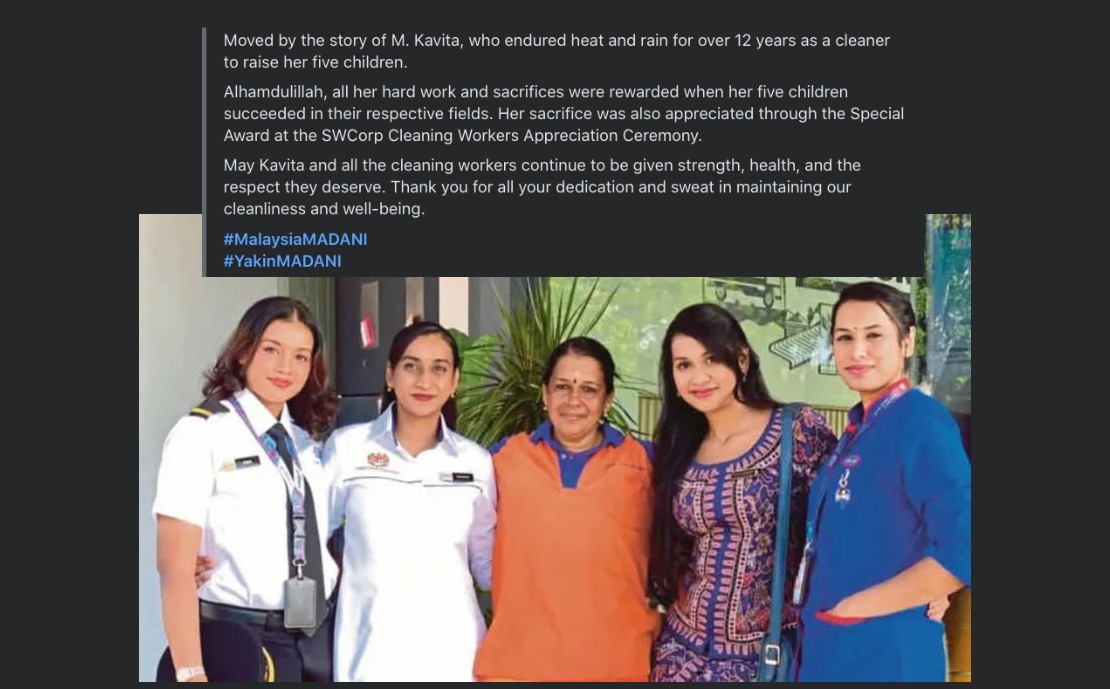
Prime Minister Datuk Seri Anwar Ibrahim has publicly acknowledged the extraordinary efforts of M. Kavita, a street sweeper employed by SWM Environment in Seremban, commending her decades-long commitment to supporting her family while working in the lowest-paying sectors of Malaysia's service economy. Through a Facebook post, Anwar recognised how Kavita's steadfast labour across more than twelve years, frequently performed under challenging weather conditions, had enabled all five of her children to achieve professional success in their chosen careers.
Kavita's story resonates deeply within Malaysia's broader discourse on social mobility and economic resilience. While Malaysia has made significant strides in improving standards of living, sanitation workers and street cleaners remain among the most economically vulnerable segments of the workforce, often earning minimal wages and receiving limited social recognition. Anwar's public tribute represents an intentional effort to elevate the societal status of these essential workers, whose daily labour forms the backbone of urban cleanliness and public health infrastructure across the country's cities.
The narrative gained considerable traction on social media platforms last month when Kavita's four daughters orchestrated a touching surprise for their mother's fiftieth birthday celebration. Rather than merely presenting gifts, the daughters arrived at their mother's workplace dressed in their respective professional uniforms, a powerful visual statement of their achievements. One daughter serves as a commercial pilot, another works as cabin crew for an airline, while a third is employed as a staff nurse in the healthcare sector. The spontaneous gathering at Kavita's workplace, which left her tearful with emotion, encapsulated the tangible fruits of her labour and sacrifice.
Beyond the personal narrative, Kavita's recognition underscores important questions about intergenerational wealth mobility in Malaysia. The fact that a woman earning minimal wages through sanitation work could facilitate the education and professional advancement of five children suggests a combination of personal determination, access to Malaysia's public education system, and possibly support networks within her family or community. Her achievement contrasts sharply with broader patterns of economic inequality that can trap families in cycles of poverty across Southeast Asia, making her story particularly instructive for policymakers examining barriers to upward mobility.
Anwar's tribute carried specific messaging directed toward the broader community of sanitation and cleaning workers across Malaysia. In his statement, he explicitly acknowledged their contributions to public welfare, emphasising that their work directly safeguards the health and wellbeing of all citizens. This recognition moves beyond symbolic appreciation, as it frames sanitation workers as essential contributors to societal functioning rather than peripheral or invisible labour, a distinction that carries implications for how these workers are treated, compensated, and valued within Malaysia's emerging economy.
The timing of Anwar's acknowledgement coincides with formal recognition by SWCorp, the agency overseeing solid waste management in Malaysia. Kavita received a Special Award during SWCorp's Cleaning Workers' Day Appreciation ceremony, an occasion designed specifically to honour contributions of individuals within the sanitation sector. This dual recognition—from both the Prime Minister and the sector-specific regulatory body—amplifies the visibility of Kavita's accomplishments and signals commitment at multiple levels of government to acknowledging these workers' significance.
For Malaysia's broader service economy, the implications extend beyond individual recognition. As the country continues its transition toward higher-value economic activities and increasingly automates manufacturing and routine labour, questions persist about how Malaysia will treat workers in lower-wage service sectors. Countries across Southeast Asia have struggled to balance economic competitiveness with equitable treatment of essential workers, and Kavita's story illustrates both the possibilities and challenges inherent in this transition. Her success in raising educated, professionally accomplished children despite economic constraints demonstrates resilience, but it also implicitly raises questions about whether individuals should bear such burdens when structural economic support could ease pathways to advancement.
The viral nature of Kavita's birthday surprise also reflects evolving social media dynamics within Malaysia. Stories celebrating unexpected accomplishments and personal triumphs have become increasingly prominent in Malaysian digital spaces, often highlighting individuals from modest backgrounds who defy economic stereotypes. These narratives, while individually inspiring, also serve important cultural functions in reinforcing meritocratic ideals and celebrating perseverance—values deeply embedded within Malaysian society's emphasis on hard work and self-improvement.
Moving forward, Kavita's recognition may catalyse broader conversations about compensation, benefits, and workplace conditions for Malaysia's sanitation workers. While individual tributes are valuable, systemic improvements in wages, occupational health and safety standards, and training opportunities could enable more workers in similar circumstances to support their families' advancement. International evidence suggests that investments in worker wellbeing, education accessibility, and economic security produce measurable improvements in intergenerational outcomes and broader social cohesion.
Anwar's public acknowledgement also carries implicit political messaging, positioning his administration as attuned to the experiences and contributions of Malaysia's working poor. In the context of Malaysia's complex political landscape and ongoing debates about economic policy direction, recognising overlooked segments of the workforce can reinforce narratives about inclusive governance and social consciousness. However, observers will watch whether such recognition translates into substantive policy changes affecting wages, working conditions, and social protections for sanitation workers nationwide.
Ultimately, Kavita's story encapsulates broader themes relevant to Malaysia and Southeast Asia's development trajectory. As economies mature and wealth accumulates, the question of how societies value and treat essential but low-wage workers becomes increasingly pressing. Kavita's achievement in raising five successful children through dedication and sacrifice is admirable, but it also reflects wider systemic inequities that place such extraordinary burdens on individual workers. The challenge for Malaysian policymakers lies in learning from stories like Kavita's to build more equitable systems where workers in essential sectors can support themselves and their families with dignity, security, and adequate recognition.

