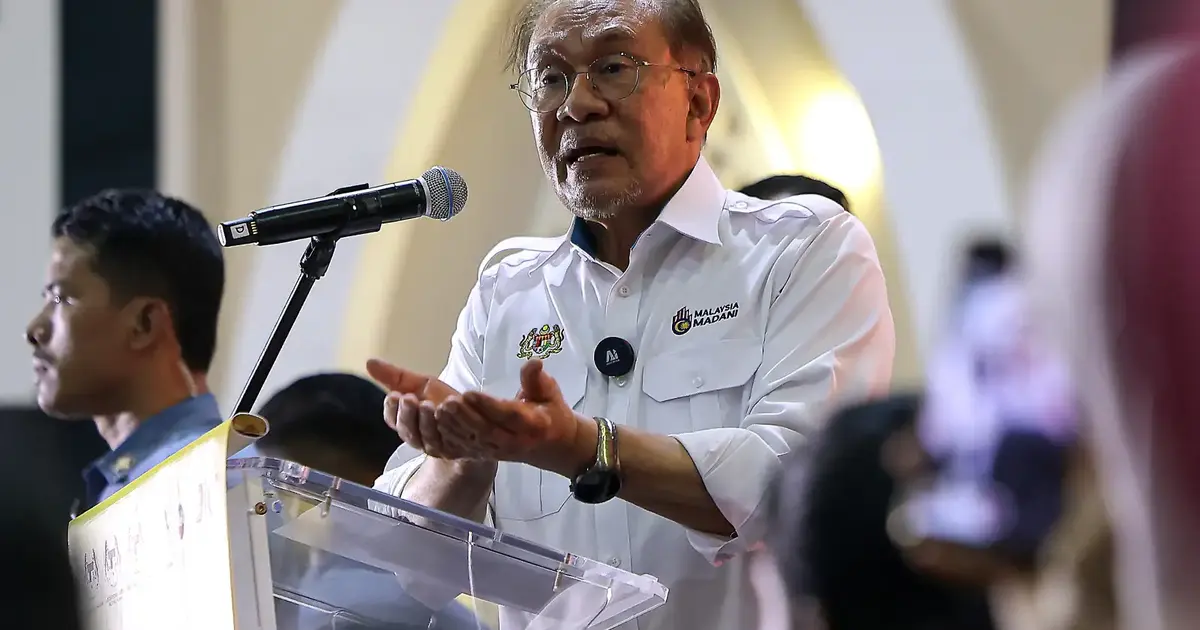
Prime Minister Anwar Ibrahim has moved to dispel what he characterises as a persistent misunderstanding in Malaysian political discourse: the notion that advancing the welfare and rights of Chinese and Indian communities necessarily comes at the expense of Islam's position or Malay constitutional privileges. In remarks that reflect ongoing tensions within Malaysia's delicately balanced plural society, Anwar has emphasised that these objectives are fundamentally compatible rather than mutually exclusive.
The prime minister's intervention speaks to a deeper anxiety that periodically surfaces in Malaysian public life. Whenever governments propose measures intended to address economic disparities, educational access, or social equity affecting non-Malay communities, critics argue such initiatives breach the constitutional settlement enshrined in the country's founding documents. This framing has become a recurring feature of political debate, particularly during periods of racial or religious sensitivity. By explicitly rejecting this binary logic, Anwar appears to be signalling his administration's intent to navigate Malaysia's complex constitutional architecture without retreating from inclusive governance.
The constitutional position of the Malays and Islam in Malaysia represents a cornerstone of the nation's founding bargain. Article 153 of the Federal Constitution guarantees certain special rights and privileges for Malays and bumiputera communities, including reserved quotas in public sector employment, scholarships, and business licences. These provisions were negotiated as part of the original independence agreement and remain deeply significant to Malay-Muslim political identity. Any perceived threat to these arrangements typically provokes swift and intense political reaction, making Anwar's reassurance strategically important for maintaining governmental credibility across communal lines.
Simultaneously, Malaysia's Chinese and Indian populations—together comprising roughly forty percent of the national population—have long navigated their place within a constitutional framework that privileges another community. Successive governments have oscillated in their commitment to addressing disparities faced by these minorities, from education funding to business opportunities to representation in civil service structures. Under Anwar's leadership, his administration has signalled renewed attention to these concerns, particularly following the electoral performances that brought his coalition to power. This has naturally triggered predictable concerns among those who view any such initiatives with suspicion.
Anwar's rhetorical strategy appears designed to reframe the conversation entirely. Rather than accepting the premise that protecting minorities necessarily erodes majority protections, he argues for a complementary understanding where inclusive governance actually reinforces the health and legitimacy of Malaysia's constitutional order. This framing suggests that constitutional arrangements prove durable only when all communities perceive them as fundamentally fair and when no group believes governance is structured to systematically exclude them from economic participation or social advancement.
The prime minister's position also carries implications for Malaysia's regional standing. As a multicultural democracy in Southeast Asia, Malaysia's approach to minority rights influences perceptions of democratic governance across the region. Investors, international observers, and neighbouring nations pay attention to how Malaysian administrations manage interethnic relations. By articulating a vision where religious and ethnic constitutional protections coexist with substantive minority rights protection, Anwar potentially strengthens Malaysia's international reputation as a functional plural democracy.
Implementing this vision, however, requires sustained political will and careful calibration. Previous attempts by Malaysian governments to balance these competing demands have often faltered when opposition figures successfully mobilised concerns about constitutional dilution among Malay-Muslim constituencies. The political costs of appearing insufficiently protective of majoritarian interests can be steep, potentially explaining why progress on minority rights has historically proved episodic and contested.
Anwar's remarks also reflect broader developmental anxieties within Malaysia. Economic competitiveness increasingly depends on leveraging talent regardless of ethnic background, and systematic exclusion of significant population segments from certain sectors represents a potential drag on national productivity and innovation. From this perspective, ensuring that Chinese and Indian Malaysians have equitable access to quality education and professional opportunities serves not minority interests narrowly conceived, but national economic interests broadly understood.
The memorandum of understanding that currently sustains Anwar's coalition government involves partners representing different communal constituencies. Maintaining this arrangement requires demonstrating to each component that the prime minister's government delivers tangible benefits while respecting core constitutional positions. Anwar's statement can be read as an attempt to navigate these political constraints by explicitly reassuring Malay-Muslim partners that inclusive governance does not entail constitutional revisionism.
Looking forward, the test of such rhetoric lies in implementation. Malaysian voters across communal lines will assess whether Anwar's government translates these principles into policy outcomes affecting education access, economic opportunity, and public sector representation. Success in this endeavour could help normalise the notion that constitutional protections and minority rights protection represent complementary rather than contradictory imperatives, potentially reshaping how Malaysians discuss these perpetually contested issues.

