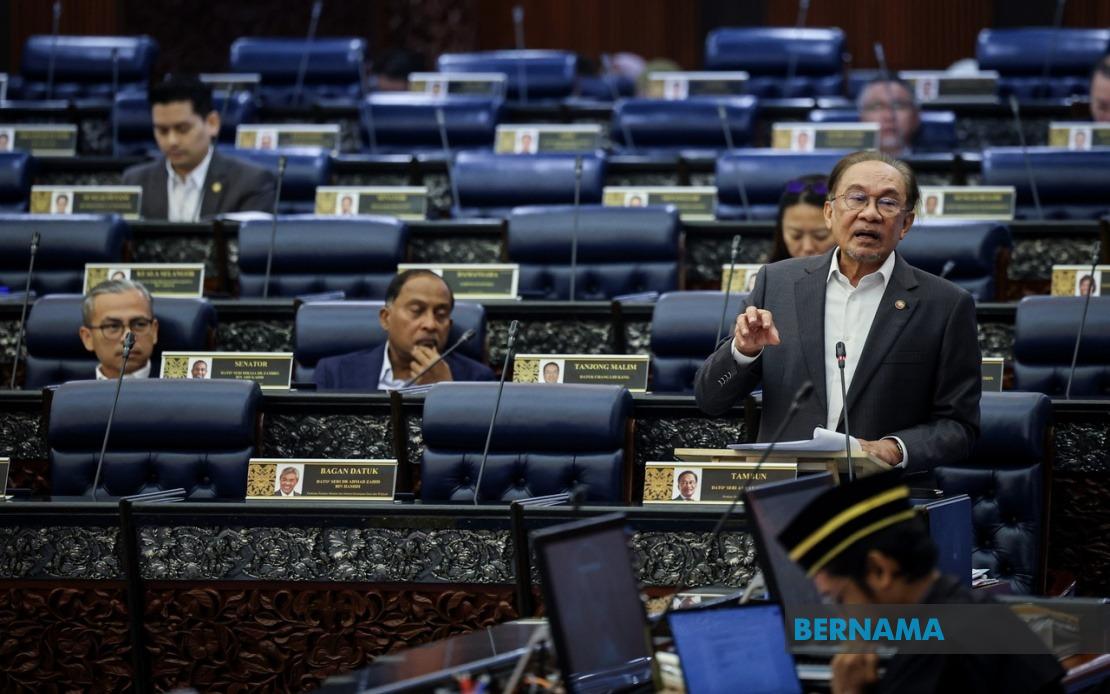
Prime Minister Datuk Seri Anwar Ibrahim moved to dispel any perception of overreach in his recent public remarks about the Johor state election, telling parliament that his observations on polling day selection represented merely his individual thinking rather than any attempt to sway the Election Commission's independent authority. Speaking during Minister's Question Time in the Dewan Rakyat on July 7, Anwar underscored that while he had expressed a preference for Sunday voting on practical grounds, the EC retained complete discretionary power to set the actual date regardless of his views.
Anwar's clarification emerged after he had previously stated his reasoning during the Johor campaign, noting that a Sunday election would accommodate the significant Malaysian workforce based in Singapore who have limited availability on weekends due to work commitments. He elaborated that many such workers operate under Saturday half-day schedules, making a Sunday poll date more convenient for their participation. However, he was careful to emphasise that should the EC proceed with Saturday voting—as ultimately occurred—that represented a legitimate independent decision warranting full acceptance and respect from all quarters.
The prime minister's measured response to parliamentary questioning reflects broader sensitivities surrounding the EC's constitutional independence, a principle central to Malaysia's democratic framework. Any suggestion that executive officials pressure the commission or influence its determinations could undermine public confidence in the neutrality of electoral administration. By explicitly distinguishing between personal commentary and institutional interference, Anwar sought to reinforce that his role as premier does not extend to directing the EC's operational choices, even when he holds substantive policy preferences.
The issue gained particular prominence because Malaysians residing and working in Singapore represent a distinct electoral constituency with specific logistical challenges. The cross-border worker demographic, numbering in the hundreds of thousands, has historically faced difficulties returning to Malaysia for voting due to employment obligations and transport constraints. This population's voting participation directly influences electoral outcomes in constituencies with significant cross-border employment, making the practical scheduling of polls a legitimate policy consideration beyond mere administrative convenience.
When asked whether he might engage Singapore's Prime Minister Lawrence Wong to facilitate voting arrangements for Malaysian residents there, Anwar firmly rejected the proposition. He reiterated Malaysia's commitment to the principle of electoral sovereignty and non-interference in another nation's internal democratic processes. While acknowledging his personal rapport with Wong and the robust overall relationship between Kuala Lumpur and Singapore, Anwar stressed that matters concerning Malaysian elections constituted purely domestic affairs requiring no external coordination or governmental-level negotiation with Singapore's leadership.
He did clarify, however, that private companies operating in Singapore with Malaysian staff had independently been informed of their workers' voting entitlements and encouraged to accommodate their temporary absences when elections occurred. This distinction—between government-to-government coordination and employer-level facilitation—proved significant, as it allowed Anwar to acknowledge practical support mechanisms without implying any formal diplomatic engagement over electoral matters. The approach reflected acknowledgment that private sector cooperation could address logistics without requiring state-level diplomatic involvement.
Anwar's parliamentary intervention addressed supplementary questions from Ahmad Fadhli Shaari of PN representing Pasir Mas and Mohd Sany Hamzan of PH representing Hulu Langat. Their inquiries probed whether the prime minister had overstepped appropriate bounds in his public commentary and whether Malaysia should formally negotiate voting logistics with Singapore. These questions likely reflected broader scrutiny within parliament regarding the proper boundaries between executive influence and the EC's operational independence, a perpetual constitutional tension in any electoral system.
The episode underscores how Malaysian public discussion of electoral matters frequently touches on questions of institutional autonomy and political propriety. The EC, constitutionally mandated as an independent body, nonetheless operates within a political environment where senior officials inevitably hold opinions on policies affecting elections. Drawing clear lines between permissible commentary and impermissible interference remains an ongoing challenge requiring vigilance from both political leaders and institutional custodians of democratic processes.
From a regional perspective, the Johor election and its associated logistical considerations also reflect Southeast Asia's complex cross-border labour patterns. Singapore's status as a major employment hub means Malaysian electoral participation increasingly depends on practical arrangements accommodating workers temporarily abroad. Similar dynamics affect other regional states, suggesting that electoral commissions across Southeast Asia face comparable challenges in designing polling systems that accommodate mobile, internationally-engaged populations while maintaining procedural integrity and independence.
Anwar's comments also carry implications for how Malaysia manages its substantial relationship with Singapore. Both countries maintain deliberately compartmentalised diplomatic engagement that separates electoral affairs from bilateral cooperation. By categorically declining to involve Singapore's government in Malaysian voting arrangements, Anwar reinforced this careful separation, even while acknowledging strong personal ties with his counterpart and pointing to broader cooperation frameworks between the nations.

