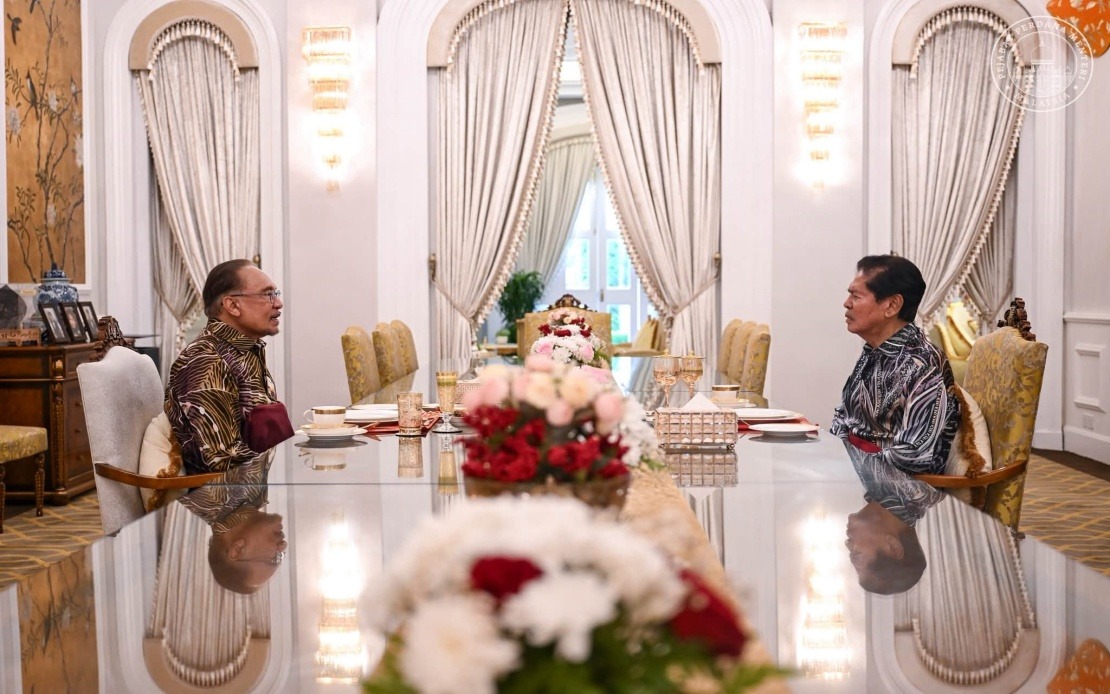
Prime Minister Datuk Seri Anwar Ibrahim brought his two-day working visit to Penang to a close on Thursday with a formal tea reception at Seri Mutiara, the official residence of Governor Tun Ramli Ngah Talib. The private gathering served as a ceremonial capstone to a schedule packed with official engagements across the state, reflecting the customary diplomatic protocol that accompanies high-level state visits by the nation's top leadership.
Through a social media update, Anwar characterised the occasion as an opportunity to deepen the existing partnership between Malaysia's federal administration and Penang's state government. He emphasised that both levels of government remain aligned in their vision for advancing Penang's economic and social progress, signalling continuity in the collaborative framework that has underpinned recent developmental initiatives across the northern state.
Governor Ramli extended warm remarks about receiving the Prime Minister, noting that the visit facilitated meaningful dialogue on pressing issues affecting both Penang's regional interests and Malaysia's broader national agenda. His comments underscored the significance of such direct exchanges between federal and state leadership in navigating complex governance challenges and aligning policy priorities during a period of significant national development efforts.
A particularly human element emerged when Ramli recounted how his grandson, Aldrey Alfi, attended the reception and engaged the Prime Minister with questions, describing how Anwar graciously entertained the young visitor. The Governor's public acknowledgment of this intergenerational moment, while seemingly informal, reflects a broader pattern of Malaysian political culture wherein leaders cultivate personal connections across formal state visits, humanising what might otherwise remain purely transactional diplomatic events.
Anwar's itinerary during his Penang stay was notably comprehensive, encompassing multiple sectors and demographic groups across the state's economy and society. The Prime Minister participated in launching the Permatang Pauh Entrepreneur Revival Programme, an initiative targeting business recovery and economic resilience within this historically significant parliamentary constituency, which has long held particular importance within Malaysia's political landscape.
The visit also included Anwar's attendance at the 15th Malaysia Scout Jamboree, positioning him alongside youth organisations and demonstrating federal government commitment to youth development and civic engagement through established institutional channels. Scout movements in Malaysia carry significant cultural and patriotic dimensions, making such appearances symbolically important for political leadership seeking to reinforce national values and intergenerational continuity.
Additionally, Anwar participated in the MADANI Sahabat 2026 National Day Countdown Programme, aligning with the government's broader MADANI framework that has become central to the administration's policy messaging. This initiative connects to preparations for Malaysia's coming anniversary celebrations and reflects efforts to build momentum around the government's development agenda well in advance of commemorative national events.
The concentration of these activities within a single two-day visit reveals how contemporary Malaysian political practice orchestrates multiple public appearances and policy announcements into a single state visit, maximising media coverage and demonstrating active federal engagement across diverse constituencies. Such comprehensive scheduling also allows the Prime Minister to address various stakeholder groups—entrepreneurs, youth, and the broader public—within a focused timeframe, creating a cascading series of news cycles that extend the political impact of the visit beyond the state's borders.
Penang occupies a strategically important position within Malaysia's economic and political geography, functioning as a major manufacturing and trade hub while simultaneously representing a state where opposition parties have maintained considerable influence. Federal visits to Penang thus carry particular significance as opportunities to showcase federal-state cooperation regardless of partisan differences, particularly when focused on economic development and non-contentious nation-building activities.
The formal reception at the Governor's residence represents the traditional conclusion to such visits, providing a moment for senior officials to reflect publicly on outcomes and reinforce messaging about collaboration and shared purpose. By emphasising the warmth of his reception and the productive nature of discussions, Ramli signalled to Penang's residents and the broader Malaysian public that functional working relationships between federal and state authorities remain intact despite the state's complex political landscape.
Anwar's participation in such ceremonial moments forms part of a larger pattern whereby Malaysia's federal leadership invests in maintaining symbolic unity and institutional cooperation across the federation's constituent states. These interactions, though sometimes appearing routine in media reporting, serve important functions in reassuring state-level stakeholders about federal commitment to their regions and in preventing the emergence of governance disconnects that might undermine policy implementation or national cohesion.

