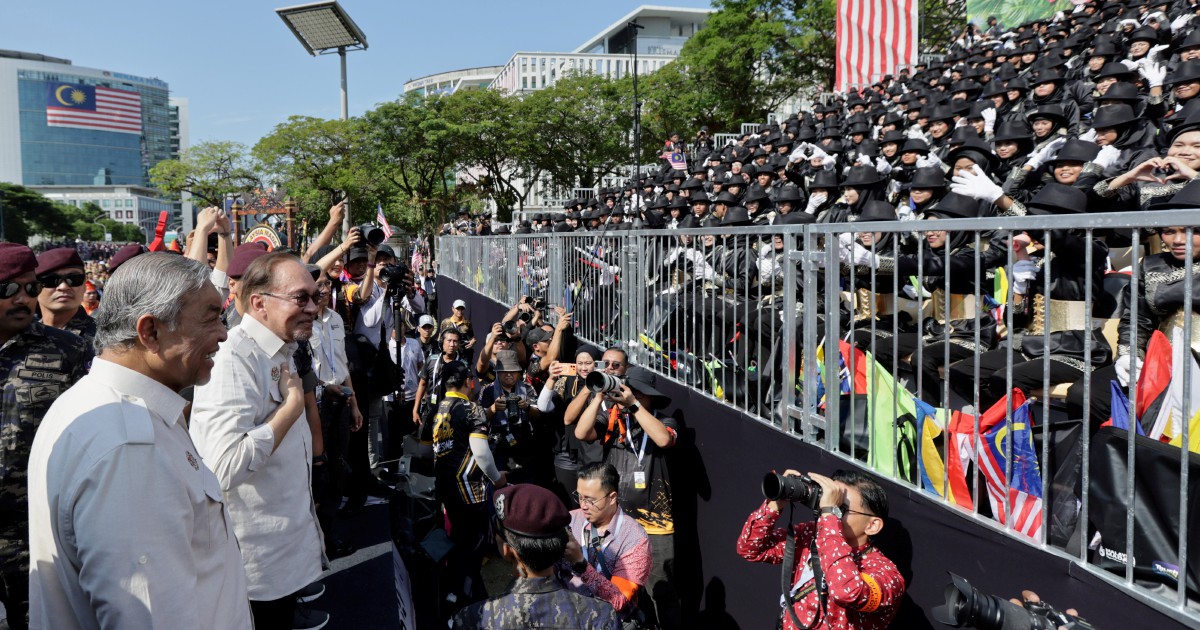
Prime Minister Datuk Seri Anwar Ibrahim seized the opportunity following this year's National Day parade at Dataran Putrajaya to engage directly with members of the public, moving beyond the ceremonial confines of the official proceedings to connect with ordinary Malaysians. Rather than departing immediately after the formal celebrations concluded, Anwar undertook an impromptu walkabout through the crowd, stopping frequently to acknowledge well-wishers and interact with younger attendees who had gathered to witness the festivities marking the nation's independence.
The spontaneous engagement reflected a leadership approach increasingly centred on visible accessibility and grassroots connection, with the Prime Minister demonstrating a willingness to move beyond prepared remarks and staged appearances. Throughout his passage through Dataran Putrajaya, Anwar repeatedly paused to speak with citizens, his interactions marked by genuine warmth and an apparent comfort in informal public settings. The moments captured attention partly because such unscripted exchanges remain relatively uncommon at high-level state ceremonies, where security protocols and event schedules typically constrain senior officials' movement and availability.
Children constituted a particular focus of Anwar's attention during the walkabout, with the Premier engaging in extended interactions with multiple young attendees and embracing several throughout his journey across the venue. These moments carried symbolic weight within Malaysia's political culture, where direct engagement with young citizens can signal a leader's commitment to intergenerational connection and future-oriented governance. The informal nature of these exchanges stood in contrast to the rigidly structured ceremonial aspects of the National Day parade itself, creating a more personalised dimension to the public appearance.
The location itself—Dataran Putrajaya, the ceremonial heart of Malaysia's federal administrative centre—provided a significant backdrop for these interactions. As the appointed venue for major state functions and celebrations, Putrajaya carries substantial symbolic importance within Malaysia's national narrative. The choice to conduct an extended public engagement at this location underscored the occasion's significance whilst also democratising the space through informal interaction, transforming a formal ceremonial ground into a site of more accessible leadership presence.
National Day celebrations in Malaysia traditionally blend ceremonial grandeur with expressions of national unity and patriotic sentiment. The parade component of such events showcases military capabilities, cultural performances, and civic participation, drawing thousands of spectators and commanding significant media coverage. However, the post-parade period typically receives less public attention, making Anwar's decision to utilise this timeframe for extended public interaction a deliberate choice to extend the engagement beyond the formal programme.
The walkabout's emphasis on interaction with families and younger Malaysians reflects broader contemporary trends in political communication, particularly the emphasis placed on demonstrating accessibility and approachability. In an era of social media scrutiny and heightened public expectations around leadership conduct, such moments generate significant photographic and video documentation, extending their reach far beyond those physically present at Dataran Putrajaya. The informal interactions thus acquire a dual function, serving both as authentic public engagement and as curated messaging for broader consumption.
For Malaysian citizens present at the celebration, such unplanned accessibility can carry meaningful psychological impact, creating personal memories of proximity to national leadership that extend beyond typical hierarchical political arrangements. These moments, captured and circulated through various digital platforms, contribute to broader perceptions of a leader's character and governance philosophy. The emphasis on embracing children particularly resonates within Malaysian culture, where such gestures typically convey warmth, continuity, and investment in the nation's future.
The National Day parade remains one of Malaysia's principal annual civic occasions, drawing participation from governmental, military, and civil society organisations. Beyond the ceremonial aspects, such events serve important nation-building functions, reinforcing collective identity and shared national purpose. The post-parade public engagement thus became an extension of this broader commemorative mission, translating the abstract concept of national unity into tangible human interaction.
For the Prime Minister's office, the documented interactions likely serve strategic communications objectives, demonstrating leadership qualities including approachability, genuine interest in citizens' welfare, and comfort with unmediated public contact. Within Malaysian politics, such imagery and anecdotes contribute significantly to public perception and political legitimacy. The spontaneity of the walkabout, whether genuinely unplanned or carefully orchestrated to appear so, reinforces a leadership brand centred on accessibility and direct engagement rather than formal distance.
These interactions occur within a broader context of Malaysian political development, where expectations around leadership engagement have evolved considerably. Citizens increasingly anticipate meaningful access to elected representatives and senior officials, with perceptions of aloofness or remoteness potentially damaging political standing. Anwar's demonstrated comfort with informal, unstructured public engagement thus addresses contemporary expectations regarding leadership accessibility and responsiveness to constituent concerns.

