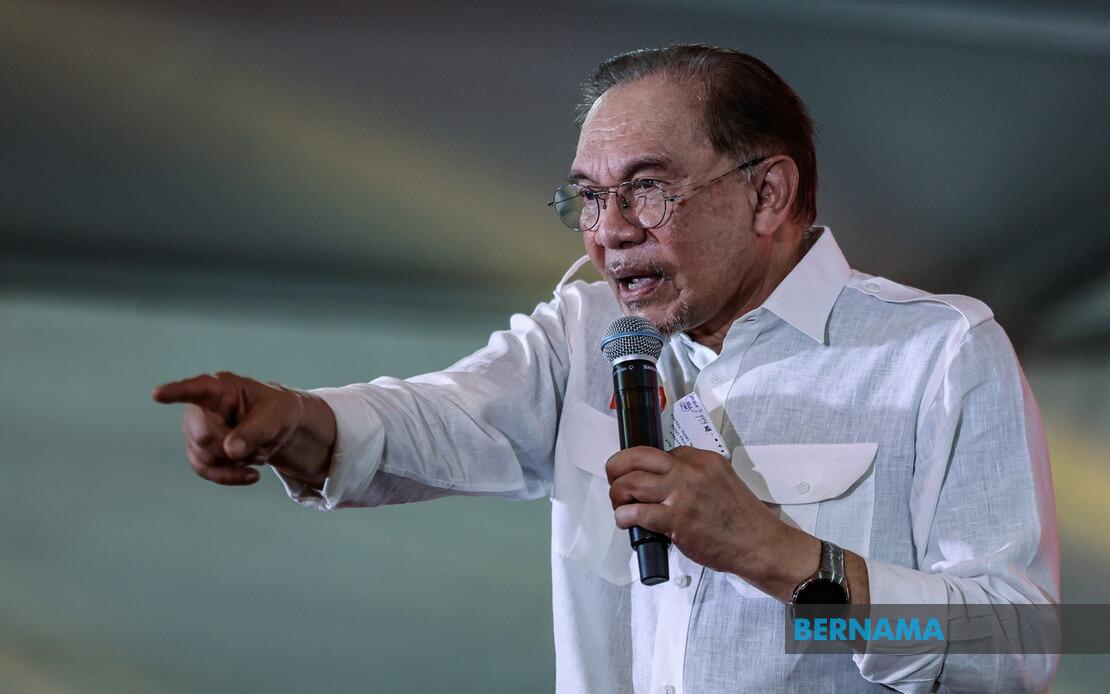
Prime Minister Datuk Seri Anwar Ibrahim has expressed frustration with what he characterizes as unwarranted political attacks from Kedah Menteri Besar Datuk Seri Muhammad Sanusi Md Nor, while reiterating his administration's determination to propel the state forward economically. The Pakatan Harapan chairman's remarks, made during a campaign event in Simpang Renggam, underline an ongoing friction between federal and state-level leadership in Kedah, a state governed by the opposition Parti Islam SeMalaysia.
Anwar's comments came after Sanusi had publicly criticized him in Johor, apparently questioning the Prime Minister's approach to federal-state relations since taking office. The PM seized the opportunity to highlight concrete developmental initiatives, pointing to his decision to bring Thai Prime Minister Anutin Charnvirakul to Bukit Kayu Hitam rather than keeping high-level diplomatic engagements confined to the capital. This deliberate choice of venue underscores a broader strategy of directing international economic partnerships toward border regions and peripheral areas that traditionally receive less prominent national attention.
The road alignment project connecting Malaysia's Bukit Kayu Hitam Immigration, Customs, Quarantine and Security Complex to Thailand's Sadao Customs, Immigration and Quarantine facility represents infrastructure advancement aimed at facilitating smoother bilateral trade flows. By bringing the Thai Prime Minister to officially inaugurate this connection, Anwar sought to demonstrate tangible federal commitment to enhancing economic integration at the Malaysia-Thailand border, an area that stands to benefit both Kedah and Perlis. This infrastructure improvement addresses longstanding logistical bottlenecks that have constrained cross-border commerce and movement, matters of considerable consequence for residents and businesses in the northern corridor.
Central to Anwar's defense is his assertion that federal development initiatives transcend partisan politics, a principle he emphasized by explicitly acknowledging Kedah's governance under the opposition PAS. This stance reflects a deliberate effort to position the Pakatan Harapan-led administration as pursuing a nationwide development agenda unburdened by factional considerations. The Prime Minister articulated this position clearly, noting that his responsibility extends to all Malaysians and that he harbors no intention of sidelining any state on account of its political complexion.
Sanusi's earlier critiques, according to media reports, revolved around the Prime Minister's perceived tendency to frame federal assistance as a dependency relationship, suggesting that Anwar's governance approach treats states as subordinate entities reliant upon Kuala Lumpur's largesse. This characterization taps into historical sensitivities concerning federal-state power dynamics in Malaysia's federalist structure, particularly among state administrations governed by opposition parties who fear potential marginalization in resource allocation and development prioritization.
The timing of this exchange is notable, occurring as the Johor state election looms, with Anwar conducting an intensive campaign schedule to bolster Pakatan Harapan's electoral machinery and candidate visibility. His Simpang Renggam appearance represented one of five campaign events staged in Johor on that single day, reflecting the central importance of the southern state to the coalition's strategic objectives. Against this backdrop, the friction with Sanusi takes on additional dimensions, illustrating how federal-state relations remain intertwined with broader electoral calculations and intra-coalition dynamics.
Beyond the immediate controversy, Anwar utilized the occasion to announce potential enhancement of the Sumbangan Asas Rahmah assistance program, a welfare initiative designed to provide basic relief to economically disadvantaged Malaysians. The Prime Minister indicated that expanded allocations would become feasible provided the Federal Government maintains fiscal stability and continues receiving electoral validation from the populace. This conditional framing subtly ties the administration's capacity to enhance social assistance to sustained political support and prudent financial stewardship, linking domestic welfare improvements to macroeconomic performance and electoral fortunes.
The dispute illuminates broader tensions within Malaysia's political landscape regarding the respective roles and influence of federal and state governments, particularly when opposing political coalitions control different levels of administration. Border-region infrastructure development takes on heightened importance in this context, as such projects yield measurable economic benefits that can demonstrate federal effectiveness to constituents in opposition-held territories, potentially strengthening support for the ruling coalition ahead of future electoral contests.
Anwar's insistence that no state faces deliberate federal neglect addresses a perception problem that opposition-controlled governments have periodically raised, claiming systematic disadvantage in resource distribution and development project allocation. By directing high-profile international diplomatic engagement toward Kedah's border region and investing in infrastructure that serves both Kedah and neighboring Perlis, the PM sought to provide concrete evidence contradicting Sanusi's characterizations. Such actions carry particular significance given Malaysia's federal structure, wherein state governments retain considerable authority over local administrative matters and public perception.
The road-connectivity initiative between the two nations reflects broader Southeast Asian regional integration trends, wherein improved cross-border infrastructure facilitates trade intensification and economic complementarity among neighboring countries. For Malaysia's northern states, enhanced Thailand connectivity offers avenues for expanding market reach and attracting investment that leverages geographic proximity and cultural affinities. Anwar's emphasis on bringing the Thai leadership to witness this project opening suggests recognition that regional development narratives hold considerable sway with voters concerned about their state's economic trajectory and competitive positioning within Malaysia's federal economy.
Looking forward, the trajectory of federal-state relations in Kedah will likely influence broader political dynamics across Malaysia, particularly as opposition-controlled states navigate their relationship with a Federal Government led by a different political coalition. The episode demonstrates how development initiatives extend beyond purely technical or economic considerations, becoming instruments through which political leaders communicate narratives about capability, equity, and commitment to diverse constituencies. Whether Sanusi's criticisms gain traction among Kedah voters, or whether Anwar's tangible infrastructure projects succeed in redirecting public perception, remains contingent on how effectively each administration translates policy announcements into visible, community-level improvements that residents recognize as enhancing their daily economic opportunities and quality of life.

