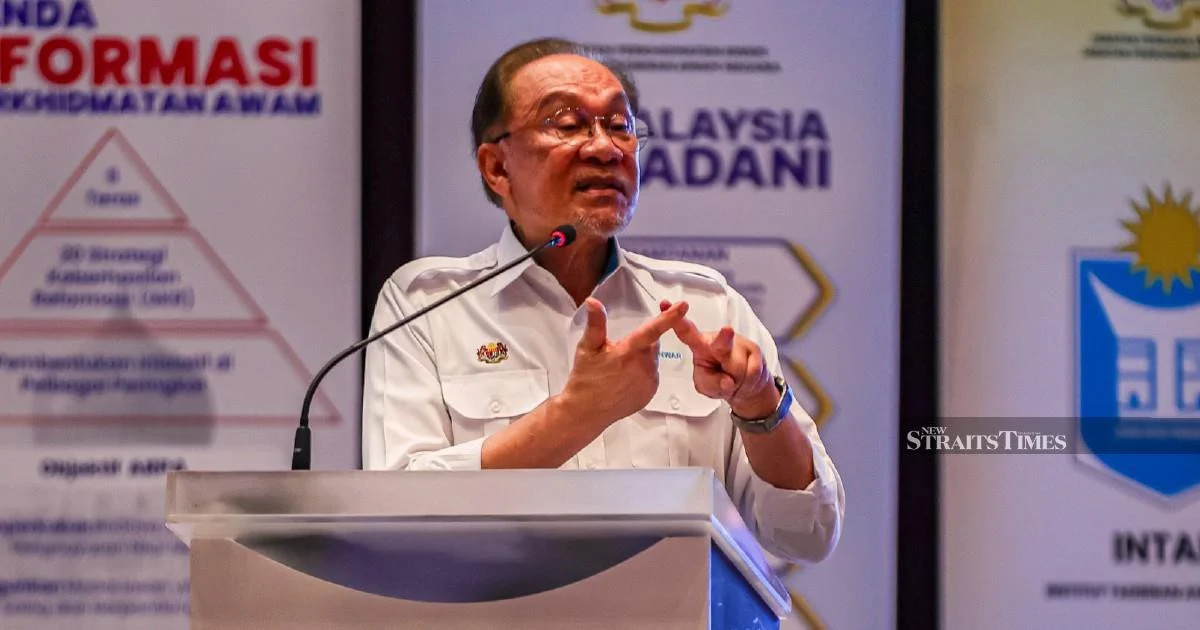
Prime Minister Datuk Seri Anwar Ibrahim moved to quell brewing tensions within Malaysia's political landscape on Friday, defending Amanah president Datuk Seri Mohamad Sabu against allegations that his recent remarks constituted mockery of rival parties. Speaking in Alor Gajah, Anwar characterised the furore as an overreaction and sought to reframe the narrative around the contentious speech delivered during the Pakatan Harapan candidate announcement ceremony in Tangkak. The intervention represents an attempt by the Prime Minister to prevent what could have escalated into a damaging internal conflict at a time when the ruling coalition faces multiple political pressures.
The controversy stems from comments made by Mohamad Sabu, commonly known as Mat Sabu, at the coalition-wide event in the Johor constituency. Critics from opposing camps seized on the remarks as evidence of disrespect towards their respective organisations, though the precise nature of the allegedly offensive content remained subject to interpretation across different political constituencies. This type of dispute has become increasingly common in Malaysia's hyperactive political environment, where statements are routinely parsed for hidden meanings and treated as fodder for inter-party disputes.
Anwar's swift response underscores his position as the coalition's principal arbiter in disputes between member parties, a role that grows more complicated as ideological and strategic differences within Pakatan Harapan occasionally surface. By publicly defending Mat Sabu, Anwar signalled that he views the incident as negligible rather than symptomatic of deeper fractures within the alliance. The Prime Minister's measured tone also reflects his broader governing philosophy of maintaining sufficient cohesion among coalition partners to sustain the federal administration's stability and legislative agenda.
The incident illuminates the precarious balance within Pakatan Harapan, which comprises ideologically diverse parties that have managed a largely functional alliance despite periodic tensions. Amanah, as a party with significant representation in certain states and a meaningful voice in cabinet-level discussions, occupies a delicate position where its leaders must navigate internal party expectations whilst contributing constructively to broader coalition decisions. Mat Sabu, in particular, occupies a prominent role as Defence Minister and party president, making his public utterances subject to heightened scrutiny from both allies and opponents.
The Tangkak candidate announcement itself carried particular significance, as this Johor parliamentary seat represents contested territory where the governing coalition faces determined challenges from opposition forces. Such events typically feature rousing rhetoric designed to energise party members and supporters ahead of electoral campaigns, and speeches frequently contain pointed references to opposition parties' perceived shortcomings. The line between robust political criticism and inflammatory rhetoric remains contested terrain in Malaysian political discourse, with different actors maintaining substantially different thresholds for what constitutes acceptable language.
Anwar's decision to intervene publicly rather than allow the matter to fester quietly suggests his assessment that allowing the narrative to develop independently could generate unnecessary friction precisely when the coalition requires maximum unity. The Prime Minister's call for calm addresses not only the immediate parties involved in the dispute but also serves as a broader signal to coalition members that he expects restraint and measured responses to provocations, real or perceived. This managerial approach has characterised much of Anwar's tenure as Prime Minister, emphasising inclusive governance and conflict resolution over confrontational leadership.
The political context surrounding this incident deserves consideration, as Malaysia's opposition parties and critical media outlets have consistently framed any coalition-internal disputes as evidence of instability and dysfunction. By moving quickly to defuse tensions and presenting a united front, Anwar attempts to deny critics ammunition for claims that Pakatan Harapan operates as an incoherent alliance perpetually on the verge of collapse. Such perceptions, whether accurately founded, carry genuine consequences for voter confidence and legislative effectiveness, making Anwar's interest in maintaining visible harmony a matter of substantial practical importance.
Mat Sabu himself represents a particular political phenomenon in contemporary Malaysia—a figure whose background as a former Islamist activist transformed into a coalition-building moderate commands respect across certain demographic segments whilst simultaneously generating suspicion among others. His dual role as Defence Minister and party president places him in a position where his statements carry government authority as well as partisan significance, complicating efforts to parse his intentions. The controversy surrounding his Tangkak remarks reflects broader societal debates about political discourse norms and the appropriate boundaries for criticism amongst coalition partners.
Looking forward, this incident may serve as a cautionary moment for Amanah and other coalition members to exercise heightened vigilance regarding potential misinterpretations of their public statements. The ease with which political remarks can be weaponised by opportunistic opponents suggests that coalition partners must calibrate their communication with awareness of how statements might be received across the broader political spectrum. Anwar's backing of Mat Sabu, however, sends a countervailing message that overly cautious self-censorship among coalition members is neither necessary nor desirable.
The episode ultimately reflects the perpetual challenge facing any governing coalition in a highly polarised political environment: maintaining sufficient internal cohesion for effective governance whilst allowing member parties sufficient latitude to pursue their distinct political identities and appeal to their core constituencies. Anwar's handling of this matter suggests his preference for diplomatic resolution and his calculation that projected unity serves the coalition's interests more effectively than allowing disputes to fester and expand. Whether this approach generates long-term stability or merely postpones inevitable confrontations remains an open question as Malaysia's political landscape continues its volatile trajectory.