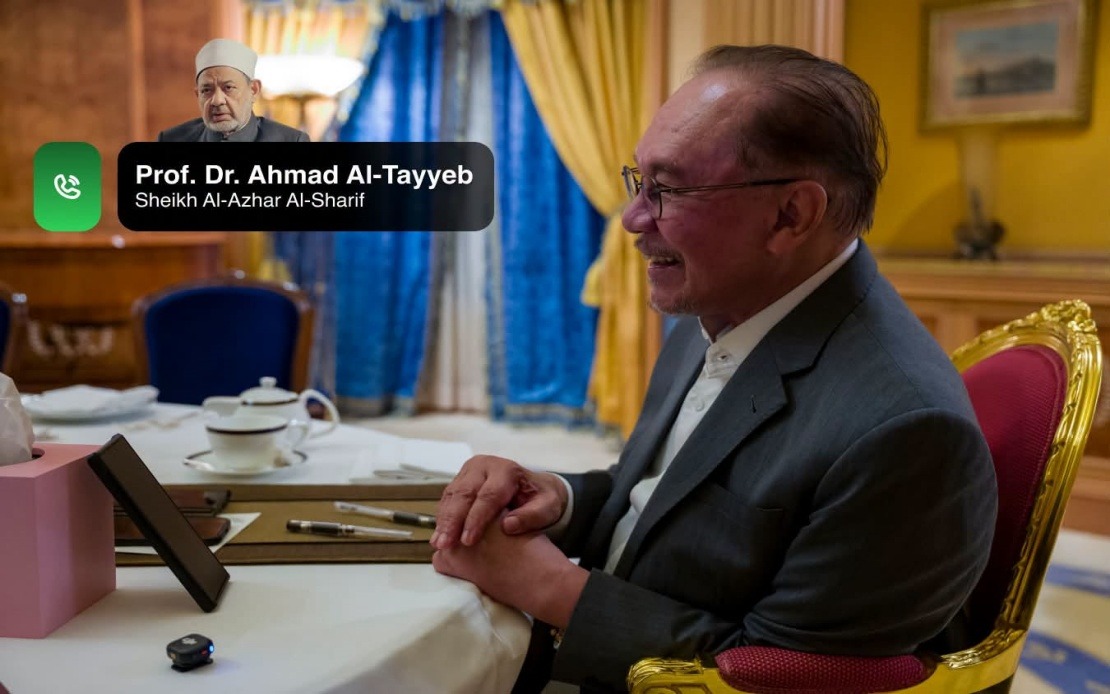
Prime Minister Datuk Seri Anwar Ibrahim has engaged in meaningful dialogue with one of Islam's most revered institutional leaders, Sheikh al-Azhar al-Sharif Prof Dr Ahmad al-Tayyeb, in a telephone conversation centred on advancing Islamic understanding and religious scholarship across Malaysia. The discussion took place following Anwar's recent surgical procedure, during which the prominent Egyptian cleric reached out to inquire about the Prime Minister's health and extend his prayers for a swift recovery.
In recounting the exchange through social media, Anwar expressed deep gratitude for the Grand Imam's concern and spiritual support, noting that his surgical intervention proceeded without complications and his recuperation has progressed favourably. The conversation transcended courtesy pleasantries, however, transitioning into substantive dialogue regarding the continuation and expansion of dakwah—Islamic outreach and education—initiatives designed to deepen religious comprehension within Malaysian society and beyond. This thematic focus reflects Anwar's broader commitment to positioning Malaysia as a centre for progressive Islamic thought and interfaith understanding within the Southeast Asian region.
The Prime Minister emphasised that Sheikh al-Tayyeb's counsel and intellectual guidance would remain instrumental in preserving and advancing the noble traditions of Islamic knowledge. The invocation of this guidance suggests a deliberate alignment with Al-Azhar's reputation as a bastion of Sunni Islamic learning, an institution that has shaped Islamic jurisprudence and theology for over a millennium. For Malaysia, such a connection carries particular significance given the country's position as a Muslim-majority nation seeking to navigate contemporary challenges whilst maintaining doctrinal integrity and scholarly rigour.
Anwar specifically recalled the Grand Imam's previous visit to Malaysia, characterising it as leaving an indelible impression upon the Malaysian Muslim community. This reference carries weight beyond sentiment; it underscores how high-level engagement with international Islamic institutions can amplify soft power and enhance Malaysia's standing within the global Islamic community. Al-Azhar's imprimatur on Malaysian Islamic initiatives lends credibility and scholarly authority to local efforts, particularly when those efforts emphasise moderate, inclusive interpretations of Islamic teaching.
Looking forward, Anwar expressed hope for renewed in-person meetings between himself and Sheikh al-Tayyeb, proposing either Cairo or Kuala Lumpur as venues for continued collaborative dakwah work and knowledge dissemination. Such bilateral engagement promises tangible benefits for Malaysian Islam, potentially facilitating exchange programmes for Islamic scholars, joint research initiatives, and the harmonisation of Islamic education curricula. The proposition also signals Malaysia's ambitions to cement itself as a bridge between Middle Eastern Islamic scholarship and Southeast Asian Muslim communities, a role that aligns with the government's broader diplomatic strategy.
Parallel to his exchange with the Grand Imam, Anwar also engaged with Mohamed Abdelsalam, Secretary-General of the Council of Muslim Elders (Majlis Hukama Muslimin). This conversation introduced a dimension of personal compassion into the Prime Minister's broader engagement with Islamic institutions, as Anwar took the opportunity to inquire about the health of Abdelsalam's wife, who is currently hospitalised, and to express prayers for her recovery. Such gestures, whilst personal in nature, reinforce the relational bonds that underpin institutional cooperation and demonstrate a holistic approach to diplomacy that acknowledges both official and human dimensions.
Abdelsalam likewise touched upon Sheikh al-Tayyeb's aspiration to revisit Malaysia, a prospect that suggests sustained interest from Egypt's foremost Islamic institution in deepening ties with the Malaysian Muslim community and government. This eagerness for renewed engagement indicates that Al-Azhar perceives Malaysia as a significant partner in advancing shared objectives regarding Islamic education, scholarly exchange, and the promotion of what both institutions characterise as an Islam that is straightforward in principle, liberated from extremist distortions, and grounded in authoritative traditional learning.
The emphasis on strengthening Malaysia's institutional relationship with Al-Azhar reflects a calculated strategic initiative. By cultivating close ties with one of Islam's most prestigious and influential scholarly centres, Malaysia positions itself as a custodian of orthodox Islamic teaching and a proponent of moderate, intellectually rigorous Islamic practice. This approach provides a counterbalance to more rigid or literalist interpretations that sometimes dominate public Islamic discourse in parts of Southeast Asia, whilst simultaneously enhancing Malaysia's soft power credentials within Muslim-majority nations.
Anwar's public acknowledgement of his wife Datuk Seri Dr Wan Azizah Wan Ismail's role throughout his political journey, characterising her as an exemplary woman whose steadfastness and sacrifice have been instrumental to his endeavours, added a personal narrative dimension to the official account. This recognition, whilst tangential to the primary discussion concerning Islamic studies and dakwah, reinforces the Prime Minister's messaging around family values and the role of spousal support in public service, themes that resonate within Malaysian Islamic and conservative circles.
The overarching theme emerging from these conversations is one of coordinated institutional effort aimed at promoting a vision of Islam that is simultaneously deeply rooted in classical scholarship and engaged with contemporary challenges. For Malaysia, such engagement with international Islamic bodies offers practical benefits including enhanced credibility in Islamic governance and education, opportunities for capacity building and scholar exchange, and the ability to position the nation as a moderate voice within global Islamic discourse. The anticipated renewal of Sheikh al-Tayyeb's visit to Malaysia, coupled with plans for expanded collaboration, suggests that this engagement represents a sustained diplomatic priority rather than a episodic exchange, with implications for Malaysia's religious, educational, and foreign policy trajectories in coming years.

