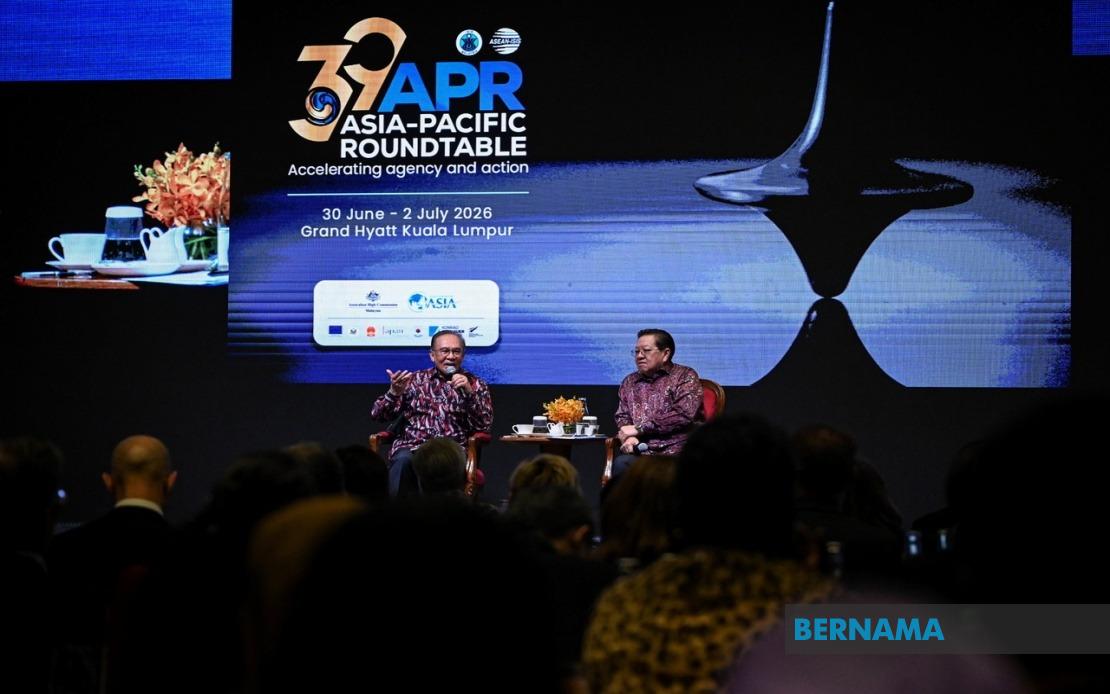
Prime Minister Datuk Seri Anwar Ibrahim has pushed back against what he characterises as alarmist framings of regional security, declaring that conflict in the South China Sea is neither inevitable nor preordained. Speaking during a question-and-answer session at the 39th Asia-Pacific Roundtable in Kuala Lumpur on Thursday, Anwar articulated a more optimistic assessment of Malaysia's bilateral relationship with China and the broader outlook for regional stability, one that stands in contrast to mounting international anxiety about maritime tensions in one of the world's most strategically consequential waterways.
The Prime Minister's remarks reflect Malaysia's longstanding attempt to balance its geopolitical positioning between major powers whilst protecting its own maritime interests. He described his personal interactions with Beijing's leadership, including President Xi Jinping and Premier Li Qiang, as productive and substantive, with no fundamental issues emerging that might kindle significant friction. This characterisation matters not merely for diplomatic protocol but because it signals Malaysia's commitment to maintaining pragmatic relations with its largest trading partner whilst navigating territorial complexities in the disputed waters. The framing also underscores Kuala Lumpur's preference for incremental, confidence-building measures rather than confrontational posturing.
Central to Anwar's position is Malaysia's faith in existing multilateral frameworks designed to manage contested maritime space. He highlighted China's demonstrated support for the United Nations Convention on the Law of the Sea, the foundational legal instrument governing ocean governance globally, as evidence that Beijing operates within internationally sanctioned parameters. Equally significant in his assessment is the ongoing negotiation of an ASEAN-China Code of Conduct in the South China Sea, a protracted diplomatic initiative aimed at establishing behavioural standards and dispute-resolution mechanisms among claimant states. For Malaysia and other Southeast Asian nations with overlapping claims, these frameworks represent the most viable path toward preventing accidental escalation and establishing predictable rules for maritime activity.
Anwar specifically cautioned international and regional observers against what he perceives as exaggerated narratives focused on the prospect of military conflict. This caveat appears directed at commentary emanating from Western capitals and regional security analysts who have intensified warnings about China's assertiveness and the risk of miscalculation among rival claimants. By explicitly rejecting what he termed "phobia" about threats to regional peace, the Prime Minister positioned Malaysia as a voice advocating restraint and realism, pushing back against what Kuala Lumpur may view as inflammatory rhetoric that could become self-fulfilling if it hardens positions on all sides.
The Prime Minister's argument rests significantly on ASEAN's historical record of conflict prevention and the institution's distinctive diplomatic culture. He emphasised that the association's capacity to preserve peace over recent decades stems fundamentally from the quality of personal relationships among member leaders, who maintain direct communication channels enabling them to address disagreements before they metastasise into larger disputes. This observation highlights a crucial distinction between ASEAN's operational reality—characterised by back-channel diplomacy, consensus-seeking, and gradual relationship-building—and the more rigid institutional structures typical of other regional groupings. For Malaysia, which chairs ASEAN in 2023, this philosophy of managed engagement through sustained dialogue aligns with its broader foreign policy orientation.
Anwar's remarks also extended to adjacent regional tensions, specifically the long-standing Cambodia-Thailand border dispute. He welcomed both nations' commitment to continuing negotiations and contextualised many border disagreements across Southeast Asia as legacies of the colonial period, when external powers drew boundaries with limited regard for local geography or populations. This historical framing carries particular resonance for Malaysia, which itself navigates inherited boundary arrangements with its neighbours. His expression of confidence that persistent dialogue and mutual trust would eventually yield peaceful settlements reflects an underlying belief in the region's capacity for gradual, patient resolution of intractable problems—though the track record of some disputes suggests such optimism may sometimes exceed demonstrated progress.
The Prime Minister's intervention at the Asia-Pacific Roundtable carries weight because it publicly articulates positions that help shape how Malaysia is perceived by both regional partners and international observers. By explicitly rejecting conflict inevitability, Anwar signals that Kuala Lumpur will not endorse frameworks premised on zero-sum competition or great-power confrontation. This stance has implications for ASEAN's collective positioning, particularly as the grouping navigates pressures from external actors seeking to align Southeast Asian countries against China or to adopt more confrontational stances on specific disputes.
Simultaneously, Anwar's emphasis on international law and multilateral institution-building suggests Malaysia continues to view these instruments as the most reliable mechanisms for protecting smaller states' interests. The reference to UN Convention on the Law of the Sea is particularly significant, as UNCLOS establishes rights and responsibilities for all maritime actors and theoretically constrains any single power's unilateral actions. For Malaysia, with significant offshore resources and a substantial exclusive economic zone, robust international legal frameworks offer more protection than bilateral negotiations with Beijing would.
The Prime Minister also invoked the need for reforms of global multilateral institutions, including the United Nations and the World Trade Organisation. This framing reflects a broader Malaysian and Southeast Asian frustration with international institutions established in the post-Second World War era, which many developing nations view as inadequately representative of contemporary global realities. Anwar's linkage of South China Sea stability to broader institutional reform suggests he sees regional security challenges as inseparable from questions about how the international system distributes voice and influence.
Anwar's remarks ultimately reflect Malaysia's strategic calculation that sustained engagement, rather than confrontation, offers the most viable path toward protecting its interests whilst maintaining regional stability. This approach acknowledges the reality of maritime disputes without accepting the premise that such disagreements must inevitably produce military conflict. For Malaysian readers, the Prime Minister's position represents a deliberate choice to position the country as a stabilising force, seeking to demonstrate that prosperity and security can coexist with territorial complexity if all parties commit to dialogue, transparency, and adherence to international norms. Whether this optimistic assessment proves vindicated will depend substantially on the intentions and restraint demonstrated by all regional actors in the years ahead.

