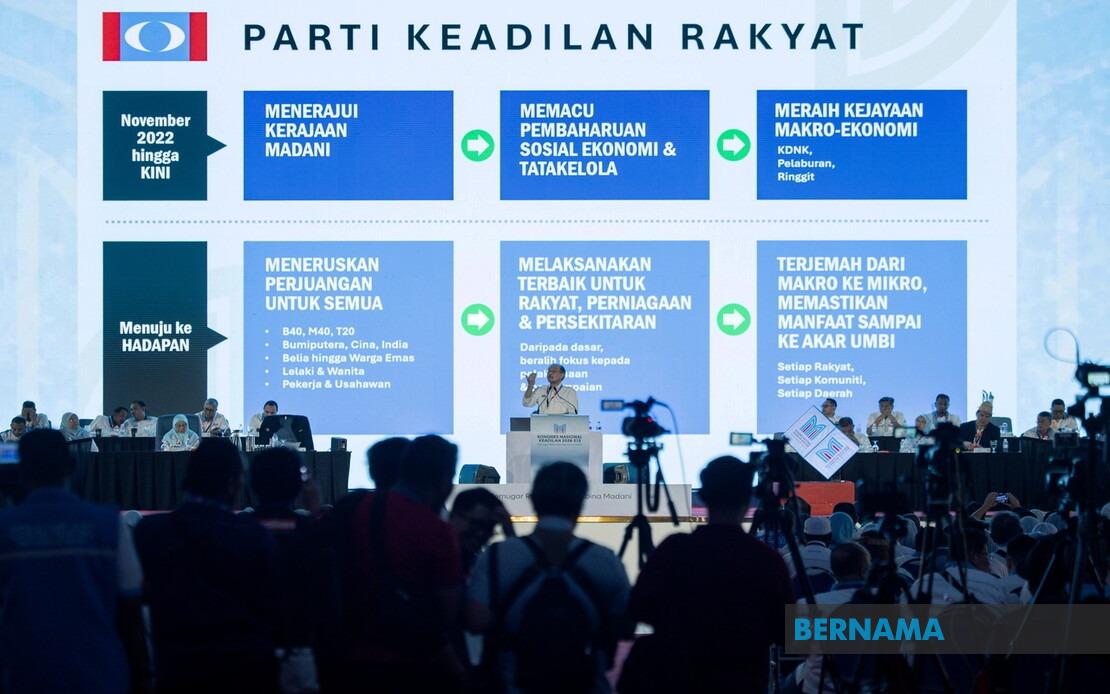
PKR president Datuk Seri Anwar Ibrahim has entrusted Home Minister Datuk Seri Saifuddin Nasution Ismail with complete authority to discharge the responsibilities of party deputy president while Nurul Izzah Anwar steps back temporarily. The announcement came during Anwar's closing remarks at the PKR National Congress 2026, held at the Melaka International Trade Centre in Ayer Keroh on August 16, marking a significant realignment in the party's internal power structure ahead of the next general election cycle.
The interim arrangement represents a deliberate strategic choice by Anwar to consolidate leadership operations within his immediate circle. By characterising Saifuddin Nasution as someone he has known for many years and whose understanding of his working methods runs deep, Anwar signalled continuity and trust rather than operational disruption. This framing is particularly important within PKR's culture, where personal relationships and ideological alignment have historically determined effective governance more than formal titles alone.
Nurul Izzah's temporary leave absence, while not explicitly detailed in official statements, arrives during a challenging period for PKR's electoral prospects. The party suffered a setback in the Negeri Sembilan state election on August 1, losing ground to opposition forces and creating internal pressure for accountability. Allowing the deputy president's position to be filled on an interim basis by someone operationally embedded in the Prime Minister's Office suggests the party prioritises immediate executive functionality over maintaining ceremonial deputy leadership during this transitional phase.
The Central Leadership Council had formally approved Saifuddin Nasution's temporary appointment on August 6, according to PKR Information Chief Datuk Seri Fahmi Fadzil, establishing institutional legitimacy for what might otherwise be perceived as an ad-hoc reshuffle. This procedural soundness matters considerably in Malaysian politics, where party structures and formal governance processes carry symbolic weight beyond their practical function. Membership requires visible adherence to constitutional processes, and the MPP's prior endorsement provides that essential democratic scaffolding.
Concurrently, Anwar announced broader leadership adjustments designed to strengthen electoral machinery and government coordination. Datuk Seri Amirudin Shari, another vice-president, has assumed the role of election director, positioning him centrally in campaign planning and voter mobilisation strategies heading toward the next general election. This appointment acknowledges the urgency of rebuilding PKR's electoral credibility after recent state-level disappointments.
Tengku Datuk Seri Zafrul Tengku Abdul Aziz's designation as Prime Minister's Office coordinator further illustrates Anwar's desire to create direct institutional linkages between party leadership and government machinery. This role carries particular significance for Southeast Asian political contexts, where party structures and state apparatus often operate with significant overlaps. The coordinator position functions as a critical node managing information flow and policy alignment between PKR's strategic interests and governmental implementation.
The Negeri Sembilan situation illuminates underlying tensions within PKR's state structures and the broader challenge of managing disappointed constituencies following electoral reverses. Six PKR division chiefs from Negeri Sembilan had formally requested a review of Datuk Seri Aminuddin Harun's position as chairman of the state leadership council, reflecting grassroots frustration with recent electoral performance. Rather than immediately acceding to these demands, Anwar chose to redefine Aminuddin's responsibilities, redirecting his considerable experience toward cadre development and membership training at various organisational levels.
Anwar's personal intervention to address Aminuddin's situation demonstrates the limits of procedural governance in Malaysian politics, where senior party figures often require direct presidential assurance regarding their standing. By committing to personally respond to the division chiefs' demands while redeploying Aminuddin toward institutional strengthening work, Anwar navigated between acknowledging grassroots concerns and maintaining leadership stability. This balance reflects a sophisticated understanding of PKR's internal political economy, where radical removals risk alienating factional constituencies while complete dismissal of member grievances invites perception of unaccountable leadership.
The Negeri Sembilan defeat itself signals broader competitive pressures PKR faces in state-level contests. Anwar explicitly rejected scapegoating Aminuddin for the electoral outcome, instead framing it as a collective party responsibility requiring systematic correction. This collective accountability framing carries important implications for how PKR approaches post-election analysis, suggesting the party intends comprehensive strategic review rather than personalised blame allocation that might fracture internal solidarity.
For Malaysian observers, these developments reveal PKR navigating simultaneous challenges: maintaining government stability at the federal level, rebuilding state-level electoral capacity, managing internal leadership succession questions, and sustaining organisational cohesion amid disappointment. The interim deputyship arrangement buys operational time while more permanent structural questions regarding Nurul Izzah's future role remain unresolved. Whether her temporary absence becomes permanent or represents a genuine interregnum with eventual reinstatement carries significant implications for PKR's long-term succession planning.
These leadership adjustments also reflect the peculiar demands of Malaysia's political system, where regional variations in political sentiment require flexible local strategies even as national party structures demand consistency. PKR's performance varies considerably across states, and Saifuddin Nasution's interim deputyship enables more responsive central coordination of state-level operations without the delay inherent in waiting for formal deputy presidential elections or replacement procedures.
The timing of these announcements at the national party congress provided an opportunity for Anwar to communicate directly with party grassroots members, establishing legitimacy for interim arrangements and demonstrating continued leadership dynamism. This communicative function matters considerably in Malaysia's competitive political environment, where opposition figures constantly scrutinise governing party internal stability for signs of vulnerability or dysfunction.
Looking forward, the interim deputyship creates space for PKR to address the Negeri Sembilan situation and implement electoral reforms while maintaining organisational continuity. Whether these arrangements crystallise into permanent structural changes or represent genuinely temporary expedients will depend on electoral performance in upcoming contests and evolving factional dynamics within Malaysia's complex party system.

