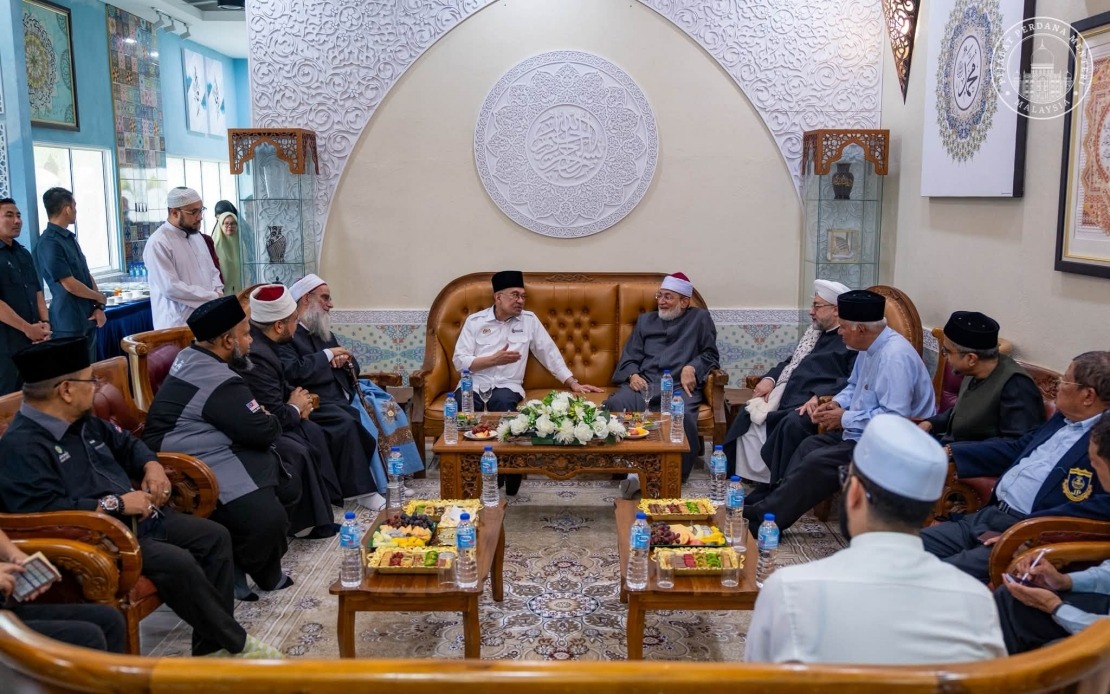
Prime Minister Datuk Seri Anwar Ibrahim has made time in his schedule to receive three distinguished Islamic scholars who are presently based in Malaysia, underscoring the government's continued engagement with prominent religious figures and institutions across the Muslim world. The unscheduled visits demonstrate Anwar's personal commitment to fostering relationships with leading voices in Islamic scholarship and theological discourse at a time when Malaysia is working to position itself as a centre of Islamic learning in Southeast Asia.
Among the three visiting dignitaries was Al-Fadhil Al-Allamah Al-Muhaddith Syeikh Dr Mustafa al-Nadwi Al-Hasani, an internationally recognised Egyptian scholar specialising in hadith studies and Islamic jurisprudence. Also present was Al-Fadhil Al-Allamah Al-Muqri' Syeikh Dr Ahmad Isa Al-Ma'sarawy, whose reputation as a world-renowned Quranic reciter has earned him prominence across Muslim-majority nations. The third visitor was Al-Fadhil Al-Syeikh Maulana Al-Sayyid Afeefuddin Al-Jailani, who serves as the grand custodian of the waqf, mosque and maqam complex dedicated to the revered Sufi saint Syeikh Abdul Qadir Al-Jailani.
The Prime Minister's visit, which took place at Nasyrul Quran, reflects a broader diplomatic strategy of cultivating ties with recognised religious authorities beyond Malaysia's borders. Such engagements serve multiple purposes: they reinforce Malaysia's standing as a destination for Islamic scholarship, provide platforms for cross-cultural theological dialogue, and strengthen the government's relationship with influential Islamic institutions. For Anwar, who has long positioned himself as a leader committed to Islamic values within a pluralistic framework, these meetings align with his broader vision of governance informed by both Islamic principles and inclusive democracy.
In remarks posted on social media following the encounters, Anwar indicated that the visits were driven by his desire to enquire into the scholars' welfare and to solicit their spiritual counsel and prayers. He also expressed gratitude for their decision to travel to Malaysia and contribute to the dissemination of Islamic knowledge within the country. Such personal attention from a sitting prime minister carries symbolic weight, signalling to both the local Muslim community and the broader Islamic world that Malaysia's leadership takes seriously its responsibility as a steward of Islamic learning and values.
The emphasis placed on seeking advice from these eminent figures is noteworthy given the complex religious and political landscape of Malaysia. The government's strategic cultivation of relationships with Sunni Islamic scholars of international standing may also be interpreted as part of efforts to maintain religious cohesion and promote moderate Islamic thought. By associating with scholars known for their scholarly rigour rather than hardline ideological positions, the administration appears to be reinforcing its commitment to mainstream Islamic jurisprudence and theological moderation.
Anwar's statement highlighted his aspiration that the scholars' presence in Malaysia would enhance public understanding of Islamic teachings and foster a more virtuous, knowledge-based society rooted in harmony and coexistence. This framing suggests that the government views Islamic scholarship not as a source of divisiveness but as a unifying force capable of strengthening social bonds across different communities. The Prime Minister's invocation of traditional Islamic phrases—"Alhamdulillah wa syukrulillah" (praise be to God and gratitude to God) and "insya-Allah" (God willing)—underscores his personal piety while communicating directly with religiously observant Malaysians.
For Southeast Asia more broadly, Malaysia's engagement with prominent international Islamic scholars reflects the region's growing importance in global Islamic discourse. As Southeast Asian Muslim-majority nations seek to establish themselves as thought leaders in contemporary Islamic theology and practice, high-profile visits by world-renowned scholars serve as indicators of intellectual exchange and theological relevance. Malaysia's position as a relatively wealthy, stable Muslim-majority democracy makes it an attractive venue for such scholarly dialogues.
The presence of Al-Fadhil Al-Allamah Al-Muhaddith Syeikh Dr Mustafa al-Nadwi Al-Hasani, in particular, carries significance given Egypt's historical role as a centre of Islamic learning and hadith scholarship. The invitation and reception of such figures implicitly positions Malaysia within a broader tradition of Islamic scholarship that traces its roots to Al-Azhar University and other venerable Egyptian institutions. This cultural and intellectual lineage carries prestige within Islamic circles and may enhance Malaysia's credibility as a serious participant in global Islamic conversations.
The timing and nature of these engagements also merit attention in the context of Malaysia's domestic religious dynamics. By publicly meeting with scholars known for their traditional credentials and scholarly methodologies, Anwar's administration may be attempting to navigate between various constituencies within the Malaysian Muslim community—from those who prioritise orthodox Islamic scholarship to those concerned with modernisation and social progress. The strategy suggests a recognition that Islamic legitimacy remains an important political currency in Malaysia, even as the government pursues economic development and regional cooperation agendas.
Furthermore, the involvement of Nasyrul Quran as the venue for these meetings indicates coordination with established Islamic educational institutions and publishing houses within Malaysia. Such partnerships help facilitate the practical work of disseminating Islamic knowledge through structured programmes, lectures, and publications. The Prime Minister's presence at these venues sends a message about the government's support for institutions dedicated to Islamic education and scholarly discourse.
Looking forward, the visits suggest that Malaysia may seek to organise additional scholarly exchanges and lectures featuring these international Islamic figures. Such initiatives could include public lectures, seminars with religious scholars and teachers, or contributions to existing educational programmes. The spillover effects of such exchanges extend beyond immediate diplomatic gains to include the enrichment of Islamic intellectual life within Malaysia and the region.
The encounters also reflect evolving patterns in how Muslim-majority governments engage with religious authority in an increasingly globalised context. Rather than attempting to monopolise religious discourse through state-controlled institutions alone, Anwar's approach demonstrates a willingness to engage with independent, internationally recognised scholars. This approach may help legitimise the government's policies among populations that value authentic Islamic scholarship while simultaneously presenting Malaysia as an open, intellectually vibrant society capable of hosting diverse perspectives within an Islamic framework.

