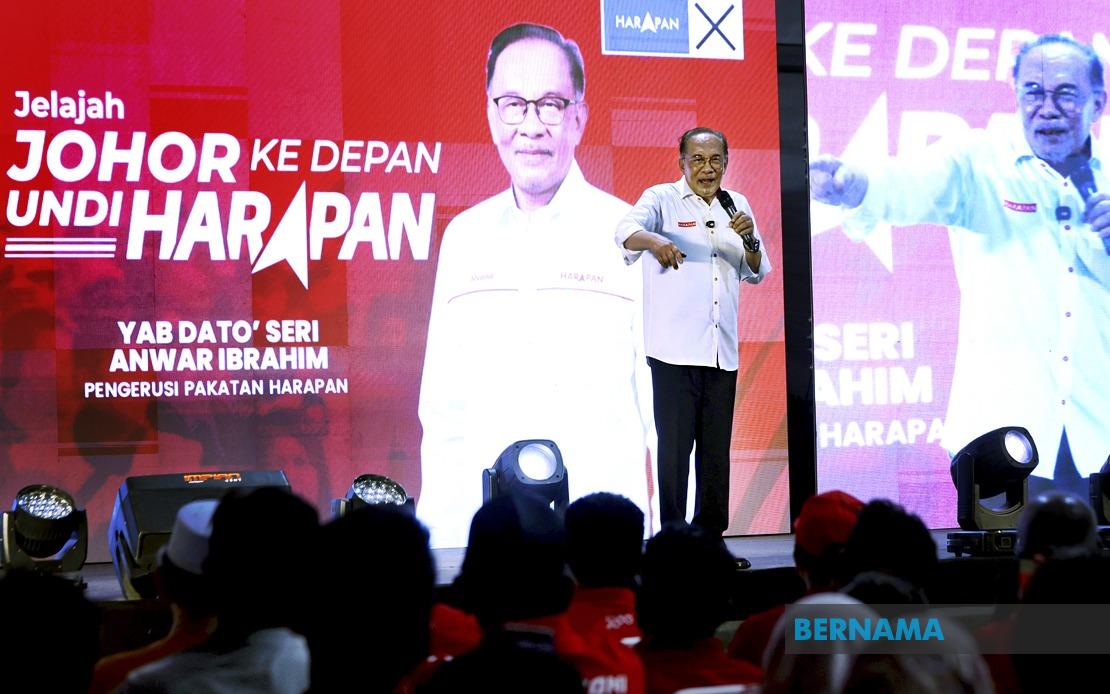
Prime Minister Datuk Seri Anwar Ibrahim has drawn a line in the sand regarding governance standards, declaring emphatically that the era of systematic plunder and patronage politics has ended under his administration. Speaking at a campaign rally in Sungai Mati, Muar, the MADANI Government's leader stressed that contemporary Malaysia must chart a fundamentally different course, one defined by institutional integrity rather than personal enrichment through public office. His remarks came as the ruling coalition intensified its campaign efforts ahead of the Johor State Election, signalling that anti-corruption credentials will remain central to the government's political messaging moving forward.
The Prime Minister's statement represents a deliberate repositioning of how the government frames its core mission to voters. Rather than focusing narrowly on specific economic policies or development targets, Anwar emphasised that restoring public confidence in administrative systems takes precedence. He articulated this vision by pointing out that every ringgit of national wealth must directly serve the population rather than vanish into networks of well-connected individuals and their families. This framing carries particular resonance in Malaysia, where decades of documented cases involving contract manipulation, inflated procurement processes, and asset transfers to politically connected businesspeople have eroded institutional trust.
Anwar was explicit in rejecting the sectarian logic that sometimes pervades Malaysian political discourse. He stated clearly that leadership quality transcends racial categorisation—good governance demands honest Malays, honest Chinese, and honest leaders from all communities, while conversely, corruption originating from any ethnic group deserves equal censure. This statement attempts to neutralise accusations that anti-corruption initiatives might disproportionately target particular populations, a criticism that has occasionally surfaced in Malaysian public debate. By emphasising merit and integrity as the sole criteria for evaluating leaders, Anwar sought to reframe the anti-corruption agenda as fundamentally inclusive rather than divisive.
The specific practices Anwar targeted reflect patterns documented in Malaysia's recent history. He explicitly called out the use of state power to enrich family members, the funnelling of government contracts to spouses and relatives, and the systematic diversion of public resources for private benefit. These mechanisms characterised governance during the previous administration and remain subjects of ongoing legal proceedings. By naming these practices directly, Anwar signalled that the government's institutional memory of past abuses remains sharp, and that such patterns will be actively disrupted rather than tolerated if they resurface within the current administration's ranks.
Crucially, Anwar extended his anti-corruption guarantee to encompass all officials regardless of factional or personal connections. This promise—that no one would receive preferential treatment if implicated in corruption during his tenure—distinguishes his position from previous rhetoric in Malaysian politics, where concerns have existed that anti-corruption enforcement might be applied selectively based on political loyalty. By explicitly foreswearing such protection for current government figures, Anwar positioned himself as holding the administration to a higher standard than his predecessors. The credibility of this commitment will likely determine voter perceptions of whether this administration genuinely differs from its predecessors in practice, not merely in rhetoric.
Anwar attributed opposition political activities to what he characterised as personal motivations to regain federal power. This framing is significant because it shifts discussion away from substantive governance questions toward rival factions' strategic calculations. By portraying opposition criticism as self-interested rather than principled, Anwar attempted to inoculate his government against scrutiny, though the tactic simultaneously suggested potential defensiveness about governance vulnerabilities. The effectiveness of this rhetorical move would depend on whether observers perceived it as reasoned rebuttal or deflection from substantive concerns.
The timing of these remarks during the Johor State Election campaign indicates that anti-corruption positioning has become a focal point in contemporary Malaysian electoral competition. The state contest for 56 seats, involving 172 candidates heading toward polling on July 11, represents a significant test of voter sentiment regarding the MADANI Government's performance and promises. Anwar's intensive campaign schedule—completing fifteen engagements over two days, with this speech constituting the eighth stop—underscores the administration's commitment to validating its governance claims through direct engagement with constituencies. For Johor specifically, where historical political dynamics have revolved around faction competition, Anwar's emphasis on integrity-based leadership potentially addresses longstanding voter frustrations regarding patronage networks and institutional underperformance.
The presence of other senior coalition figures, including Penang Chief Minister Chow Kon Yeow and Ledang MP Syed Ibrahim Syed Noh, reinforced the coordinated nature of the anti-corruption messaging. Having multiple high-ranking officials reinforce these commitments simultaneously creates perception of institutional consistency, though the actual implementation of such promises across different governmental levels remains subject to ongoing assessment. Regional differences in how anti-corruption enforcement operates—particularly between federal and state levels—will shape public perceptions of whether these declarations translate into sustained institutional change.
For Malaysian voters and observers monitoring governance quality, the significance of Anwar's statements lies not in the rhetoric itself but in the observable consequences. Specific indicators of credibility would include: transparent investigation and prosecution of sitting officials implicated in graft, resistance to political pressure to shield connected individuals, and measurable improvement in public procurement practices. The government's track record in implementing anti-corruption measures during its initial tenure provides baseline evidence for evaluating whether current campaign promises reflect genuine commitment or standard electoral positioning.
The international dimension also merits consideration. Malaysia's standing among foreign investors and development partners has historically been affected by corruption perceptions indices and documented governance deficiencies. Anwar's stated commitment to earning global respect through clean administration addresses this reality directly. International observers monitoring Malaysia's institutional development will assess whether administrative changes produce measurable improvements in transparency metrics, rule of law indicators, and institutional independence—particularly regarding autonomous oversight bodies and judicial capacity to process corruption cases without political interference.
For the broader Southeast Asian context, Anwar's positioning reflects regional trends toward electoral competition centred on governance quality rather than solely on economic performance or security issues. As neighbouring countries grapple with similar concerns regarding institutional integrity, Malaysia's approach to anti-corruption governance carries implications beyond its borders. Successful institutional reform could establish a model for regional democratic development, while failures to implement stated commitments would reinforce scepticism regarding whether anti-corruption messaging in developing democracies typically constitutes genuine reform intent or rhetorical positioning designed to secure electoral support.

