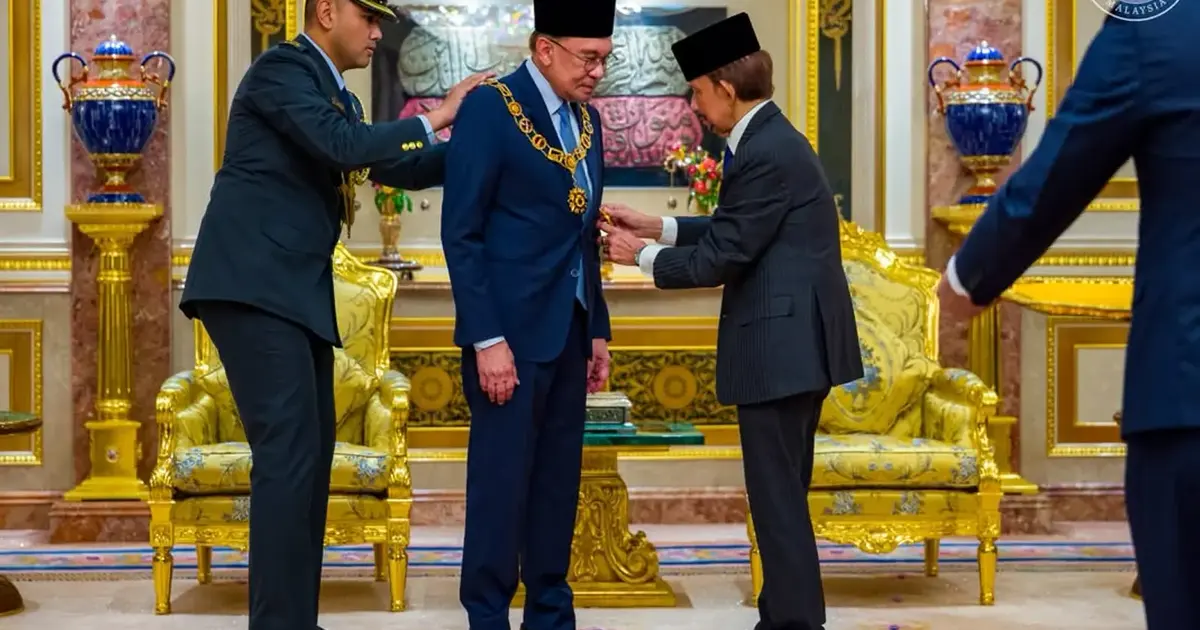
Prime Minister Anwar Ibrahim has received one of Brunei's highest honours, the Darjah Kerabat Laila Utama Yang Amat Dihormati (D.K.), conferred by Sultan Hassanal Bolkiah, underscoring the close bilateral relations between Malaysia and Brunei Darussalam.
The presentation of this esteemed royal decoration represents a significant gesture of respect from Brunei's monarchy towards Malaysia's premier. Such honours are typically bestowed upon foreign dignitaries and leaders who have demonstrated exceptional commitment to strengthening ties with the sultanate. The D.K., translating to "Most Honourable Royal Kinship Order," ranks among Brunei's most distinguished awards and carries considerable diplomatic weight in Southeast Asian protocol.
Anwar's receipt of this award reflects the sustained engagement between Kuala Lumpur and Bandar Seri Begawan across multiple sectors. The two neighbouring nations share deep historical, cultural, and religious bonds that have traditionally formed the bedrock of their relationship. Brunei's decision to honour the Malaysian Prime Minister signals confidence in his leadership and commitment to maintaining the partnership that has characterised Asean's smaller member states.
The timing of such recognition often coincides with broader diplomatic initiatives or celebratory milestones in bilateral relations. Malaysia and Brunei maintain extensive cooperation in trade, defence, education, and cultural exchanges. Their maritime boundary arrangements and coordination on regional security issues have required sustained high-level dialogue and mutual understanding, both of which Anwar has actively fostered since assuming office.
From a Southeast Asian perspective, this honour underscores the continued importance of personal relationships between regional leaders in maintaining institutional stability and cooperation. Unlike larger, more formally structured diplomatic frameworks, relationships among Asean members often derive significant momentum from the personal rapport and credibility of their respective heads of government. Anwar's international standing has been instrumental in rehabilitating Malaysia's diplomatic profile after years of internal political turbulence.
The award also reflects Brunei's consistent approach to engaging meaningfully with its immediate neighbours. The sultanate, despite its modest size and population, maintains a dignified presence in regional affairs through deliberate diplomatic outreach and consistent institutional engagement. The conferment of royal honours serves as both a recognition mechanism and a tool for deepening interstate relationships at the highest levels.
For Malaysian observers, the honour carries symbolic importance beyond the ceremonial aspects. It demonstrates that the country's leadership continues to be respected and valued by regional counterparts, a factor that holds significance given Malaysia's aspirations to play a constructive mediating role in addressing regional challenges. Anwar's personal diplomatic efforts have extended beyond bilateral relationships to encompass broader regional stability and economic cooperation initiatives.
The Brunei government's recognition comes at a period when Malaysia has been actively strengthening its regional engagement across multiple fronts, from trade negotiations to security cooperation. Anwar has prioritised personal visits and high-level dialogue with neighbouring leaders as a cornerstone of his administration's foreign policy approach. Such gestures from counterparts validate these efforts and create momentum for continued cooperation.
Historically, royal honours exchanged between Asean monarchies and regional leaders serve practical purposes beyond diplomatic courtesy. They facilitate access at the highest levels, provide platforms for substantive discussions on bilateral and regional matters, and create institutional memory that helps transcend ordinary political transitions. The D.K. conferred upon Anwar becomes part of the formal record of Malaysia-Brunei relations and reinforces commitments made across various government-to-government frameworks.
Both nations face common challenges in maritime security, climate adaptation, and economic diversification. The enhanced rapport symbolised by this honour creates space for greater policy coordination in addressing these shared concerns. Brunei's oil and gas wealth contrasts with Malaysia's more diversified economy, yet both countries recognise mutual benefits in expanding trade ties and investment flows.
The honour also resonates with Malaysian domestic audiences, reinforcing the notion that the country remains a valued partner within its immediate region despite periodic international criticism on various governance matters. Regional validation of national leadership often serves to strengthen domestic political positions and public confidence in a government's international standing and negotiating capacity.
Looking ahead, such recognitions typically precede or accompany expanded cooperation frameworks. Previous exchanges of honours between Malaysian and Brunei leaders have often been followed by new memoranda of understanding or expanded bilateral initiatives. The practical significance extends beyond protocol to encompass genuine partnership-building in areas ranging from economic integration to coordinated responses to transnational challenges affecting both nations and the broader Southeast Asian region.

