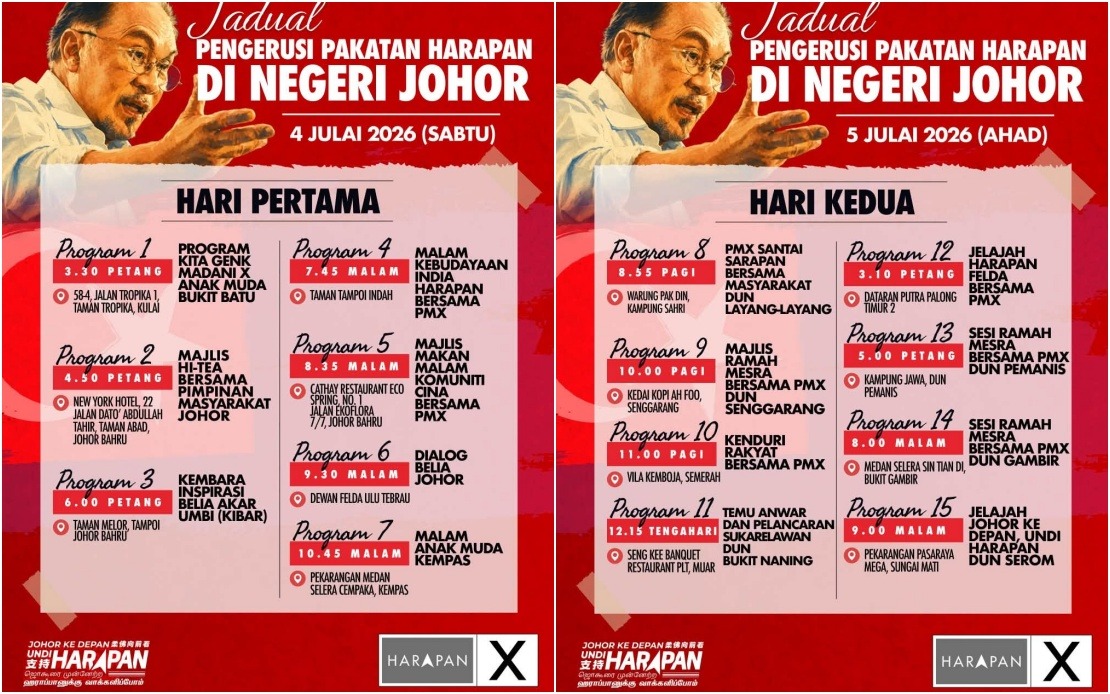
Datuk Seri Anwar Ibrahim, chairman of Pakatan Harapan, has committed to an intensive weekend campaign across Johor, scheduled to participate in 15 distinct events designed to consolidate support for 56 PH candidates contesting the 16th Johor state election. The announcement comes as the opposition coalition moves into the final phase of campaigning, with voting set for July 11 and early polling on July 7. The breadth of Anwar's schedule underscores PH's determination to contest strongly in Johor, a state where political fortunes have shifted significantly in recent years and where securing substantial ground support remains critical to electoral success.
Anwar's campaign itinerary reflects a carefully calibrated strategy to reach diverse voter constituencies across socioeconomic and demographic lines. Beginning on Saturday afternoon in Kulai with the Kita Genk MADANI x Anak Muda Bukit Batu programme, the PH chairman will progress through a sequence of community-focused engagements designed to build personal connections with constituents. The schedule includes a high-tea gathering with Johor community leaders, youth-oriented dialogues, and cultural celebrations spanning Indian and Chinese community events. This multi-ethnic approach highlights PH's attempt to maintain its broad-based coalition, particularly important in Johor where communal considerations remain electorally significant.
The evening portion of Saturday's programme reveals the intensity of Anwar's commitment, with events scheduled at 7.45 pm, 8.35 pm, 9.30 pm, and concluding at 10.45 pm. This late-night campaign activity suggests PH strategists are working to capture voters across different time preferences and occupational schedules. The Harapan Indian Cultural Night with PMX in Taman Tampoi Indah, followed by a Chinese Community Dinner, underscores the coalition's recognition that electoral victory in urban and semi-urban Johor constituencies depends on mobilising diverse communities effectively. The inclusion of youth-focused events reflects broader PH strategy to engage younger voters, a demographic that has shown variable support for the coalition compared to older age groups.
Sunday's programming begins early, commencing at 8.55 am with a breakfast engagement in Layang-Layang. Anwar will move through morning meet-and-greet sessions and what organisers have termed "kenduri rakyat" gatherings, traditional community feast-style events that carry cultural and political significance in Malaysian political campaigning. These sessions extend through midday with volunteer launches and afternoon activities spanning multiple constituencies. The schedule demonstrates PH's intention to establish visible presence across geographically dispersed areas within Johor, recognising that voter dispersion across both urban and rural constituencies requires targeted, ground-level engagement rather than centralised rallies alone.
For Malaysian and Southeast Asian observers, Anwar's intensive campaign schedule carries significance beyond immediate electoral calculations. As a longstanding political figure whose trajectory has encompassed dramatic reversals of fortune, Anwar's willingness to commit personally to extensive grassroots campaigning signals confidence in PH's organisational capacity and his own political standing. The decision to personally attend 15 events over a single weekend, rather than delegating to party lieutenants, reflects both the competitive intensity of Johor politics and the apparent confidence PH leadership holds regarding electoral prospects in the state.
Johor's political importance extends beyond its size as Malaysia's second-largest state by population. The state has historically served as a political barometer for national sentiment, with its voting patterns frequently presaging broader electoral trends. PH's performance in Johor during the 16th state election will offer significant indicators regarding the coalition's strength heading toward potential federal electoral contests. The allocation of considerable leadership resources to this campaign underscores the importance PH places on demonstrating electoral viability and maintaining momentum that could translate into federal-level political advantage.
The emphasis on youth engagement throughout Anwar's schedule reflects demographic and strategic considerations affecting Malaysian politics more broadly. Younger voters, particularly those aged 18-40, have demonstrated higher volatility in recent electoral cycles, with shifting allegiances between political coalitions rather than stable partisan alignment. PH's attempt to cultivate youth support through dedicated dialogue sessions and community events addresses this volatility directly, recognising that sustained coalition strength requires secure foundations among emerging generations of voters who will determine Malaysian politics over coming decades.
Culturally, the inclusion of Indian and Chinese community-specific events within Anwar's campaign represents both continuity with PH's established electoral coalition and necessary effort to sustain that coalition's viability. Non-Malay communities, constituting significant proportions of Johor's population particularly in urban areas, have historically regarded PH favourably compared to other political blocs. However, electoral retention cannot be assumed, requiring active engagement and demonstrated commitment to community concerns. Anwar's personal attendance at culturally-specific events signals that PH leadership regards these communities as integral to the coalition rather than peripheral constituencies.
The timing of this campaign push, occurring during the final weekend before early polling on July 7, indicates strategists view this period as critical for consolidating voter intention and mobilising supporters toward actual voting participation. The density of events scheduled during a single 48-hour period creates substantial logistical challenges but maximises media attention and generates momentum narratives valuable for encouraging supporter turnout. This approach assumes that late-campaign, high-visibility activity by senior leadership can shift marginal voters and ensure base mobilisation among committed supporters.
Regional observers should note that Johor's significance extends beyond state-level politics, affecting broader Malaysian politics and even regional dynamics. As Malaysia's southernmost state, directly adjacent to Singapore and serving as an economic integration point within the region, Johor's political stability and economic governance affect investor confidence and regional development trajectories. PH's demonstrated commitment to competitive campaigning across the state reflects recognition that political legitimacy and electoral victory in Johor carry implications that extend well beyond state boundaries, influencing how Malaysia's federal government approaches critical economic and security matters affecting Southeast Asia.
The explicit invitation extended through social media to all Johor voters to participate in weekend programmes represents contemporary political communication practice in Malaysia, where digital platforms enable direct candidate-to-voter messaging without media intermediation. Anwar's Facebook announcement of his campaign schedule allows supporters to coordinate attendance and encourages broader participation in what organisers frame as community celebration rather than strictly partisan activity. This communication strategy reflects sophistication in understanding how contemporary voters, particularly younger demographics, access political information and make participation decisions.
Fundamentally, Anwar's intensive Johor campaign represents both tactical necessity and strategic positioning. At the tactical level, PH must demonstrate organisational strength capable of competing effectively in state elections, establishing credibility for broader electoral challenges. At the strategic level, Anwar's personal commitment demonstrates confidence in PH's electoral trajectory and his own political viability as the coalition's leading figure. The success or difficulties encountered across these 15 events will provide early indicators of PH's campaign effectiveness and public reception, offering valuable data for assessing electoral probabilities as voting approaches on July 11.

