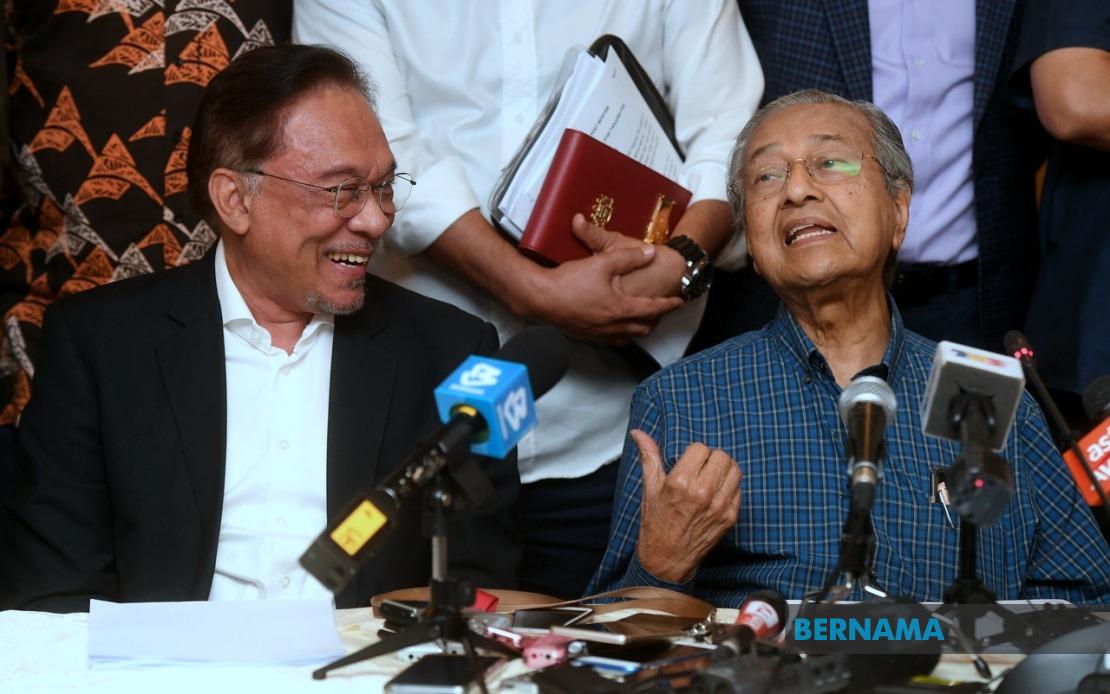
Prime Minister Datuk Seri Anwar Ibrahim marked an important milestone in Malaysia's political history by extending warm birthday wishes to former Prime Minister Tun Dr Mahathir Mohamad, who celebrated his 101st birthday on July 10. The gesture, shared through a Facebook post, underscores the complex yet enduring relationship between two of Malaysia's most prominent political figures, whose careers have shaped the nation's trajectory across multiple decades.
In his birthday message, Anwar expressed heartfelt sentiments, saying "May Tun continue to be blessed with grace, good health and be under His blessings, Insya-Allah." The carefully chosen words reflect both personal respect and public acknowledgement of Mahathir's towering place in Malaysian politics and society. For a Prime Minister to publicly recognise the centenarian former leader signals not only personal courtesy but also recognition of historical continuity in the nation's governance.
Tun Dr Mahathir's longevity itself represents a remarkable chapter in global politics. Born on July 10, 1925 in Alor Setar, Kedah, he has witnessed and participated in nearly a century of Malaysia's political development. His first stint as Prime Minister stretched across 22 years from 1981 to 2003, during which he implemented the Vision 2020 framework that shaped Malaysia's modernisation agenda and positioned the nation as a developing economy with significant industrial aspirations.
Perhaps even more notably, Mahathir returned to the Prime Minister's office from 2018 to 2020, at the remarkable age of 92, making him the world's oldest serving prime minister at that time. This unprecedented comeback demonstrated both his political acumen and his enduring appeal to Malaysian voters, even as age considerations typically disqualify leaders in most democracies. His return marked a turning point in Malaysian politics, interrupting what many analysts believed would be a continuous tenure by the previous administration.
The birthday acknowledgement carries particular significance given the historical tensions between Anwar and Mahathir. The two have been at odds on numerous occasions throughout their political careers, with their relationship shaped by episodes of alliance and confrontation. Anwar served as Deputy Prime Minister under Mahathir but was dismissed and subsequently imprisoned during the 1998 financial crisis, an episode that created deep scars in Malaysian politics and became a defining moment in Anwar's political narrative.
Yet their more recent political trajectory has seen them unite around common causes. They worked together to overthrow the previous government in 2018, demonstrating that Malaysian politics operates within a framework where even former adversaries can find common ground when strategic interests align. The birthday greeting from the current Prime Minister therefore represents more than simple courtesy; it reflects the pragmatic evolution of Malaysia's political culture.
Mahathir's influence extends far beyond his formal periods in office. As an intellectual figure, prolific author, and commentator on global affairs, he has maintained a significant platform to shape political discourse in Malaysia and across the Asia-Pacific region. His views on international relations, particularly regarding Western influence and regional autonomy, continue to inform political debate. At 101 years old, he remains an active voice in national conversations, regularly sharing perspectives through various media channels.
The centenarian's health and longevity have become matters of national interest, with Malaysians broadly wishing him well regardless of political affiliation. Anwar's public blessing reflects this broader sentiment while also performing an important symbolic function—demonstrating maturity in Malaysian politics where respect for elders and predecessors transcends partisan divides. In many Asian societies, veneration of age and experience carries cultural weight that extends beyond ordinary courtesy.
Mahathir's 101 years span an era of tremendous transformation. He has seen Malaysia progress from a colonial outpost to an independent nation, experienced multiple economic cycles including the Asian financial crisis of 1998, witnessed the rise of digital technology and globalisation, and navigated complex regional geopolitics involving changing relationships with major powers. His longevity offers a living connection to Malaysia's pre-independence past and provides historical perspective that remains valuable for contemporary policymakers.
The birthday greetings also highlight generational transitions within Malaysia's political establishment. Anwar himself represents a generation younger than Mahathir yet already approaching elder statesman status himself. How Malaysian politics will evolve in the coming years as the current generation of leaders inevitably passes leadership to successors remains an open question. Mahathir's extended life and continued relevance suggest that political influence in Malaysia often transcends formal office-holding.
For international observers, Anwar's gesture illustrates how Malaysia's political culture, despite its competitive nature, maintains certain protocols and traditions of respect. This capacity to separate personal and historical grievances from public acknowledgement of important figures reflects a degree of institutional maturity, even when particular political disputes have been acrimonious.
As Malaysia continues to navigate domestic and regional challenges—from economic pressures to political stability to managing international relationships—figures like Mahathir continue to command attention as repositories of experience and strategic thought. His 101st birthday serves as an occasion not merely for personal reflection but also for the nation to acknowledge the contributions of its elder statesmen and the lessons their lives offer for future governance.

