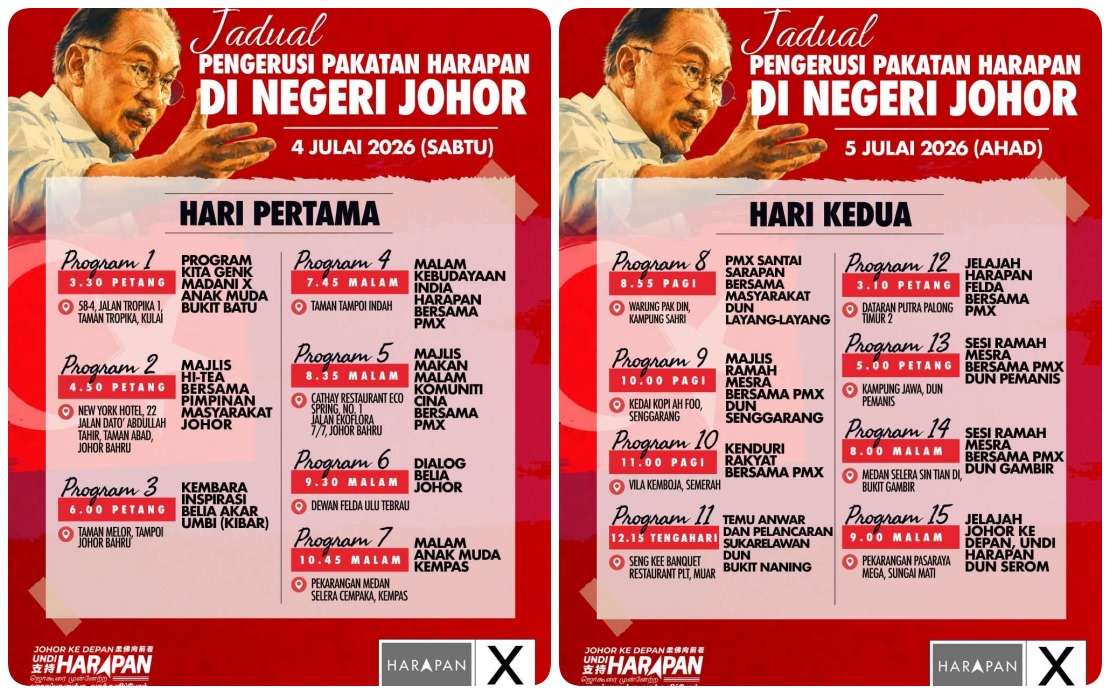
Prime Minister Datuk Seri Anwar Ibrahim is ramping up the Pakatan Harapan coalition's presence across Johor with an ambitious schedule of seven campaign programmes on July 4, signalling the intensity of efforts to galvanise support in the critical southern state just days before voters go to the polls.
The comprehensive itinerary, detailed on Anwar's official Facebook page, begins with direct voter engagement before transitioning to a high tea reception with community leaders at a hotel in Johor Bahru at 4.50 pm. The high tea format offers a more intimate setting for Anwar to connect with residents from different professional backgrounds and social strata, a strategy that allows the coalition to demonstrate accessibility beyond formal rallies.
The campaign schedule demonstrates PH's particular focus on youth mobilisation, with a dedicated Johor Youth Dialogue session scheduled for 9.30 pm at the Felda Ulu Tebrau Hall. This segment reflects broader national concerns about engagement with younger voters, a demographic that has shown unpredictable voting patterns in recent Malaysian elections and represents a critical swing constituency in any state-level contest.
Anwar's presence in Johor extends beyond a single day. The Prime Minister's commitment to the state underscores the strategic importance of the 16th Johor state election, with plans for eight additional programmes scheduled for the following day to sustain momentum and reinforce key campaign messaging among PH's grassroots machinery and candidate pool.
The Pakatan Harapan coalition is contesting all 56 state assembly seats in Johor, with seat distribution reflecting the three-party partnership structure. The PKR contingent comprises 20 candidates, while Amanah fields 19 representatives and the DAP contributes 17 candidates. This comprehensive contest across all constituencies indicates PH's ambition to capture the state rather than settle for partial gains, a significant shift in strategy compared to past electoral cycles where opposition parties sometimes ceded seats.
The broader electoral landscape in Johor encompasses 172 candidates competing across the 56 seats, suggesting a competitive multi-cornered contest. The presence of independent candidates and splinter groups alongside the main coalitions means vote fragmentation could play a decisive role in determining outcomes in marginal constituencies, particularly where community-specific grievances have driven voters away from established parties.
The election calendar itself compresses the campaign timeline considerably. With the main polling date set for July 11 and early voting already scheduled for July 7, campaigning parties effectively have only days to make their final pitches to electors. Anwar's intensive personal schedule reflects the urgency of maximising prime ministerial visibility and leveraging his position as head of government to amplify PH's message during this critical window.
For Malaysian observers and regional analysts, the Johor election carries significance beyond state-level implications. As the second-largest state by population and historically a competitive electoral battleground, results here often provide early indicators of broader political sentiment and can shift the balance of power within state governments and the federal coalition architecture.
The multi-event approach spanning different voter segments—from community leaders to youth activists—suggests a diversified campaign messaging strategy rather than a monolithic approach. Different audience groups respond to distinct policy priorities and communication styles, and the coalition's tactic of tailoring engagement formats reflects professional campaign management targeting specific constituencies within the broader electorate.
PH's decision to contest all 56 seats is a bold statement of electoral confidence, positioning the coalition as a comprehensive alternative government rather than a limited oppositional force. Successfully campaigning across every seat simultaneously requires substantial organisational resources, candidate quality, and grassroots mobilisation capacity, representing a considerable operational undertaking that tests the coalition's infrastructure and cohesion.
The energy invested in the Johor campaign also reflects broader calculations about Malaysia's evolving political landscape. State elections serve as crucial testing grounds for parties to assess policies, refine messaging, and gauge voter sentiment on specific regional issues before larger general elections. Johor's outcome could influence strategic thinking across other state governments controlled by different coalitions and potentially reshape calculations about the viability of various political combinations for future national contests.
As the campaign enters its final phase, the intensity of Anwar's personal involvement signals the stakes PH associates with the Johor result. Prime ministerial presence can energise party activists and generate media attention, though electoral outcomes ultimately depend on broader patterns of voter preference, ground organisation effectiveness, and the relative appeal of competing candidates in individual constituencies.

